
Farison V7E: 'I drove a white van for the day in this new Chinese van - it may have won me over'
The race to produce a reliable and practical electric van is well and truly on, with a host of newcomers challenging the established elite. Steve Teale looks at one hopeful which has entered the market.

The high position, the knowing nods from other loftily perched drivers and the remarkably comfortable drive – I think I could get used to being a van driver.
Of course I’ve used them before, but I’ve never been enthusiastic. The echoes of the loadbay and the rattle of ill-fitting features meant I was quite happy to go back to the comfort of a car.
But this exotically-titled model might just have won me over. It’s a Farizon, a name which usually draws blank stares.

If you have never heard of them, you’re not alone. Farizon is a Chinese company and quite a big one.
It’s a subsidiary of the Geely group which makes this a sister brand to some makes you might have heard of: Volvo, Polestar and Lotus.
I guess having those three in your family tree must help you gain credibility in the notoriously hard-to-break British car market.
This is the V7E. I know, having a letter-and-number model name helps cross international markets but surely a proper title would help establish this van against more familiar opposition.
I think many companies under-estimate the importance of a name. Bad ones can kill a brand. Good ones elevate it.
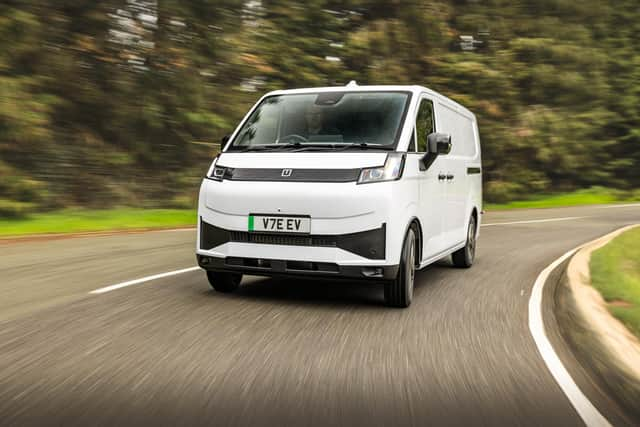
So, what is the V7E? It is a new midsize van and is the firm’s entry-point into electric commercial vehicles.
It sits below the larger SV van and offers “class-leading cargo capacity, payload and range”.
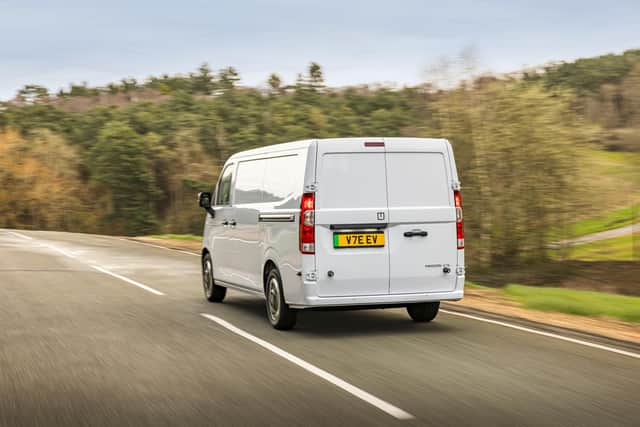
It purposefully, I think, strikes a simple, unfussy pose. It is slab-sided and has sliding side doors and huge rear doors which open wide to offer an uncluttered access to the loadbay.
It’s a fuss-free zone but the designers have managed to have just a little fun on the way. V7E will use the firm’s LED ‘tomahawk’ headlight design.
It has a flat floor, a digital driver’s display, a central infotainment screen and physical shortcut controls for the climate control.
The van will come with the option of two battery packs, the 67kWh and 83kWh units found in the SV.
It is a vehicle with rivals in its sights. V7E will be going up against vehicles such as the Kia PV5 Cargo and Ford E-Transit Custom.
Farizon V7E made its debut at the Commercial Vehicle Show, taking place at the NEC, Birmingham last April 21.
It’s very much a functional vehicle. Just under five metres long, its cargo length is 2,730mm with bulkhead.
The white van market might seem like a fringe event to most of us but it’s not.
The Royal Mail and BT Openreach – our two biggest van fleets – alone have tens of thousands of models and like most of us they are looking closely at the electric vehicle market for financial and ethical reasons.
The drive to promote EVs among the van community is a challenging one. The shift away from polluting diesel engines to electric will play a major role in efforts to cut carbon emissions from vans.
Reports from 2023 suggest 18m tonnes or 12 per cent of all transport emissions were down to vans. But it’s proving a struggle.
In 2025, the headline target was for 16 per cent of new vans sold in Great Britain to be electric. Manufacturers only managed 9.5 per cent.
That has led to a battle between manufacturers and some of the biggest buyers over how quickly Britain should make the switch.
So, how does the V7E shape up? It’s neat and simple to drive. Hop in and the engine – or rather, motor – is silently fired up.
Click into gear and away you go. You might expect silence but this vehicle emits a low hum. Not unpleasant, but unexpected.
The lack of an ignition switch or button isn’t rare in cars these days but it’s the first time I’ve encountered this in a van. Useful, I imagine, if you’re an Amazon driver in and out of the vehicle all day.
It is swift and smooth and comfortable to drive. It’s swift off the mark and rides and handles better than a slim, tall van should.
Inside, simplicity is the order of the day. Few pocket or document holders but a useful long shelf. The switchgear is simple but perhaps a little on the flimsy side for what is expected to be a workhorse.
It’s range might be more of a sticking point for some people. It can manage 290 miles (204 miles on a combined route) between charges which might suit some people.
But I imagine many delivery drivers and the like would need a bigger range even if a 20 per cent to 80 per cent charge takes as little as 18 minutes.
Meanwhile, Farizon has revealed a new range-topping variant to the SV van line-up with the ‘SV Sport.’
The SV Sport is equipped with lots of sporting extras; including a redesigned front bumper with a front splitter, sculpted side skirts with ‘SV Sport’ badging, a roof-mounted spoiler and a new rear bumper with an integrated diffuser and fog light.
All models boast new 20-inch alloy wheels, though customers can opt for smaller 18-inch wheels for no added cost.
The cabin is complemented by bespoke SV Sport kick plates and Sport branding on the steering wheel; there’s a dashboard plaque displaying the van’s conversion origin and an individual production number.
Standard equipment includes heated front seats and steering wheel, a 360-degree surround camera, a heated windscreen, automatic windscreen wipers and a vehicle-to-load (V2L) function, where electrical appliances such as a hair dryer can be plugged in using the van’s battery pack.
Underneath the Farizon SV Sport is available with a choice of three battery packs of 67kWh, 83kWh and 106kWh units that deliver claimed ranges of 204 miles, 234 miles and 247 miles, respectively. All variants are fitted with the same single electric motor that produces 228bhp and 336Nm of torque.
Farizon V7E: £30,500 excluding VAT. A 50kWh model costs £28,000; A 67kWh model which puts out 110kW and 230Nm; Top speed 75mph and 0 to 60mph in 17 seconds; 295 miles range on a city cycle and 204 miles on a combined route; Five Years/120,000 miles warranty (whichever is reached first)