
Honda Jazz Crosstar 1.5 Hybrid review: I test drove the new Honda Jazz - and managed to get lost
Honda’s Jazz Crosstar 1.5 Hybrid has a reputation as a car for sensible drivers, with excellent engineering and plenty of storage space. Frederic Manby tests it out – and keeps calm despite getting lost.
The Jazz is a keystone in Honda’s family. It is small outside, large inside with a unique storage feature. It is chic without being cheeky and from what I see does not attract boy racers or go-faster girls.
This mature - or sensible - buyer profile separates it from every other small hatchback. There is no racey version, an omission which must be intentional because Honda has made some of the faster cars on the planet including the sensational NSX and Type R Civics.
Honda and compatriots Toyota, pioneered hybrid petrol electric engines a quarter of a century ago. Toyota with its global scale became the industry leader. Honda never gave up and its Jazz benefits from self-charging hybrid assistance to the 1.5 litre petrol engine.
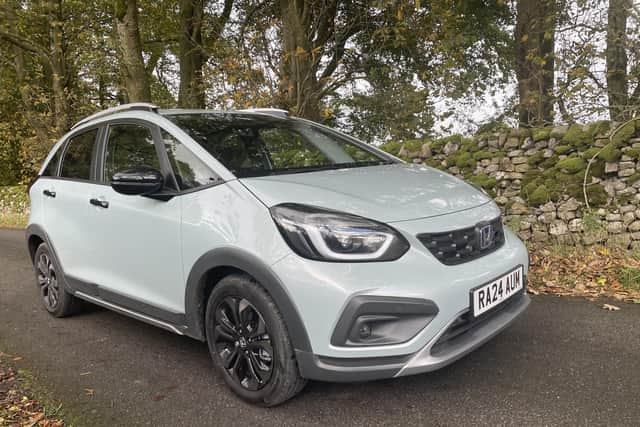

A few years ago the regular Jazz was joined by the Crosstar, which stands slightly higher with roof rails, has minor body panel changes and looks a bit more interesting, with a hint of SUV though it is not one. It costs an extra £1,000 which looks good to me.
However, no Jazz is cheap. It is a lot of money for a small car. The entry model is the Elegance at £26,885 but it does have Garmin navigation and adaptive cruise control and automatic gears and runs on 15 inch alloys. There is a rear camera, front and rear parking sensors, LED lights The £28,085 Advance adds smart phone integration, a heated leather steering wheel and 16 inch alloys and keyless operation. The £29,285 Advance Sport has water repellent seats for those wet sporty moments I suppose, a rear spoiler, black caps to the mirrors and steering wheel flippers to adjust the braking and deceleration through the gears.
There is only one Crosstar, in Advance spec for £29,085. Mine was painted in a cool blue called fjord mist: £625. Its extras include a rear spoiler, heated front seats and keyless locking, unlocking and push-button ignition. The seats are water resistant too and there’s a rubber boot tray.
All have Honda Sensing, its term for safety intervention and safe travel.
Options include the “functional fun pack” which for £1,250 jazzes up the car with cosmetic details inside and out and some fancier floor mats. A tow bar for trailers or carrying bikes is £1,155. A spare wheel is not offered.
Honda engineering is rightly renowned and is evident as soon as you get in the Jazz. The power delivery is free of vibration as the stored electricity sets off you off smoothly. The aural refinement takes a punch if you accelerate hard. There is loud booming as the continuously variable transmission gets you up to speed. Once there everything quietens nicely. Accelerating at higher speeds actually brings a not unpleasant sporty pitch.
Our other concern was the colossal road roar over coarse asphalt through the Dunlop Enasave EC300+ tyres on the light alloy wheels.
Otherwise the Crosstar was quieter on smoother roads and managed bumps reasonably well if not sublimely.
The Jazz has other attributes. It is easy to get in and out through tall and wide-opening doors. There is a surprisingly large deep luggage area. At 40 inches wide and extending to 55 inches with the seats folded it would take a pallet, for example, or lots of your bags.
The Jazz has Honda’s magic seating. If you fold up the bases of the back seats against the backrest there is a huge area measuring 50 inches from floor to ceiling, 55 inches wide by 30 inches front to back.
It is the sort of thing you may find useful for carrying bulky things in a contained area. A friend’s wife uses it for safe carriage of her pottery. I’ve carried a dismantled bike in there, too, and bags of firewood.
The cabin architecture has a quality feel and is ergonomic with a high ceiling to give headroom when seated. There is a modestly sized digital panel easily seen behind the steering wheel - which has buttons for speed control, audio volume, voice requests and so forth on its spars. A central touch screen carries navigation, media and information on the car’s settings. There are welcome conventional rotary wheels to manage to air flow and heating. Front and rear USB points are the older large format. Upper and lower gloveboxes are useful as are cup pods at the ends of the fascia.
Unfortunately the navigation does not carry traffic updates and there was no advance warning of the closure of a busy key link between motorways in wildest Lancashire.
So, I got lost alone in a hapless and futile belief that by driving in the general direction of home for several miles the Garmin would pick up the new route. An hour later after some moorland roads which ended in remote and eery farmyards I ended back at the junction with the road closure.
Oddly, I was not stressed at all, though a puncture in the lonely dusky lanes may have done the job. The Crosstar was calming, with good visibility through the projecting windscreen, nimble turning, enough ground clearance for the flooded potholes. I took the long view, back over Britain’s highest motorway section, then through early Bradford with brightly lit pavement cafe bars hard to ignore.
And the really good news was the fuel economy on this 60-mile jaunt was 58mpg. In fact it never went lower all week and often exceeded 60mpg. This gives a reliable range of 500 miles on a full tank.
Honda Jazz Crosstar 1.5 Hybrid: £29,085 (£29,710 as seen); Engine 1.5 litre petrol hybrid; 106 bhp (petrol); Torque 186 lb ft (battery); CVT automatic transmission; Top speed 108 mph; 0-62mph 9.2 seconds; 8.9 mpg (exceeded in testing); 8.8 gallons tank; CO 2 emissions 108g/km; Length: 162 inches long; 500kg Bbraked towing limit; honda.co.uk