
Peugeot 408: how the traditional saloon has been transformed

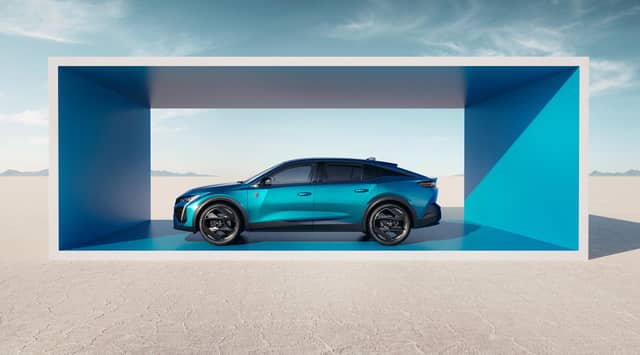

IT seems the saloon car has faded away into the distance to be replaced by the omnipresent crossover. Remember the 405, Peugeot’s one-time rival for Mondeo, Vectra and co? Well, it is no longer a saloon.
It is in fact a sort of estate-SUV, which makes it sound dull. It isn’t. In fact, it’s a very charming and well-appointed model which ticks a lot of boxes: it’s green, smart, very well equipped and quick.
OK, so it’s expensive. The test model is over fifty grand which sounds astonishing until you compare prices with its rivals and you realise the £20,000 family motor is very largely a thing of the past.
No-one is going to hand over £50,000 for this or any other car. It’s just not the way cars are “bought” these days. Rather they are leased in much the same way that you “buy” your iPhone. Still, fifty grand does sounds a lot.
But this car is a world apart from Peugeots of the 1990s and 2000s.
Back in my day, a phrase I can use now I’m in my sixth generation, meaty family cars were powered by engines of at least two litres in size which spat out power and drank like a thirsty docker.
Emissions weren’t an issue back then, so goodness knows exactly what pollution they gave out, but it wasn’t good.
So, move on 20 or 30 years and we have Peugeot’s modern iteration of its 4 series.
This is the 408, a hybrid model which I must say impressed me more than I expected. It shines in lots of areas: space, performance, economy and quality cabin, among others.
It drives and feels like a well-balanced saloon and is quick and smooth. In my mind it’s either a tall saloon or a sporty SUV, take your pick.
The GT model costs £44,720 but it had more than £5,000 of extras too including an onboard charger, white paint and a sophisticated hi-fi system, plus an £1,100 driver and passenger sports seat package (not sure I would have paid more for them) and £300 of alloy wheels (a relative bargain).
More appealing were some of the standard items.
The i-Connect satellite navigation system was great, as was the abundance of USB-C sockets and the steering wheel-mounted gear change paddles and smart electric tailgate.
Parking sensors front and rear make sense for such a big car and the reversing camera and huge clear screen were easy to use.
It has three modes – eco, normal and sport – and unlike on some rivals, you can tell the difference. The sporty one in particular is brilliantly responsive.
The boot isn’t as deep as I expected but it did just about manage to hold three suitcases for a lads’ break to Germany and the rear seats fold flat with ease.
Safety is impressive. It has anti-lock brakes and emergency brake assistance when required, plus automatic post-collision braking.
Basically, if you crash and lose control the car will set the brakes and bring you to a quick stop.
It has lane-keep assistance (it nudges you back in to line if you wander) and it also helps you to keep in the middle of the lane.
Economy sounds too good to be true. It manages more than 232mpg, presuming you are diligent enough to keep the electric levels topped up, yet it offers an incredible amount of power for a 1.6 litre model.
The alloy wheels are a work of art and the combination of leather and imitation leather is excellent.
Broadly, it will appeal to those who don’t like the idea of an SUV, as well as Peugeot fans who like the 308 but find it a little too compact.
Either way, you’re getting a car which is comfortable, decent to drive and has a smart, premium-feeling cabin. Peugeot reckons it falls into several categories and has no direct rival, which will no doubt boost sales.
It is a good-looking car in my opinion. The striking shape contains a mix of bodystyles: hatchback, fastback, and a bit of SUV. This has been made possible by a body that’s 4,687mm long – 51mm longer than even the 308 SW estate. But the key figure for many will be the increase in wheelbase. It allows Peugeot a chance to address one of the 308’s biggest flaws: rear passenger space.
The cabin is delightful. The dashboard style is shared with the 308, and the quality matches anything else for similar money.
Peugeot’s latest infotainment is an improvement over past attempts, and the second touch panel below the screen can be customised to pick shortcuts.
Meanwhile, Peugeot has revealed the final jigsaw piece in the firm’s EV puzzle with its new E-408. The standard car comes with a choice of hybrid and plug-in hybrid powertrains, but the electric version will complete the set, offering a wider choice of engine and motor setups to buyers. The E-408 sits on the firm’s EMP2 platform which is the same as on the smaller 308 and Vauxhall Astra.
Under the bonnet, there is a 58.2kWh battery pack with an electric motor that kicks out a total of 213bhp and 345Nm of torque. Peugeot claims the car can do up to 279 miles on a single charge. Plus, all E-408s come with DC 120kW rapid charging allowing for the car to go from 20 to 80 per cent in half an hour.
Prices for the UK have not been revealed yet, however, there will be two trim levels available – Allure and GT.
Peugeot 408 GT Plug-In Hybrid 225: £44,720. Test car cost £50,920 including options. Range starts at £31,720; A 1.6 litre turbocharged petrol engine and an electric motor which jointly emit
225bhp. It manages 34 miles in electric-only form; Top speed 145mph and 0 to 60mph in 7.8 seconds; 174.5mpg to 232.5mpg; Three years warranty. 60,000 miles; Insurance group 31E; Emissions 31g/km