
Porsche Cayenne: 'I drove the new Porsche Cayenne - the bottom line is it's lovely'
Frederic Manby has always loved a Porsche Cayenne, despite the outcry when it was first released. Here he gets behind the wheel of the Crayon Cayenne and finds there is, again, little to fault it.
Cayenne is the name of a car which took Porsche away from its reliance on low-slung sports cars. Customer outrage ensued.
It was the automobile equivalent of Bob Dylan going electric and it saved Porsche.
The large, practical five-seater had the ability to travel any road or terrain that was safe enough.


It made Porsche so much money it was aiming to buy Volkswagen. Not so fast, Ferdinand.
It was VW which bought Porsche but they’ve done well, like Dylan at Newport 61 years ago. It didn’t do him any harm.
There had been plans to put the legendary 2+2 911 coupe out to grass. It dates from 1964 and is still with us, outliving several other models. Buyers still want a 911.
It had record sales last year, when we said thanks for some wonderful memories to the Boxster and Cayman mid-engined joys.
Financial salvation had come with the Cayenne in 2002. It shared structural components with the Volkswagen Touareg and was built in the same factory in Bratislava, Slovakia.
It was the first family Porsche, with a five-door body and its first all-terrain vehicle apart from a couple of tractors in the 1950s, suitable for Maggie’s Farm.
Gosh, they loved Cayenne. In 2024 it was still the brand’s best seller: other models are the Panamera limo, the Macan small SUV (marginally outselling Cayenne last year) and the electric Taycan. I think I’ve got them all.
The Cayenne you see here is the third generation plug-in e-hybrid. It dates from 2019 with a major refresh in 2023.
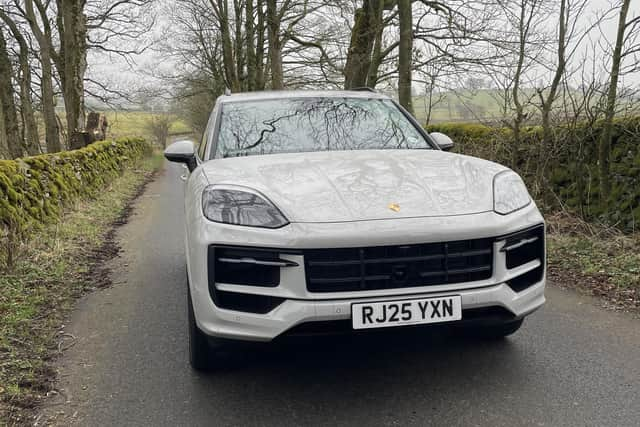
Ours was the practical belt and braces SUV body but a lower sportier Coupe is tempting. All are petrol-engined. The fourth generation is electric only but with carmakers revising their electric future who knows.
Porsche lost sales last year, down to 18,805 in the UK (from 20,000) and to 279,449 world wide (310,718). China crashed by 26 per cent. North America was its best market, steady at 86,541 sales.
Fully electric models took 22 per cent of sales and plug-in hybrids 12 per cent. Sales of the gorgeous Taycan fell by a fifth last year. In the UK the top three were Macan and 911 and Cayenne in that order.
Buyers will not let the 911 go, nor across various drivers’ brands such as Alfa Romeo and Lotus, forsake lusty petrol power.
Lamborghini, a VW groupie sharing the Cayenne structure under its Urus SUV, has decided its buyers want to hear a petrol engine and has scrapped its electric supercar.
Bratislava also makes the Touareg, Audi Q7 and Q8 and Bentley Bentayga. Their V6 turbo engines are based on an Audi engine.
I have driven most of the Cayennes. The first was utterly impressive, matching the contemporary Range Rover off-road and out-performing it on-road.
Since then the carmakers have been goaded into an absurd and unusable faster and faster power battle. There are several which will exceed 190mph, driving up egos and profits.
You can buy a Land Rover with a 626bhp engine that will haul the 2.5 ton farmers’ friend to 60mph under four seconds.
No mechanical intervention beats common sense. I’ve won a few (minor) ice driving races on circuits in Italy and Switzerland but still drifted a Cayenne helplessly into huge berms of snow on a quiet road in Finland. Its winter tyres and diff-locks extricated it promptly.
So here we are now on dry March roads in northern Britain. The Cayenne looks almost shy in its “crayon” paint job, a £2,868 addition to the base price of £86,300.
The standard Cayenne has active suspension, a surround view camera, heated front seats, wireless phone charging, all-wheel-drive, matrix headlamps, navigation and so on.
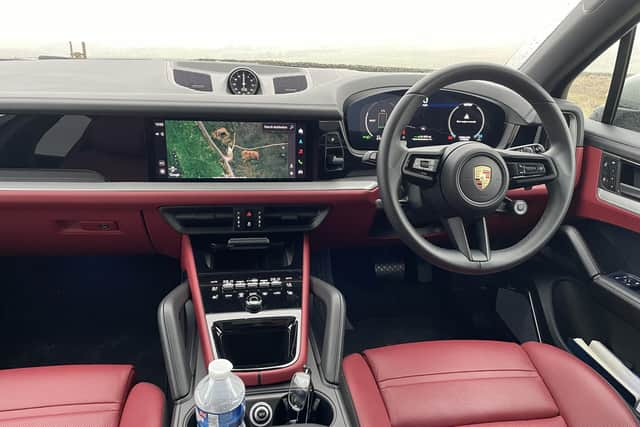
The interior is as modest as the unfussy exterior, which Porsche sensibly keeps simple. Have a look at the garish rump of the new BMW iX3 to see where designers need lessons in good taste.
The total price of the Crayon Cayenne you see here is £122,214, plus on the road costs. The biggest lump, wasted on my cloth ears, was £4,894 for a bespoke audio installation.
The unnecessary 21-inch wheels added £742.25p each. You’ll need four. A headlamp upgrade was £2,226 (for the pair). Smart black and red leather, £3,178. Full-length, part opening glass roof, £1,585.
I’d tick that, and £1,389 for the air suspension with three ride heights and automatic levelling. Rear-wheel steering added poise (also £1,389).
There were other spending options such as InnoDrive that anticipating road conditions and junctions adjusts your speed, keeps you in lane and costs £2,144.
Bottom line, it’s lovely. It weighs 2.5 tons but handles like a lower and lighter saloon, is not upset by road faults, even on its show-off wheels, is quiet on its broad Michelins and very quick.
If you can afford a Porsche you’ll buy it and help offset a slight dip in UK sales this year.
You get what it promises on the badge.
One caveat, when the electric motor battery is depleted fuel economy plummets. There is a consequent harmful spike in CO2 and other engine emissions.
Zero emission Cayennes now include the S Electric, £99,900 and 657bhp.
Porsche Cayenne e-hybrid: £123,214 as seen; Engine is a 3-litre petrol V6 with electric motor; Total power 464bhp and 279 lb ft; Automatic 8 speed ransmission; 0-62mph4.9 seconds; Economy combined 63 to 72mpg; Electric range up to 48 miles; Tank capacity 15.4 gallons (70 litres); CO2 emissions 94g/km; Braked towing limit 3,500 kg; Length 194 inches (4.9m); More information at porsche.co.uk