
Renault 4: 'I drove the revamped new Renault loved by the French countryside - it's excellent to drive'
Renault is continuing to roll back the years as a new R4 pays tribute to its popular predecessor of the late 20th century. Steve Teale gets behind the wheel – and enjoys a comfortable and engaging drive.

Renault’s on a roll, partly thanks to its heritage. It is using some of its fabulous history to spark new interest in today’s cars.
Renault didn’t invent this concept. I think MINI and Volkswagen will row about who had the idea first for the new MINI and Beetle respectively.
And whoever owns the rights to the Morris Minor must be kicking themselves for missing the boat. Am I the only person who thinks a retro Minor would be a hit? Surely not.

But Renault has bought into this heritage idea heavily with the 5, arguably the best new car since the MINI arrived in 2001.
A car which made Renault cool again, something it has struggled to manage since Papa and Nicole were pensioned off.
The 5 deserves its credit. It is a delight, a model which delights even non-car enthusiasts who never fail to fall for the charm.
But it’s not alone. Renault has also revived the Renault 4, a slightly lesser know model from 1961 to 1994.
Known as Quatrelle to the French, this was a sort of rival to the 2CV. It was popular with French countryfolk who loved its sturdy simplicity.
In fact, its top-hinged single-piece tailgate means it can claim to be the world’s first hatchback. Now there’s a question for your next pub quiz.
R4 was also the company’s first front wheel car and it sold eight million in total. It was built for 33 years, which is astonishing by today’s standards.
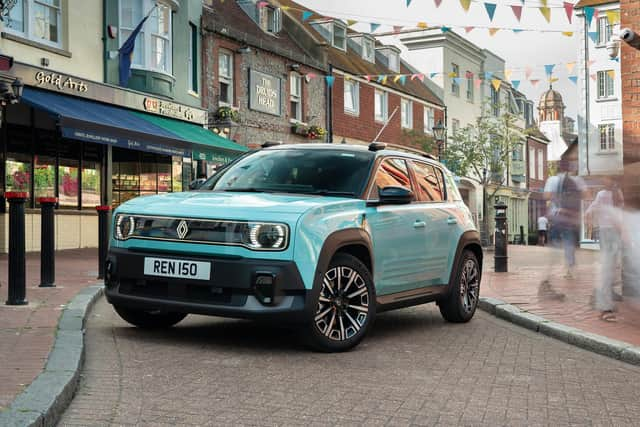
So, how does the new R4 shape up? R4 takes design inspiration from the original car of the 1960s with its bold sculpted lines that run down the doors, the small C-pillar rear windows and its three-part LED taillights.
On the road, the R4 delivers a comfortable and engaging driving experience, while the interior is a nice place to be with its infotainment system angled towards the driver.
There is also a ‘Plein Sud’ model, which comes with a canvas-style electric sunroof, which gives a wind-in-the-hair experience.
It sits on Renault’s ‘AmpR’ electric vehicle platform and comes equipped with a 52kWh battery pack paired to a single electric motor as standard.
That means it can manage a claimed range of up to 247 miles between top-ups and can be charged at speeds of 100kW, allowing for 10 to 80 per cent to be completed in 30 minutes.
The R4 is also excellent to drive thanks to its responsive electric setup and well-weighted steering.
The 4 has one of the best interiors of any small electric car. Materials are pleasant and thoughtfully chosen, and while it’s a bit less whimsical than the smaller 5, there’s still some fun accent colours here and there.
The dash is sensibly laid out, with plenty of physical switches for climate control, volume and so on. The 4’s steering wheel is shared with other Renaults, and gets the same big-button layout that’s incredibly easy to get to grips with.
The 4 is to the 5 what the Captur is to the Clio. At 4144mm, the newer car is 222mm longer than the 5 but not any wider.
The two-box silhouette is of course crossover styled, with a propped-up ride height enhanced by bigger tyres.
Retro details come in the form of circular headlights within an LED-rimmed, one-piece grille that references the original’s aluminium surround, and ridges along the flanks, which are also echoes of the past.
The rear quarterlight window is another reference to the original 4, as are the neat, lensless tail-lights.
The chassis, shared with the 5 and the Twingo, uses the same front-axle assembly as the Clio, with a multi-link rear axle.
The cabin of the original 4 was very basic, but the new model’s cockpit is nearly identical to that of the 5. Here you’ll find a variety of materials and interesting ideas.
The Mercedes-style gear selector is also finished with a crystal-like tip that has the Renault logo etched into it. It’s a bit of jewellery you might typically expect to find in a high-spec premium model.
At 375 litres, boot capacity is more than 30 per cent greater than the 5’s, with a squared-off opening and a low, knee-height lip. This is respectable but not the best in class.
Meanwhile, Renault 4 Plein Sud is making waves. Think of it as a convertible version of the 4 and you won’t go far wrong – though if we’re being pedantic, it’s really more of a big fabric sunroof.
The name, by the way, roughly translates as ‘due south’: a hint that this is a car predominantly aimed at warmer climates.
We buy more convertibles per capita than any other nation, so Renault is hoping the Plein Sud will attract plenty of sales on our shores too.
In short, the roof. Renault’s engineers have taken a tin opener to the 4’s top half, replacing metalwork with a full-length piece of canvas. It opens electrically, folding back to sit just above the rear passengers’ heads.
Unlike a regular convertible, though, there’s almost infinite adjustment: open the roof a little, or a lot, the choice is yours. It’ll open or close at speeds of up to 55mph too, which is more than most drop-tops can manage.
It’s all a bit of a throwback, not only to the original 4, but the Twingo of the Nineties. It’s all got a bit sophisticated since then though.
Rather than a simple piece of fabric, Renault says the Plein Sud’s roof has been built with a clever ‘multi-layer’ construction in a bid to cut down on road and wind noise.
The motor is good. It offers 148bhp, 245Nm of torque, and a 0-60 time of around 8 seconds – not exactly sluggish.
Renault 4 E-Tech Electric: £31,695 (£27,945 including electric car grant); A 52kWh batter generating power via automatic transmission; Range 243 miles; Emissions 0; Insurance Group 26E