
Toyota Prius PHEV: 'I test drove the new Toyota loved by Hollywood stars and taxi drivers alike'
The Toyota Prius PHEV has come a long way since it was first brought onto the market, but has it come far enough for the modern motorist? Frederic Manby took the fifth incarnation of the vehicle for a test drive.
In 1997 Toyota set out on a road which was to change what is under the bonnet of most cars.
Its Prius had a petrol engine which was boosted by an electric motor, bringing economy and reducing CO2 and other nasty emissions. It pioneered the green evolution of petrol-electric hybrid power.
Hollywood stars and cool Californians bought them. Practical taxi drivers joined the Prius club, smitten by economy and Toyota’s solid reliability.

Ten years forward, Toyota was working on a Prius with a rechargeable electric battery so that it would run solely on the battery, the plug-in hybrid electric vehicle.
The 2012 Prius PHEV could manage a meagre 14 miles on the battery before the petrol engine was needed.
It didn’t excite me but I was changing and so was the world.
At the same time luxury carmakers were creating zillions of tons of CO2 flying motoring writers across the world to exotic places to promote thirsty high performance cars which were usually made in Europe.
Clean-living California was a destination. Do you see a paradox?
Carmakers tell us that the Boggs GT has been engineered and tested in extremes of climate, on high speed tracks and those Belgian cobbles which unseat racing cyclists.
But, and a big but, for most cars the truest evaluation is on roads you know and the passage of time to prove reliability.
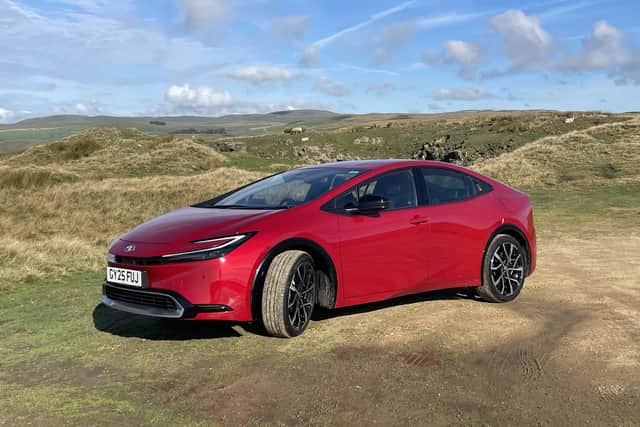
Which brings me to the all-new Toyota Prius PHEV. Taxi sir? Maybe not this time. The trade has embraced the excellent Toyota Corolla. Prius is now more coupe than cab.
Prices start at £37,895 for the Design version. The Excel we were sent is £39,995, with “scarlet flare” paint taking it to £40,545. Discounts are being offered.
It is the fifth version of a model which has passed the five million sales mark and has shared its developing hybrid tech with other Toyota and Lexus models and spin-off Suzukis as well as inspiring its peers.
It is mostly a gorgeous thing, as sleek as the first Prius was boxy, on a new platform with a new engine, new passive and active safety measures, load and loads of stuff to keep you alive and happy and feeling thrifty.
There was a time lag waiting for it, prompted by the customer demand for SUVs and their ilk. Another bit of Toyota, Gazoo Racing, was dominating long distance racing and rallying.
Prius was being re-thought and the potential range from the larger lithium-ion battery is now up to 54 miles.
This is an important figure because to achieve maximum economy and lowest emissions you’ll rely on the battery and that 54 mile range with very low CO2 emissions. It will get most of us to work.
It is why drivers of PHEV company cars pay vastly reduced benefit-in-kind tax.
If you are charging the battery on lowest domestic rates your fuel costs are negligible. If you are using a public charger they are higher. It’s the same for all PHEV cars.
When the battery is exhausted they rely on petrol power and additions of recovered electric power in the battery, with three levels of recuperative boosting on the Prius.
The high mpg falls and the low CO2 soars. However, this new Prius is by no means a guzzler when its battery is depleted because it becomes an efficient self-charging hybrid.
In this state our Prius Excel recorded 50 to 65mpg on a very congested rush-hour journey, up to 55mpg on short trips to the shops and more than 70mpg at other times.
Typically it was running on 65 per cent battery power. Adding ten litres of petrol gave 150 miles of extra range for £13.50 — around 68mpg: cheap miles for what can be a very fast car.
This is a 220bhp car with a 0-60mph time well below seven seconds. That is 100bhp more than the previous Prius.
I drove on roads I know, varying from the rural lumpy Dales to worn city urban and smooth motorway.
The electrified pace excuses the firm suspension which can hammer over patched surfaces and transmits light vibration through the Excel’s taller 19-inch wheels and 195/50 Yokohama tyres.
The screen slopes back at an acute angle shrinking the door aperture and makes entry awkward for the less nimble occupant.
Those roof pillars intrude on visibility at some junctions. Things are otherwise good in the front, with a wide central screen, detailed with some manual tabs for the cabin climate and the cooled and heated front seats — clad smartly with simulated black leather.
The speedometer cluster sits nice and high and forward under the screen.
Life in the back? For a long car it has so-so rear leg room, at the expense of a 56-inch long boot floor under the sloping tailgate which gathers rain or snow when stopped.
A wiper is not an option but you can switch on a wide angle external camera view through rear-view mirror.
A £40,000 car should have more than one map pocket in the rear, plus heater controls and back door pockets able to hold something larger than a wallet.
Toyota Prius PHEV: From £37,895; petrol 2-litre engine, plus electric motor; 222 bhp; Torque 153lb/ft; CVT automatic transmission; Top speed 110 mph; 0-62mph 6.8 seconds; Economy – rated at 134.5 mpg (and more see text), on test, 40 to 75mpg; Nine gallons tank; CO2 emissions 12 to 17g/km; Length 181 inches 4.6 metres; Towing not allowed; Visit toyota.co.uk