
Volkswagen California Coast: 'I went to Glastonbury in the new VW Camper - even us camping novices loved it'
Steve Teale and his partner headed to Glastonbury in the upgraded Volkswagen California Coast camper and had little difficulty setting everything up for a few days soaking up the music.

It’s 10pm and we’ve just arrived at Glastonbury in a Volkswagen camper which we haven’t yet got to know.
Lynne and I had planned to be here earlier so that we camping novices could set up our home for the next six days in what’s left of daylight.
But a motorway hold-up – a lorry dramatically straddling the central reservation while mounting a 4x4 – meant we spent nearly two hours sat on the M62 near the famous farm on the Yorkshire-Lancashire border when we should have been legging it down to the west country.

But no problem: this is a Volkswagen after all. Most of it was simple to assemble and the great VW family of fellow campers were happy to help.
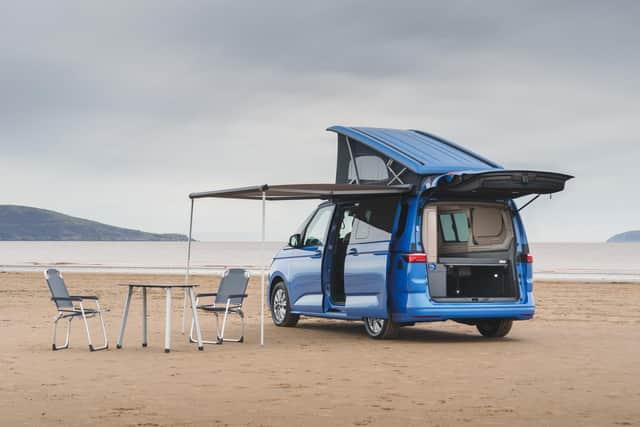
The roof raised easily; unfolding the bed was a cinch; the window blinds cleverly concealed were a doddle to fit; and the most difficult bit (the awning) took literally three minutes to open.
The hardest part? Finding the legs which fold intricately into the leading edge of the cover.
We had an occasional hiccup: the alarm kept sounding for a start but a quick Google told us that pressing the lock button deterred the siren.
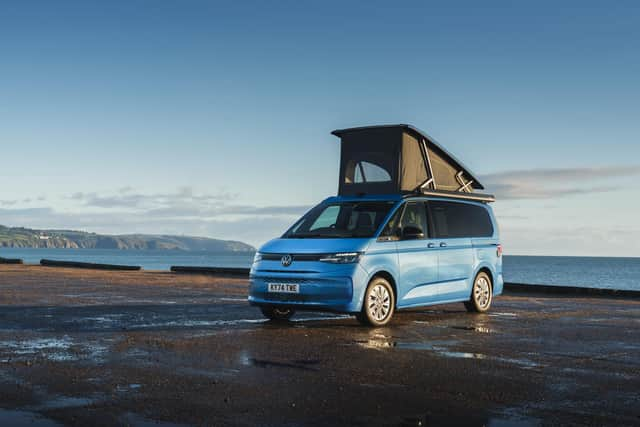
It was comfortable. It must be said, space was at a premium but it was a lovely elegant vehicle to stay in.
The cupboards and storage areas were numerous and easy to use: great while new but I wonder how sturdy they might be after a couple of years and quite a few trips.
Some say these are really day vans – you park up at the seaside or whatever and you have shelter and somewhere to cook and wash up (a clever built in stove and a basin) – rather than proper campers.
Most people with Californias at the Glastonbury site had done this before and they were cleverly armed with tents to gain more space, which turned the vehicle into essentially a bed on wheels with your social area largely under canvas.
It was our third time at Glastonbury and our third time at the Bath & West site, a basic but quiet retreat a couple of miles from the maelstrom of the festival where you can quickly recharge each evening. Glasto for the oldies, as someone put it.
So, what does the California offer? It’s a neatly designed vehicle with a familiar 2.0 litre petrol engine.
It drives very much like a car and it is swift and smooth managing 60mph in 10 seconds while returning around 30mpg officially.
Actually, I managed nearer 35mpg. The rear door is huge and heavy and I wonder how some may cope with it.
It costs from around the £70,000 mark. Sounds expensive to me but you try looking at motorhome prices. This really isn’t bad. And if you're into the lifestyle then it's probably a wise investment.
The latest incarnation of the popular camper brings with it a range of changes and tweaks over its predecessor, including sliding doors on both sides – rather than just one, as before.
Similar to the previous-generation California, the new version is available in an eye-catching two-tone colour scheme, with three colourways there to choose from. In addition, there are 11 single-tone colours to pick between.
Inside, there’s a redesigned and more accessible kitchen area as well as a new external folding table which brings an extra level of versatility. All versions get a pop-up roof with a front window, too, as well as two additional side windows. All come with mosquito nets.
The new lightweight rear seats are fully removable and replace the heavier bench seat that you’d find on the older California. It also enables the Volkswagen van to accommodate larger items when needed.
A number of power sockets are located throughout the cabin, too, including two USB-C ports up front and four in the passenger area.
Instead of the van-based platform as its predecessor, the new California uses the MQB platform that you’ll find underpinning many of Volkswagen’s passenger vehicles, as well as the current Multivan.
It aims to deliver a more car-like driving experience and allows the California to come equipped with a range of efficient engine choices including a 148bhp 2.0-litre diesel – though a plug-in hybrid engine which combines a 1.5-litre petrol engine with an electric motor and battery will be added to the line-up soon.
All versions of the California get a full infotainment system, Apple CarPlay and Android Auto alongside the aforementioned kitchen, awning and parking sensors.
Higher-grade Coast versions add in a redesigned kitchen and three-zone climate control – among other features – while the top-spec Ocean receives a larger infotainment system, seat heating and a camper parking heater for ‘continuous operation’.
The ”downstairs” bed was fine for us. Had we felt agile enough to clamber into the roof we might have found more space.
There is a camper control unit (in the right C-pillar) and a camping table underneath the bed extension.
Plus there are two folding chairs which are concealed cleverly in the tailgate.
There are ample drawer compartments underneath the exterior seats in the passenger compartment and two waste containers.
California plays to wild and free dream. Where ever you lay your van, that’s my home.
I can see the appeal. But if you’re shelling out £70,000 for a van, invest a thousand or two in a tent alongside. And roll on Glastonbury 2027 – for 2026 is a fallow year.
Volkswagen California Coast: £72,156. As tested: £73,597 with extra equipment including improved satellite navigation (£900); tailgate with power latching (£126); power latching for side doors (£228); floor mats in front (£42); and driving mode selection (£180); 2.0 litre petrol engine generating 204ps; Top speed 124mph and 0 to 60mph in 10 seconds; Costs 30.7mpg; Emissions 210g/km; Warranty – 5-plus Promise which combines five services plus three MOTs; five years/124,000 miles; three years paint; 12 years body protection