
'I make Christmas decorations that you can keep out all year'
Artist Fiona Newby is breaking the traditional mould on bauble making this Christmas, as Sally Clifford discovered when she chatted to the ceramic artist about her work for this year’s holiday season.
The countdown to Christmas is on, and our attention has consciously turned to decking the halls for the festivities. Trends change, of course.
The sentimental among us will always make room on the Christmas tree for the decorations passed down through the generations, but less seems to be more these days, with fuss-free and simplistic alternatives replacing over-the-top trimmings of yesteryear.
When it comes to bauble making, you could say Fiona Newby has broken the traditional mould.
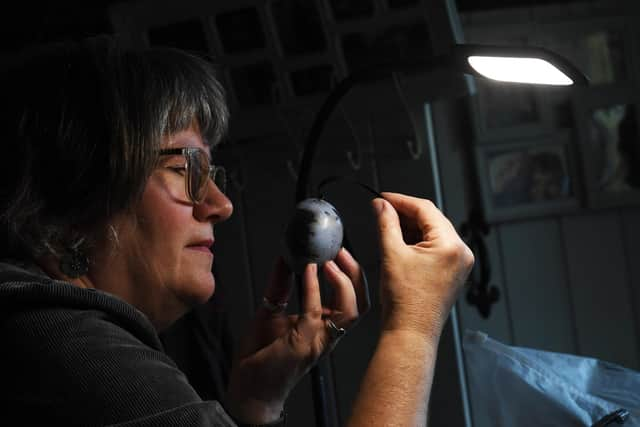

“I thought it would be nice to make baubles. I started making them last year. These were some of the first ones I made,” says Fiona, pulling open a drawer in the studio at her Meltham home.
She explains the design has evolved to incorporate hand-made metal hooks which are attached during production. A velvet hanger adds the festive finishing touch.
The baubles, angels, and other pieces Fiona creates are made using Ashraf Hanna Clay.
“He is an Egyptian potter – it is his own clay recipe – and I like it because it works for me and it is really robust.”
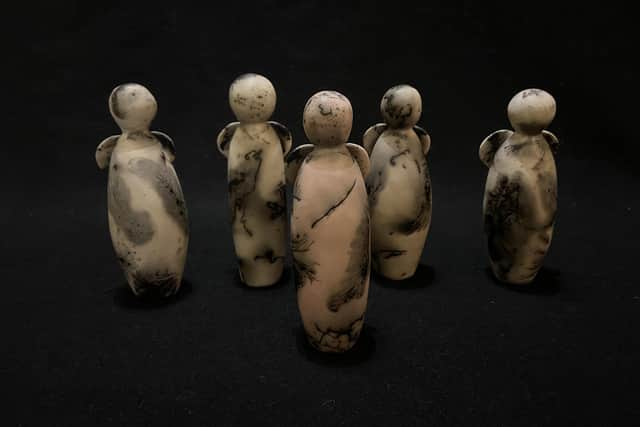
Each piece Fiona creates begins with the build. Using her hands, Fiona manipulates the raw clay.
“To start off, I weigh the clay – the baubles are 40g each, and I pinch them out to make the two sections which are joined and moulded together to make a spherical shape.
"I also use the coiling technique. I coil in ribbons of clay – the baubles are pinched.”
Three coats of fine Terra Sigillata slip – in pink, blue or natural – are applied to the piece. Burnishing then starts, or polishing the drying clay’s surface – described by Fiona as a ‘therapeutic’ process.
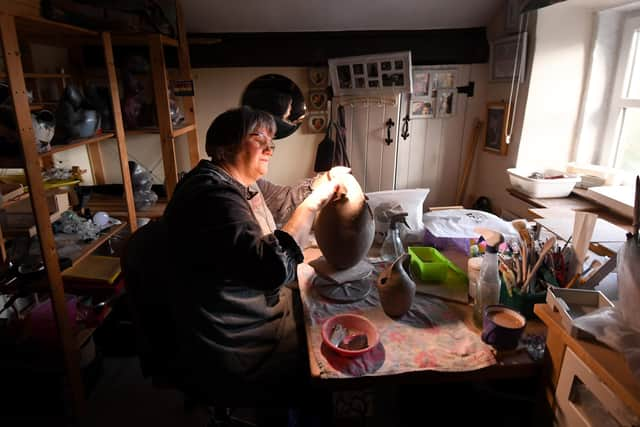
Using a range of tools, including rose quartz and metal spoons, Fiona smooths out any imperfections.
“I am absolutely obsessed with the surface.”
Once completely dry, she places the pieces in her electric kiln and fires them at up to 1,000 degrees Celsius, ‘bisque temperature’, she explains.
Instead of glazing, Fiona uses two firing techniques to create her signature style.
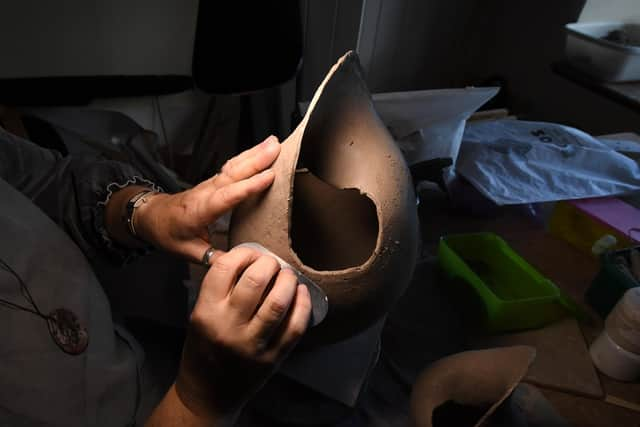
“When I go to the shows, and I say I don’t glaze, people are always surprised, saying things like ‘wow’ because I get amazing results using alternative firing techniques.”
Fiona discovered the Japanese technique raku while studying for her fine art degree in ceramics at Bretton Hall College, within the grounds of the Yorkshire Sculpture Park.
With her husband, Mark, a bike mechanic whom she fondly refers to as her ‘technical director’, she converted an oil drum into a raku kiln which can fire up to 900 degrees.
“I had experimented with raku firing at university but wanted to make my own, so we built the kiln, and I have fired it about 20 times, and it is going great.”
Using long-handled tongs, Fiona pulls the pieces from the raku kiln, then prints the combustibles onto the ceramic surface.
For the baubles, soft downy feathers, horse tail hair and sprinkles of caster sugar are incorporated into the design referred to as naked raku because it is unglazed.
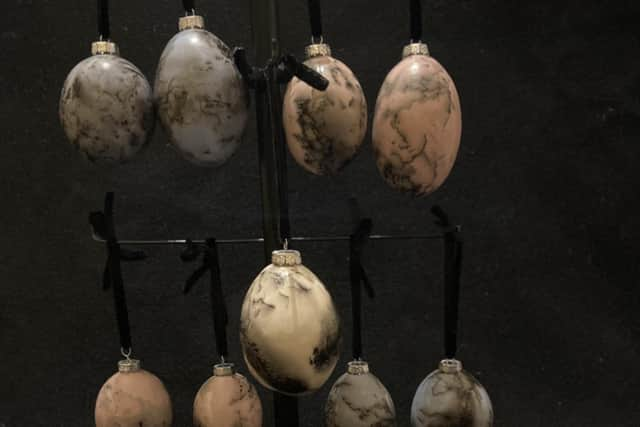
“Naked raku has been really popular. Every time I put them on display, people buy them,” she says.
Fiona believes when it comes to Christmas decorations, people’s tastes are changing with the trends.
“They either go down the red, green and gold traditional Father Christmas theme, or they want things they can put out all year round as well, and the baubles have hit a market that fulfils both.
“It is the same with the angels; they aren’t too Christmassy, and they aren’t too seasonal. People are happy to buy them and keep them out all year.”
Once the pieces are cooled, they are washed to remove the combustible residue, dried, and a light coating of beeswax is added before they are polished with a soft cloth.
Fiona’s favourite ceramics are the Mobius forms. “I love the Mobius forms where the outside becomes the inside, and the inside becomes the outside.
"These are really technically challenging to make. I call them my Emotion Forms because we, mere humans, mask our emotions; we can be thinking and feeling one thing – however outwardly we portray the opposite,” Fiona explains.
“I can’t burnish inside, leaving that more natural, whereas the outside is polished like ourselves. I like the challenge they give me in making them, which is really rewarding as well.”
Saggar firing is another technique Fiona uses to achieve the beautiful patterns on her ceramics.
Understood to have developed in China, the method involves wrapping each piece in a foil blanket surrounded by the combustibles Fiona uses in the process, such as seaweed, copper wire, Miracle Gro, copper and cobalt carbonate, banana skins and pink Himalayan rock salt.
The parcels are placed into the oil drum kiln and wood-fired to around 850 degrees Celsius. The intensifying heat smoulders the combustibles and stains the surface.
“It is like Christmas; you never really know what you are going to get, and that is the most exciting thing about opening the parcels.
"The ones I always think are like socks you get at Christmas, the ones I’m not sure about, they always sell first,” smiles Fiona. “I get nice results, but the key is getting it nice and hot. I use dry wood and sawdust.”
Decorative interior art forms are among Fiona’s ceramics collection. Hand-calming stones, she says, are the most popular.
Emotion forms, such as the aforementioned Mobius pieces, are also a popular choice for customers who have been introduced to Fiona’s work through her website and the events she attends.
Being a member of the Northern Potters Association has widened her network. She participates in Meltham Fringe and is a regular at Holmfirth Art Week, winning the event’s Artist Award last year.
This year she also attended Potfest in the Pens in Penrith and was due to participate in Saltaire Winter’s Market when we met.
Fiona also enjoys demonstrating her skills and recently invited contestants from Channel Four’s The Great Pottery Throwdown, Jonathan Jolley – known as The Jolly Potter – and Elham, a finalist on this year’s series, into her home studio.
She eventually hopes to run workshops to share her love of pottery, which she credits to her creative aunt.
“I started when I was 19, but I always had an arty and creative auntie who encouraged me. I used to draw and paint with her. When I was 19, she went to a pottery class, so I went with her, and that is where I found my love of clay.”
Contemplating her career, Fiona worked in retail for a few years before returning to education and undertaking her fine art degree in ceramics.
Drawing a pregnant life model during her university studies inspired Fiona’s womanly ceramic female forms, which she calls “Earth Mothers”, and which adorn the shelves within her home studio.
Attending a pottery-making class in Holmfirth fired her enthusiasm to buy her own kiln, and so began the pastime that has since become a part-time profession fitting around her supply teacher’s role at the local primary school.
“It started out as a bit of a hobby. I used to sell beach houses and angels, and they sold really well.”
Purchasing a thumb ring from a local jeweller established Fiona’s first supportive stockist – The Guild in Byram Arcade, Huddersfield. She credits their support and the Northern Potters Association.
“They have inspired me and given me the confidence to sell my work. I make what I want to make, which is fabulous – and people buy it. It is also therapeutic and relaxing, and that is probably why I have been doing it for so long. I find it really rewarding.”