
'Finding extraordinary in the ordinary': Christa Ackroyd on what she learnt about life from David Hockney
If ever there was a way to sum up David Hockney and the life he lived it will be his funeral which we understand will take place very soon. We may not even hear when. We may not even know where before it happens. But we know why. Small, close family and friends only and – at his request – in Yorkshire.

David Hockney was offered the funeral of the glitterati. And a place to rest in Westminster Abbey. He turned it down. Just as he turned down a knighthood in 1990 because it seemed like too much ‘noise‘. Who turns down a knighthood? David Hockney did not because he was anti-establishment, King Charles on his death mourned the loss of a “great friend “ as well as a great artists, but because it didn’t interest him.
His life was art and love and what inspired him, especially when it combined the two. Yorkshire and it’s beauty and it’s solid stoic attitude did both. And so he was insistant despite living in France, America and wherever else he could have chosen, being born here, made here of our great county, he wanted to and so will always be here.
But today I am not writing an obituary. His legacy will live on, though remember he only painted what he liked. The joy was he didn’t care whether others liked it or not. “Why should i worry what people with lesser talent think “, he once said not to be boastful but to emphasise that doing a job he loved as he saw it without fear or favour was a gift not awarded to many.
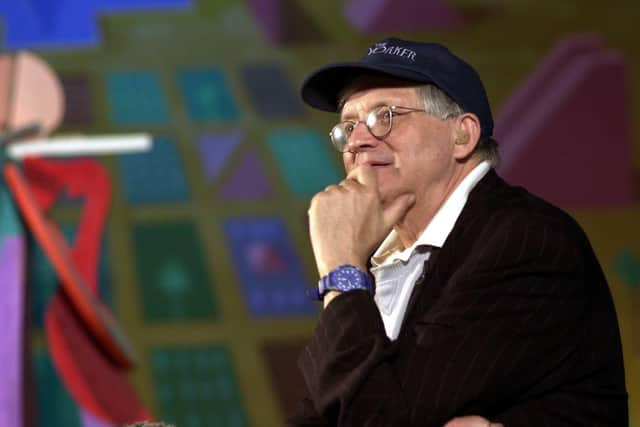

No today I am urging each and every one of us to ‘be more David’. We may never be as talented. We may never be as outspoken. And certainly very few could ever be persuaded to be as flamboyant as he was. He was a walking kaleidoscope of colour and energy. But what we can do is take his life lessons apply them to ours and be better, live better, because of it.
And so I wanted to write this column today not to critique his art. Who am I do do so? I loved it, I even have some of it and the pristine copy of the Bradford phone book he designed, but no I write to show how grateful I am to have met him, seen his work first hand and still be inspired by his attitude to each and every day. I hope by the end of reading it you will agree whether you were an admirer of his art or not his view on life was as beautiful and simple as his paintings. Only they were not.
The art of art is making them look so. I well remember taking mum to an exhibition at Salts Mill just down the road from where we lived. She was not keen. I am going to be honest, his openness about his homosexuality was another world for a woman whose only experience of swimming pools was Eccleshill baths. But his portraits of those who lived just down the road from us, his mum, his dad and his brother, blew her away. She even knew some of his subjects probably having shopped at the same supermarket. Christa, she exclaimed, he is a wonderful drawer and painter.
I recounted that story to David once when I was interviewing him. Puffing on a cigarette of course, he chuckled and said in the soft identifiable accent of a Bradford man “Of course you have to be able to draw to be able to then paint what you wish to in the future. Without knowledge as to how it works, the freedom to paint as you choose can never comes. “
I grew up knowing about David Hockney. He was born and raised less than a mile from where I lived in Bradford where stories abounded about him pushing an old pram full of paintings to sells to friends and neighbours so he could move onto bigger and better canvasses. Because David Hockney never thought small. They tried to teach him the ways of the classic artists, he wanted to think and draw like Picasso not for anyone other than himself.
He made a fortune and didn’t give a jot. Money meant nothing though he held the record for the highest price ever achieved by a living artist at more than £90 million. He sought new horizons, breaking new boundaries especially when they said he couldn’t do so, using technology, faxes, then polaroids, phones and ipads. “I think I am greedy,” he once said. “But I am not greedy for money. I am greedy for an exciting life, but then I can find excitement in raindrops falling on a puddle .”
Nothing was impossible. They told him landscapes were old fashioned so using technology he made them fashionable again adding landscapes and nature never went out of fashion it was just that artists approached them in a boring way.
He worked hard at his work painting every day musing that you never knew what would become a great painting. And so “you must plan to be spontaneous”.
Nature like life he never saw in black and white . It was big and bold and wondrous. “To me the world is rather beautiful if you look at it .. especially nature. “.
He saw what so many of us miss. Because he took time to stop and see. The beauty of the seasons. The raindrop on a windowpain, the shadows in group of trees and then delicacy of a blade of grass. His attitude was simple; “I prefer living in colour, “ adding that it was the artists job to never stop looking.
He was the eternal optimist, ferociously intelligent and gently deep and reflective. During lockdown he simply said “Do remember they can’t cancel spring”, as he shared his flower paintings to remind us that there was still beauty in a changed world as he had done for years when he said “I draw flowers every day and send them to my friends so they get fresh blooms every morning “.
He is the greatest person I have ever met when it comes to looking through a different lens.
And David Hockney spent a life of looking. He found the extraordinary in the ordinary. Because of him everything was depicted as far from ordinary. His attitude to tough times was that art heals, “It soothes”, he said. Buy I also love this quote “Only after seeing the winter do you comprehend the richness of summer”.
I have read much about David Hockney this past week but one social media post has stuck with me. It is not from the great and good in the art scene. It is not from the Tate or the Royal Academy of Art, or Bradford Art college or Bradford Live reborn from the dereliction of the Odean cinema which he campaigned to save but from an anonymous horse rider gently trekking through the Yorkshire wolds following the secret places he had painted when he came home to Bridlington.
Every so often she stopped to take a photograph on horseback which she depicted next to David’s painting of the same spot. She recalled how they had met day after day as he sat there in silence committing what he saw to paper and technology. Until each morning they would greet each other as friends. I think he would have liked that. Perhaps until then she had never really thought of art as being for her. Maybe that as well as his wondrous, life enhancing forever changing boundary breaking art is his legacy. He made the biggest of the bigger splashes as his famous painting depicted. He made the biggest of impacts in the world scene by always seeing the ‘ bigger picture’, again a title of one of his famous exhibitions. But if we adapt just a smidgeon of his attitude to life maybe we will start to see it in colour again too. As he put it, “There is always everywhere an enormous amount of suffering, But I do believe my duty as an artist is to overcome and alleviate the sterility of despair. New ways of seeing mean new ways of feeling”.
Rest in rebellion David from one Bradfordian to another the world will be a duller, greyer place without your presence. But I for one accept the challenge to always look for the colour even on, or probably especially, during the darkest of days.
David Hockney never stopped working because he never stopped living. And he never stopped seeing every day as a day of possibility. So should we. I will leave the last word to him and the way he lived.
“I intend to have it exciting until the day I die.” Thank you David. And so do I. So dear reader will you join us? We might not create a masterpiece. But we will relish every day that little bit more because of him if we do.