
Alsace: 'I visited this quirky French region and was bowled over by the scenery - and the wine'
The Tour De France will be travelling through the region of Alsace this weekend but once the cyclists have passed, Christine Austin recommends the best places to have a meal and select the best bubbles.

This article contains affiliate links. We may earn a small commission on items purchased through this article, but that does not affect our editorial judgement.
If the temperature in Alsace is as high as it was just a few weeks ago then I really don’t envy the cyclists and spectators taking part in the Tour de France on Saturday (Jul 18).
The route starts in Mulhouse, just north of Basel and takes in some of the most fabulous scenery in France.
There are plenty of hills including Le Grand Ballon (1,400 metres), Ballon d’Alsace (1,100 metres) and Col du Haag (1,200 metres), and a lot of small, winding roads that wend their way across the Vosges mountains.

The cyclists will cover around 100 miles, while the spectators will probably spend most of their time standing around, patiently waiting several hours for those brief few minutes when the peloton approaches and whizzes by.
At least they won’t have far to go far for a good lunch or a wine tasting.
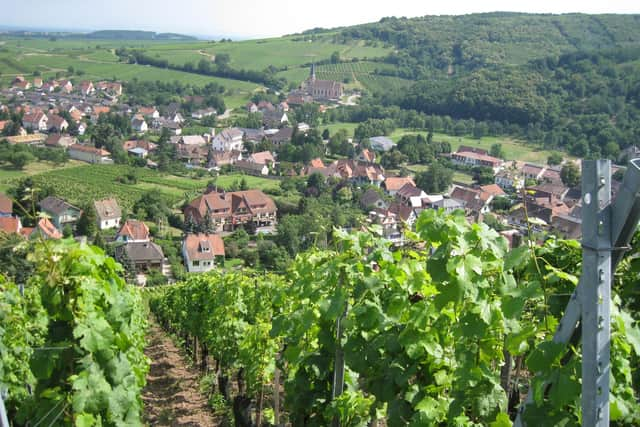
The Vosges mountains run north south, almost in a straight line, on the eastern side of France. Alsace is sandwiched between these slopes and the Rhine river, which forms the border with German.
It is a long, thin region, barely 20 miles wide and around 100 miles long, with vine-covered slopes and pretty villages tucked into the hillsides.
This warm, fertile region has been fought over so many times it has a confused personality. The language is French, but many place names sound German.
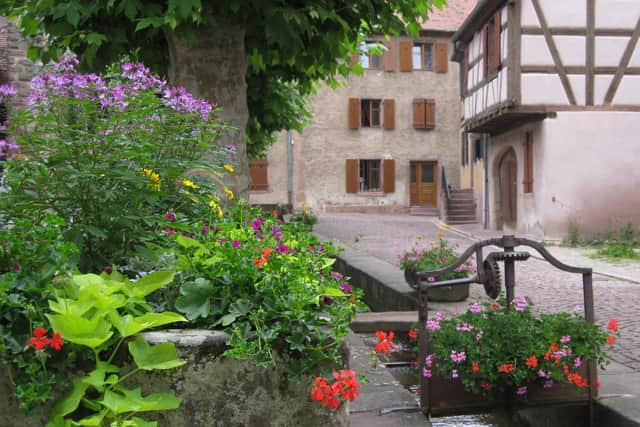
The villages are charming and all of them seem to be taking part in a competition to grow the most magnificent red geraniums.
These bright flowers decorate every balcony, window ledge and fountain.
These villages are where the Tour de France spectators will find a good lunch.
They should head to Riquewihr which looks much the same as it did in the 16th century with cobbled streets and half-timbered houses.
Close by is Ribeauvillé, another medieval gem while Eguisheim is famous for its narrow circular streets. Colmar is a major hub, but still charming and historic.
Just a few weeks ago, I visited Alsace to catch up on what has been happening there and I was bowled over by the scenery and the wines, and in particular by Crémant d’Alsace.
Crémant is the word used for any traditional-method sparkling French wine that doesn’t come from Champagne.
The words traditional-method are important since the rules stipulate that the wine must go through the long, complicated process of a second in-bottle fermentation to create the bubbles.
This is the same method used for Champagne. There are many other rules and regulations about how much juice can be extracted from the grapes and a minimum aging period.
All of this has propelled Crémant d’Alsace to be the top selling Crémant in France, with 40 millions bottles made each year, outselling Crémant wines from Bourgogne, Bordeaux, Limoux and the Loire.
The story began in 1900 when winemaker Julien Dopff from Alsace visited the Paris Exhibition and became fascinated by a demonstration of Champagne making.
He spent two years in Champagne learning the process and then headed home to make similar wines in Alsace.
It took until 1976 for Crémant d’Alsace to be allowed its own appellation, which means that this creamy, elegant wine celebrates its 50th birthday this year.
The Alsace climate is drier, sunnier and warmer than Champagne and so produces grapes with riper, more generous flavours and slightly less acidity, although they retain freshness and balance.
Grapes for Crémant d’Alsace have tended to be mainly Pinot Blanc and Auxerrois, but Pinot Gris, Riesling and are permitted, as well as Pinot Noir which is the only grape permitted for Rosé Crémant d’Alsace.
“We have seen an expansion of Chardonnay plantings in recent years because this grape adds another dimension to the sparkling wine, especially as it ages” said Jacques Cattin, who owns the Maison Cattin, one of the largest family-owned winemaking estates in Alsace.
Regulations insist on a minimum of nine months lees ageing, plus another three months in bottle after disgorgement, but everyone I met was ageing for much longer.
Two or three years was quite usual amongst the top names, with Etienne-Arnaud Dopff of Dopff au Moulin, a descendant of Julien who started the whole Crémant experiment, is ageing one of his wines for five years.
What is great about Crémant d’Alsace is the price.
Coming in at half the price of Champagne, or in many cases much less, there are fabulous wines from this region, made using the same, long, slow method, and achieving delicious, elegant flavours.
Check out some of the best wines.
Exceptional Crémant d’Alsace, Asda £10: If you are new to Crémant and Alsace, then this is the one to start with. A good blend of traditional local grapes, bolstered by 8% of Pinot Noir which adds fruit and depth. Bright and crisp with lemon drizzle on toast flavours.
Taste the Difference Crémant d’Alsace, Sainsbury, £11.75: Surely a sparkling wine can’t be any good at this price? But it is. The winemaker is Daniel Gerold who makes fabulous wines at the excellent co-operative, Cave de Turckheim. I love its crisp, citrus style, fresh pear and white peach fruit and clear, fresh finish.
Cave de Turckheim Organic Crémant d’Alsace Brut, Waitrose £15: Made from a blend of traditional grapes, Auxerrois, Pinot Gris and Pinot Blanc, this also comes from the Turckheim co-op and has creamy bubbles, crunchy apple and pear fruit with a hint of heather honey.
Arthur Metz Crémant d’Alsace, Brut, Ocado £16.25: From one of the top producers of Crémant in the region, this has creamy bubbles, a rounded, gentle, fruity palate with peach and citrus notes and a hint of toast on the finish.
Dopff au Moulin Crémant d’Alsace, Cuvée Julien Brut NV, Hic! £18: Named after the man who started the whole story of sparkling wine in Alsace, this is a creamy, elegant wine with a floral note, clear lemon zest and green apple freshness with a soft, brioche note.
Cattin Sauvage Crémant d’Alsace Brut, Bowland Forest Vintners (The Inn at Whitewell) £18.99: Famille Cattin has been making wine since 1720 and own extensive vineyards, but also source grapes from 80 families across the region.
This is a certified organic wine, with a rounded, fuller style, floral notes, with lime zest flavours and wholemeal toast.