
How to eat like royalty with the new cookbook from The Queen's son Tom Parker Bowles
Queen Camilla’s eldest son, food critic Tom Parker Bowles, lifts the pan lid on some of the Royal Family’s favourite recipes down the ages in his new cookbook, Cooking and the Crown.

Food critic and writer Tom Parker Bowles, 49, is the eldest child of Queen Camilla.
In his new book he tells how the King “appals waste”.
“There is no waste, everything is recycled, everything is used from the table. If anything is leftover from the dinner, that will be made into something else or appear the next day. Nothing’s allowed to be thrown out.”


The King has long been a champion of sustainability – the Coronation Food Project co-ordinated by his charitable fund launched last year, aiming to reduce food waste and support people living in “food insecurity”.
“It’s not the King just paying lip service, he practises what he preaches.” says Parker Bowles.
As stepson and godson, he says food sustainability is a subject he “can relate to” Charles on. “He really is a food hero. To talk to him about the strange varieties of plums or pears or anything else is endlessly fascinating”.
His latest cookbook, Cooking and the Crown, details the history of food within the Royal Family – from the reign of Queen Victoria to Charles and Camilla.
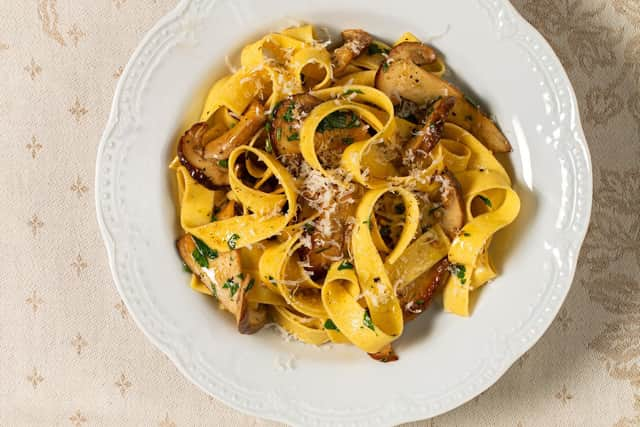
Tom Parker Bowles’ fresh pappardelle with porcini
“Wild mushrooms are somewhat of an obsession, with Charles III and Queen Camilla deeply competitive about their hauls,” says Tom Parker Bowles.
“In the late summer, porcinis – also known as penny buns or ceps – are particularly abundant in Scotland, as are the apricot-scented chanterelles, birch bolete and wood hedgehog.
“The wild harvest is either cooked fresh, preserved in butter or dried for use throughout the year.”
Serves 4. Ingredients: 400g pappardelle pasta; a big lump of butter; a big glug of olive oil; 600g porcini (cep) mushrooms, sliced vertically; 1 garlic clove, finely chopped; glass of white wine; a handful of chopped flat-leaf parsley; salt and freshly ground black pepper; a big handful of grated Parmesan, to serve.
Cook the pasta in plenty of salted water according to the package instructions.
Meanwhile, heat the butter and oil in a large frying pan over a high heat. When hot, add the mushrooms and cook for five minutes until all the water has evaporated.
Reduce the heat and add the garlic, cooking for a few minutes, then whack the heat back up and deglaze the pan with the wine. Let it evaporate, then add salt and pepper to taste, parsley and a teaspoonful of the pasta cooking water.
Drain the pasta and add to the sauce in the pan, mixing well. Serve with the grated Parmesan.
Queen Mary’s birthday cake
This is a recipe from Gabriel Tschumi, who served as chef to three British monarchs: Queen Victoria and Kings Edward VII and George V.
“The famed cake was also served each year at Queen Mary’s birthday,” says food writer and critic Tom Parker Bowles – and the recipe has proved popular throughout the years that have followed.
“This one was served to a young Prince Richard – now Duke of Gloucester – during the 1951 visit. Among her observations, the Queen had heavily underlined the chocolate cake, written Prince Richard’s name and the words ‘great success’.”
Ingredients: 125g melted butter, plus extra for greasing; 8 egg yolks; 2 egg whites; 200g golden caster sugar; 200g self-raising flour, plus extra for dusting. For the chocolate ganache: 600ml double cream; 100g caster sugar; 450g good-quality dark chocolate, grated. You will need: Two 20cm round cake tins.
Preheat the oven to 180C/350F/gas mark 4. Grease and flour the cake tins.
Whip the eggs and sugar in a bain marie (a heatproof bowl set over a pan of simmering water – do not let the base of the bowl touch the water) until thick and you reach the ribbon stage (the beaters when lifted will leave a ribbon trail of batter).
Sift in the flour in three stages, gently folding in each time, then add the melted butter and fold in until incorporated.
Pour the batter into the prepared cake tins and bake in the oven for 30 minutes, or until an inserted skewer comes out clean. Remove from the oven to a wire rack to cool in the tins, then remove from the tins to cool completely.
For the ganache, combine the cream, sugar and chocolate in a heavy saucepan and bring to the boil, then leave for one hour to cool.
Cut each cake in half and spread each layer with ganache, building up to a four-layer sandwich. Coat the entire surface of the cake with the remaining ganache.
The Queen Mother’s gin and Dubonnet cocktail
“Despite the vast and magnificently stocked cellars at both Windsor Castle and Buckingham Palace, the monarchs, from Queen Victoria to King Charles III, were not – and are not – great drinkers,” says Parker Bowles, adding that it would be the occasional glass, rather than endless bottles.
“And while the Queen Mother is affectionately remembered for liking the odd tipple – you’d certainly never go thirsty at one of her splendid lunches – it was more about being a generous host.”
A gin and Dubonnet cocktail was much appreciated by the late Queen and the Queen Mother alike, though, typically sipped before lunch.
“It has a stirring mixture of sweet, bitter and vaguely herbal flavours. And certainly puts a spring in one’s step,” he says.
Makes 1. Ingredients: 2 parts Dubonnet; 1 part gin; 4 cubes of good ice; a slice of lemon.
Pour the booze into a tumbler with the ice cubes and mix well. Garnish with the lemon slice