
St Emilion: 'I visited a historic French town - and found something new stirring in the vineyards'
Christine Austin paid a recent visit to St Emilion and found that the French town had changed little over the years… except that something new was stirring in the vineyards.

I had forgotten just how lovely St Emilion is. We used to holiday there, year after year, when our children were young, staying in a small wine château on the outskirts of this medieval town.
We were close enough to visit the bakery early in the morning, picking up crisp croissants for breakfast, but we were just beyond the busy, cobbled stone streets that became rather crowded as other holidaymakers arrived to enjoy the views and the vineyards.
Over the years the town has remained much the same, protected by its UNESCO World Heritage status.
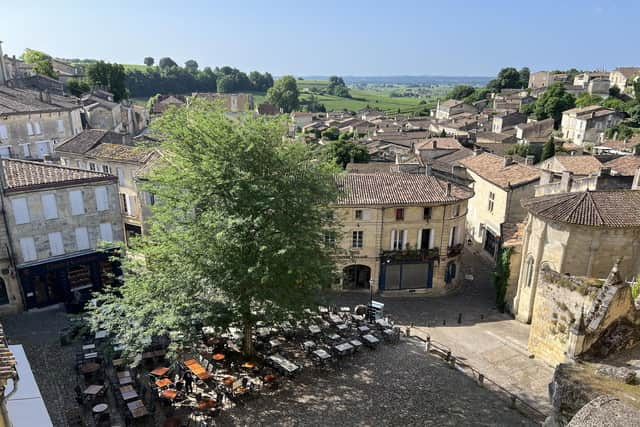

There are a few more cafes and ice cream shops, and the up-market restaurant in the middle of the village has changed hands and acquired more Michelin stars, but there is still room to wander around the town.
The Tourist centre acts as a hub for advising and arranging visits to wine châteaux, and you can even tour the vast underground monolithic church hewn out of the rock in the 12th century.
The only sign that the church is there is the bell tower which can be seen from miles around. The view from the nearby terrace extends over terracotta roofs and vineyards stretching to the horizon.
When I visited a few weeks ago, it seemed that nothing had changed – but I was wrong.
There have been significant changes in the vineyards, helped by an influx of money from owners of grand properties across the river Garonne who have brought their investment, skills and marketing to St Emilion.
The result is that some properties have not only changed hands, they have changed their cellars, their vineyards, and even their names. But the soil remains the same.
I visited Château Quintus which is situated on a prime site just south of the town.
A fold in the contours of the land allows Quintus to sit on a hill with vineyards to the north, south and east, providing a perfect range of sun exposure.
It is next to the excellent Ch. La Gaffelière, and the lovely Ch. Angélus is within walking distance.
Both of those properties are long established, and their names are well-known, but Quintus is a new name in St. Emilion, and while it is relatively unknown, it comes with a very fine heritage.
At the start of 2011 the 15-hectare property known as Ch. Tertre Daugay, was bought by Domaine Clarence Dillon, who also own Ch. Haut-Brion and La Mission Haur Brion in Pessac Léognan on the left bank.
It was renamed Quintus because this is the fifth Bordeaux wine owned by and produced by Domaine Clarence Dillon.
Later they bought the small property to the south of Quintus, Ch. L’Arrosée and a few years later acquired Ch. Grand-Pontet to the north.
In all Ch. Quintus now has 45 hectares of prime St Emilion land, with three different types of soil, some limestone, some clay and some sand which gives the property the ability to produce wines with different styles.
But at present the wines are not blended to produce just one wine.
Each is kept separate, the final blends being selected by a highly qualified team of tasters, including those from Haut Brion.
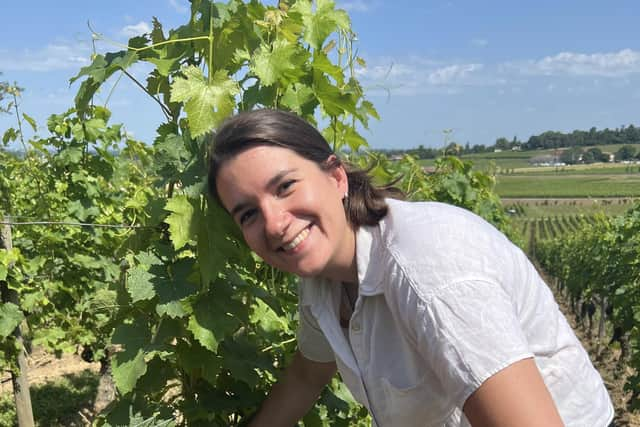
I walked through the estate with vineyard manager Pauline Comin. She oversees a workforce of 50 people which is much larger than most neighbouring vineyards.
These people are needed because the vineyards are all worked sustainably, no herbicides are used on the property and biodiversity is one of the key factors within the vineyards.
At present just 3 hectares are worked organically but this may increase with time.
The one major change has been the removal of Cabernet Sauvignon from the vineyards, replaced by Cabernet Franc. Now with a blend of Merlot and Cabernet Franc, Ch. Quintus shows the traditional style of St. Emilion wine that has been established over centuries.
“We have some very old Cabernet Franc vines which do particularly well on our soils. Some are over 75 years old,” said Pauline, who learnt her excellent English during a long, lock-down harvest in New Zealand.
“Where vines have been removed new cuttings have been propagated from these old vines to replace them, continuing the heritage of the estate.”
From the vineyards we went to the cellars, where the wine for Quintus is made. At present each of the three properties has its own winemaking facility although, there is the possibility that in the future just one cellar will be built to take the grapes from the expanded estate.
Grapes are hand-harvested and brought to a sleek, modern winery with rows of expensive large oak fermentation vats and plenty of stainless steel.
“We only do very gentle pump overs to keep the tannins soft,” she said. From there the wine is aged in French oak barrels for 15 months.
In a nod to traditional winemaking, the wine is fined to remove any remaining haze with egg whites.
This is the method that has been used for generations and is generally accepted to be an excellent part of winemaking although vegans may not like the process.
Once bottled the wine still needs time to age. I tasted through several vintages of Ch. Quintus and its second wine, Dragon de Quintus to assess the way this relatively new wine is fitting into the expected profile of St. Emilion.
Overall, I loved the wines, which showed remarkable concentration and a genuine silkiness on the plate. The tannin structure is firm yet ripe and elegant.
As the climatic conditions of each year varied, so does the mix of Merlot and Cabernet Franc giving a variation of taste and style depending on vintage.
Dragon de Quintus, sadly not yet available in Yorkshire is the more easily accessible wine, still with great presence and concentration. The 2018 vintage is tasting very well at present
As expected, Ch. Quintus is firmer and denser with the ability to age. With structure, power and balance the 2018 will see many years of exciting drinking.
The 2022 vintage of Ch. Quintus was the first year that wine from Ch. Grand-Pontet were included in the blend and it shows in the uplift of raspberry-charged fruit behind the dark, concentrated complexity.
Bon Coeur Fine Wines has stocks of Ch. Quintus 2020 at £86 per bottle plus duty and VAT.