
"We used to keep horses in the field but now grow edible flowers," Hannah Lamb of Yorkshire Edible Flowers
The unpredictability of the British weather poses a challenge for even the most adept growers. Yet, five years into what is now an established plot, Hannah and Martin Lamb are proving that tenacity and adapting to the situation is crucial to the business they are busily growing in more ways than one.
On one of the hottest summer days since the heatwave of 1976 Hannah is watering. It is just after 9am yet Hannah’s day of dampening down the crop began some five hours previously.
That’s life for a flower and vegetable grower, and while it is a totally contrasting career to her previous profession as a project manager in museums and heritage – a job which led to her meeting and marrying Martin, a freelance opera singer, writer and director whose work has taken him around the world – the transferable skillset of coordinating and planning comes in handy on the plot.
“We have a risk profile for every flower. We look at the likelihood of failure and what those risks are and how we can mitigate that,” says Hannah.
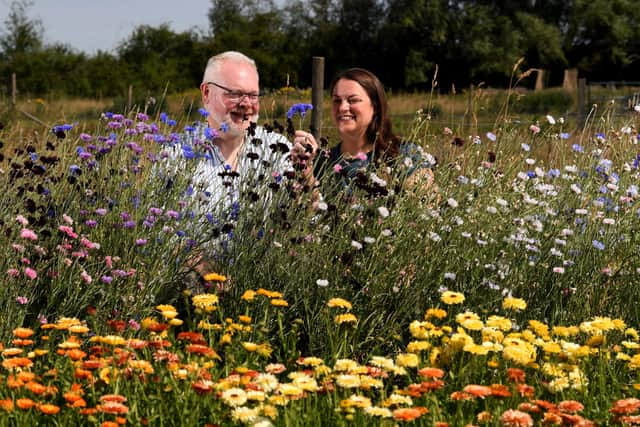

While early watering helps the flowers and vegetables to thrive when the heat is on, there are plenty of other threats to the produce they grow – it is the nature of the job.
“With tulips it is tulip fire which is a viral disease, but we plant them in different locations so if one area gets it the second won’t. We also look at the weather and also the pests eating them. We have spent the past few years developing a system so we can net our tulips so nothing gets into them.
“You have to think these consequences through and what you can do to protect it so you have that crop and some substitutes. Realistically, flowers grow so you have to work with nature not against it.”
Forward planning is another transferable skillset when it comes to growing. “It is making sure you have everything in every colour range because you cannot predict what colours customers will ask for.”
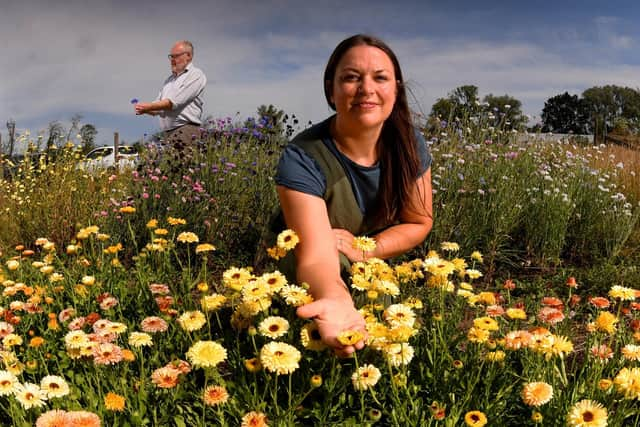
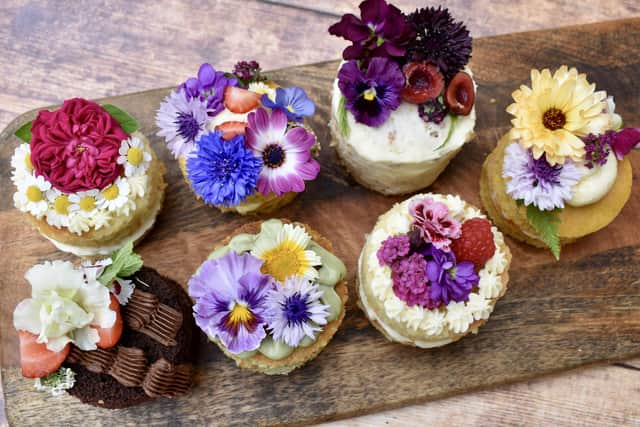
Coral and sky blue and purple and orange are just some of the striking colour couplings bakers have requested for their culinary masterpieces. Wedding cakes are the main focus for the edible floral decorations Hannah grows on the family farm in Doncaster where her mum, Ruth, moved to 12 years ago.
“Mum wanted the house and this came with it,” says Hannah. The parcel of farmland, to which Hannah refers, is around 7.8 acres and was perfect grazing land for their horses. “We used to keep horses on the field but we always talked about the possibility of doing something with it.”
“We always said we wanted to make sure we were looking after the fields and there were things we were conscious of looking after,” says Martin. Natural borders of British native trees separate their agroecology growing area and while the clay soil of the two acres the couple have under cultivation isn’t a natural growing environment, the decision to give it a go – very much the ethos behind this enterprise - led to a successful plot coming to fruition.
“We had an idea one day we would do something with the fields then Covid hit and all my work stopped because my background is in performing arts, as an opera singer,” says Martin.
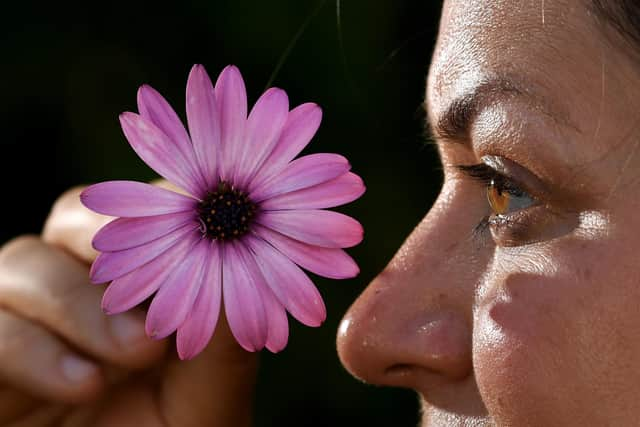
Conscious of the restrictions lockdowns brought, and the interruptions on the way of life, growing your own became a popular pastime with many seeking sanctuary at their allotments.
For Hannah and Martin, Covid forced them to think more carefully about their plans for the land. They sectioned off an allotment plot and created a small-scale kitchen garden where aubergine, peppers, asparagus, borage, broccoli and strawberries are among produce on the grow.
“We have lots of edible flowers so we set up a mixed allotment in Covid,” says Hannah. Lockdown life gave the couple time to research growing on a larger scale and explore the potential of making a living from their land. “We thought it is now or never, we have got this time,” recalls Hannah.
Being keen bakers – Martin looks after the bread while Hannah cares for the cakes – they became conscious of the boom in home baking through social media. Yet, they were also aware of the shortage of ingredients to make a decorative cake. “We knew edible flowers were very popular and I realised I had two or three on the allotment – calendula; nasturtiums and cornflowers and some roses so I realised this was potentially a market we could explore and something we were fascinated by,” says Hannah.
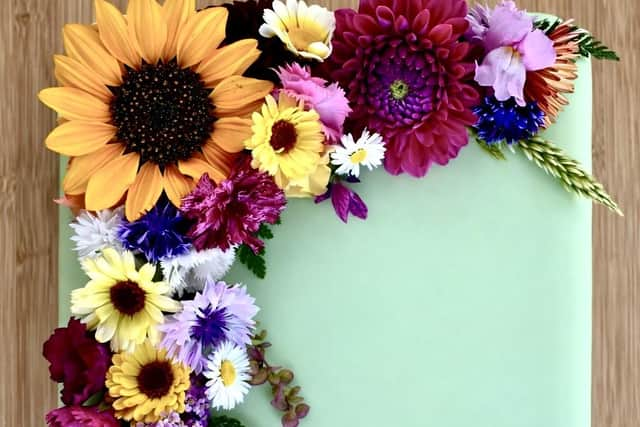
“The more we looked into it the more fascinated we were of flowers being used as foods in the past and what is edible,” says Martin.
Hannah says the lack of a standard list of edible flowers poses an issue they are trying to address through extensive research. This is also something they have included in the website they set up after launching Yorkshire Edible Flowers. For the couple it is all about education, and running workshops are a consideration for the future.
For now, Hannah gives talks, illustrated with some of the 36 varieties of flowers she grows, Nigella, Camomile, Carnations, Cornflowers, Gladioli, Marigolds, Snap Dragons; Sunflowers, Sweet Alyssum and Violas, to name a few, to organisations she has become involved with through the British flower growing network.
“We have quite a wide professional network and we both really enjoy getting to know about horticultural practices,” says Hannah, who is on the board of the Community Supported Agriculture UK (CSA) – a cooperative for farms throughout the UK.
Learning about the health of the soil, and how to grow more resilient plants, are some of the essential elements they put into practice on their pesticide-free plot.
“We are No Dig in the purest sense, but we do farm using low till methods and try to disturb the soil the least amount possible. We use a lot of cover crops and green manure,” explains Hannah.
Fast growing plants, such as deep-rooted rye and legumes, provide organic matter and release nitrogen replacing the need for synthetic fertilisers during the growing season which runs from March to November. Sustainability is evident in the compostable cardboard punnets and wood wool packaging in which their flowers are posted to customers throughout mainland UK.
Edible flowers, along with herbs, grown on the plot, are also included for salads in the hyperlocal CSA veg box scheme they set up three years ago to help the local community.
Three polytunnels, including their very first fashioned from a swimming pool frame and agricultural polythene which is still going strong, are used to propagate and nurture the seeds sourced from small British open pollinator suppliers.
“It has been a learning curve but also we are both interested in learning new things and really enjoy going to conferences and training and really getting to know and learn things,” says Hannah.
Their background in events also means they are perfectly placed when it comes to liaising with bakers and brides on their culinary requirements. Having an understanding of their flowers and how they work in different conditions is all part of the bespoke service they provide. They have also supplied edible flowers to chefs.
“We made some big decisions but we are in a good place because of it,” says Hannah. Working full-time on the plot has given her the flexibility to fit around family life. Their young son, Edwin, often lends a hand. “Edwin has planted out carrots; dead-headed flowers and done the watering. He has a really good understanding of the soil. We are working really consciously to create something that is sustainable.”
www.yorkshireedibleflowers.com