
Bathe the garden in sunshine flowers
The Tour de France is history but the colour yellow continues to make its mark in the garden. ‘Lemon Popsicle’ (who comes up with these names?) is a hardy red-hot poker that will bloom all through summer and well into autumn, its tubular lemon flowers appearing from the base upwards forming impressive, almost luminous flower spikes.
At a height of 35cm and with a spread of 45cm, it’s not one of the largest of red-hot pokers, but in the right place and in the right conditions it can certainly prove to be a bit of an eye-catcher.
Traditionalists, however, will sill stick with the likes of K ‘Lucifer’, a tall, vivid red form which spreads to form mighty clumps. The plant’s great, sword-shaped leaves are a clue to the fact that it’s a cousin of the gladiolus.
‘Lucifer’ loves the sun; site it in the shade and it will produce lots of foliage but few flowers. And that foliage can become very untidy in late summer so it’s best to cut it back hard in autumn when it starts to yellow and divide established clumps every three or four years.

On the whole, red-hot pokers won’t tolerate waterlogging but will cope with drier soils, at the foot of a wall or near a hedge, for example.
An annual mulch around the base of the clump (but not over the crown) of well-rotted manure or garden compost will help boost fertility and moisture retention. In colder gardens, young plants can be given a little extra protection with a mulch of straw or dry leaves.
If you haven’t given the plant a going-over in autumn, give it a good spring-clean, removing any dead and decaying leaves.
Loosestrife
Lysimachia punctata, aka yellow loosestrife, whose blooms are to be seen just about everywhere in late summer, is commonplace but still an attractive little flower.
It likes partial shade (but will grow well in sun) and damp, reasonably rich ground where it can spread rapidly by means of underground rhizomes. So, if you don’t like invasive plants, avoid it.
The same applies to its cousin, L nummularia, or ‘Creeping Jenny’, which rarely gets more than a few inches off the ground but which spreads like wildfire.
This very vigorous evergreen perennial forms a wide mat of creeping stems clothed in small, rounded or ovate, golden-yellow leaves. It makes great ground-cover and can also be persuaded to drape itself over walls and tree stumps.
When it gets too much, just pull it up.
Back to Lysimachia punctata, which has been grown in gardens since Victorian times. Plants form a bushy, fast-spreading clump of green leaves, with loose spikes of bright-yellow starry flowers appearing in early to mid-summer.
In beds and borders let the flowers have their way for a couple or even three years and then lift and split established clumps, replanting smaller, healthier offshoots.
Lifting and splitting is the easiest way to propagate yellow loosestrife, although it can also be propagated with root cuttings taken in the spring or summer.
Surprisingly for a flower with such a sunny disposition, it tolerates shade under trees – and long as it’s not allowed to dry out.
Conversely, in very hot spots it will pay to provide some shade.
Inula
Even if you’re not a real flower-lover, there is something special about Helianthus.
They are, of course, sunflowers, fields of which are a common sight in rural France.
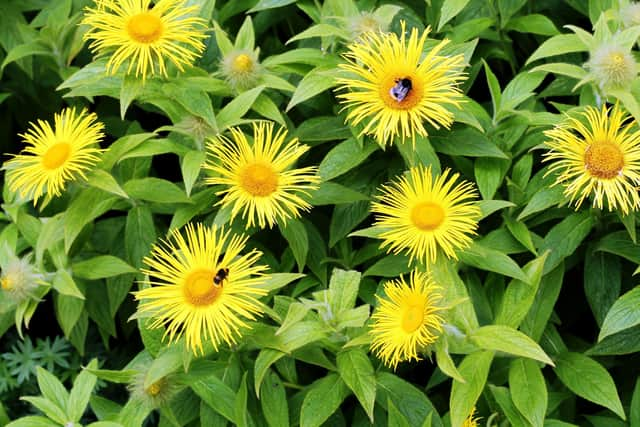
Conversely, the French appear to have little liking for a similarly-striking perennial which would be quite at home in the shadier, cooler parts of France – Inula hookeri. Perhaps it’s because it’s also known as fleabane.
I hookeri will quickly form large clumps of slender stems covered with lance-shaped leaves and topped by clusters of pale-yellow blooms which start to appear in July and continue through till the autumn.
Insects love them – as should any right-thinking gardener. If the plant starts to get too big for its roots, wait until autumn or spring and then lift it, divide it and replant smaller portions.
If fleabane still doesn’t appeal, then there are many more flowering and foliage plants which are bathed in blooms or leaves of yellow and gold perfect for a British summer.
Alchemilla mollis, pot marigolds, chrysanthemums, dahlias, the vibrant Genista lydia, gladioli, hypericum, numerous potentillas, rudbeckia, sedum and, of course, French marigolds all provide a splash of yellow to the garden. Plus, there are plenty of plants whose flowers are tinged with yellow.
And then there are those sunflowers – annuals or perennials such as the stunning Helianthus ‘Lemon Queen’ ideal for an herbaceous border where there is plenty of sunshine and where the soil is fertile and moist. The numerous blooms are smaller than those of the annual varieties, but they are numerous enough to make a big impact in a small space.
Plants with yellow foliage include maples, berberis, the fantastic Choisya ternata ‘Sundance’, plenty of chamaecyparis, ivies, Philadelphus coronarius ‘Aureus’, the much-neglected golden form of the common elder, and a host more.
The vast majority of these flowers and shrubs and trees are readily available, and most are relatively easy to grow. Just give them the growing conditions they prefer, and they should thrive.