
Gardening: It’s a game of love and hate with weeds
Any plant can be considered a weed if it grows where it’s not wanted. From rhododendrons to bluebells, one gardener’s passion is another gardener’s perdition.
So here are three to consider. Would anyone willingly cultivate them or allow them to take up home in the garden? Make up your own minds…
Pilosella officinarum does look a bit like a ragged version of a dandelion, but it’s actually mouse-ear hawkweed.
Its lemon-yellow flowerheads are tinged with red at their outer edges and they appear in their millions from May to October.

Mouse-ear hawkweed is a spreading plant of dry grasslands with short turf and chalky soils, such as those of sand dunes, heaths, clifftops and chalk downlands – and other spots where few other plants are likely to grow.
The photograph was taken at the for former concentration camp of Mauthausen, in Austria. Tens of thousands died there; the tiny blooms of hawkweed are perhaps their memorials.
Looking a bit like a ragged version of its relative, the common dandelion, the lemon-yellow flower-heads of these small plants are, in fact, a composite of lots of tiny blooms.
Insects love them but they are considered an agricultural weed of poor lawns and degraded pastures because they can spread to form dense mats of foliage and flowers which out-compete other plants for moisture and food. They also increase the acidity of the soil.
Nettles
Children hate nettles. So do lots of gardeners.
You can perhaps understand why anyone wearing shorts regard nettles as enemies, but horticulturalists should be able to see the bigger picture and realise that nettles have a lot to offer.
Stinging nettle, or common nettle, Urtica dioica, is a herbaceous perennial which actually likes to be near people – it has a strong association with human habitation and buildings. Nettles sprout on sites of old buildings where high phosphate and nitrogen levels in the soil provide ideal growing conditions.
The leaves and steams of the nettle have small fragile hairs, which are actually capsules full of several liquid chemicals, including formic acid. While touching the leaf, a hair, sharp like a needle, gets into your skin, then breaks down, and liquid gets injected into your skin.
That hurts, but there are many more dangerous and painful plants growing in the average garden. At least nettles have their uses...
Nettle stems contain a fibre, which was used for making ropes, sails and fine linen cloth, suitable even for shirts and bedding.
The leaves of the nettle may be used for producing permanent green dye for woollen stuffs and even for food, while roots boiled with alum produce a yellow colour.
Nettles are high in iron, vitamin C, a source of calcium and magnesium. Regular blood donors recover quicker after adding nettle to their diet. It’s excellent for people who have trouble absorbing nutrition from their food.
Nettles are an important habitat for tortoiseshell butterflies, so by allowing a patch of nettles to grow in the corner of your garden, you could be doing your bit for wildlife.
Nettles make fantastic compost activator and fertiliser. A lidded bucketful of nettles covered in water and left to stew for a week or two produces an all-purpose liquid feed.
So, if you don’t wear shorts, grow nettles. And if you don’t want to grow them, at least look on them in a different light.
Rosebay
It’s not so difficult to imagine that this ‘weed’ was once regarded as a thing of beauty, an elegant addition to the garden.
As a wild flower, it is quite stunning, beloved by several forms of wildlife and was once regarded as a symbol of victory.
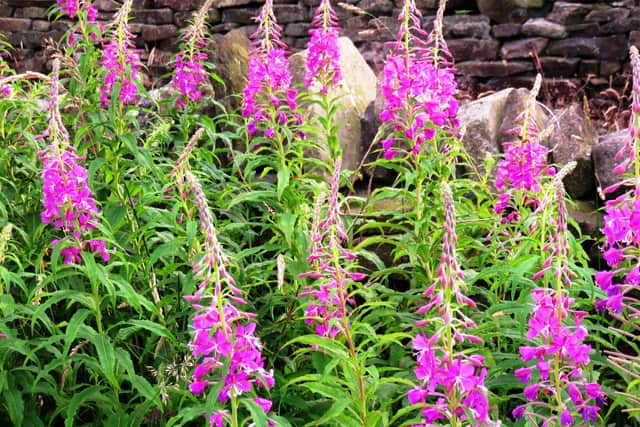
It’s Chamaenerion angustifolium, aka the American fireweed and British rosebay willow herb, a perennial that spreads by seeding and creeping with fleshy white rhizomes.
In flower, it’s one of the most easily identifiable plants in the country. In large clumps it makes a striking and its fluffy seedheads fill the late-summer air like large snowflakes.
It’s gorgeous; it’s also incredibly invasive and, to some people, a pest to be eradicated at all costs.
It was introduced from North America in the 18th and 19th centuries as a garden plant and it soon found that the British climate and terrain suited it admirably. So it escaped the confines of the garden and set about colonising the country.
From June to August, the violet or rose-purple flowers open gradually; then those small seeds covered with white silky hairs are carried away on the slightest breeze; finally, the pointed leaves turn red and yellow in autumn before the top growth dies back.
Rosebay willow herb can grow in both acid and alkaline soils but it doesn’t like waterlogged ground - and yet I have seen it growing more than 1,500ft up on Pennine peat moors.
Rosebay willow herb not only looks good but it also does some good - it is the main food-plant of the Elephant Hawk-moth caterpillar, its nectar is important for, and it was once used as food by native American Indians.
But if you hate it, you hate it. You can tackle it with a suitable weedkiller or cut it back, year on year, before it set sets seed – at least then you get to enjoy the flowers.