
Gardening: Plants that like warmth and humidity
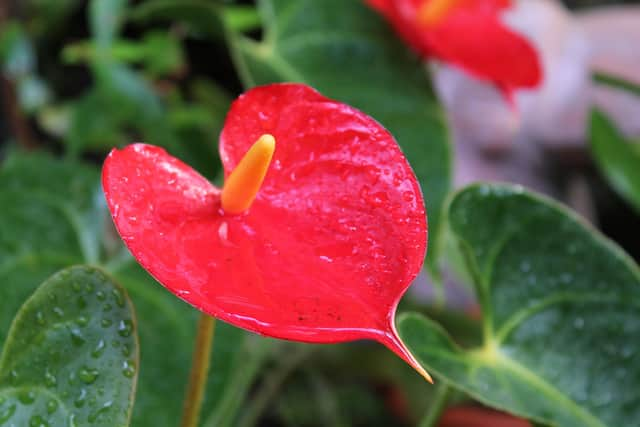
It may look like it’s made of plastic but anthurium is actually a living, breathing plant. In certain countries, where the sun shines and the temperature never falls anywhere near freezing, it is normally grown outdoors; in the UK, it is definitely a houseplant and it is one of the easiest to grow and maintain.
Just follow a few easy-to-remember rules and anthuriums should flower for ever; or that’s the way it seems.
Anthuriums are tropical plants, and appreciate a decent temperature – they grow best in rooms where the air is between 70 and 90 degrees F and has at least 80 percent humidity. Stick it in a bathroom and it should do fine.
They grow best in bright, indirect light, rather than direct sunlight through a double-glazed window. Ensure that the soil is free-draining but still holds some moisture – a mixture of half potting soil and half orchid soil or perlite should be ideal.

Every year or two they will need to be repotted. Watch out for signs your plant has outgrown its current container - roots growing through the drainage holes or circling the surface of the potting mixture and poor leaf colour.
Like the majority of houseplants, over-watering is a killer, so let the soil almost dry out between watering; once a week should be fine.
Anthuriums may need pruning occasionally. Begin by removing any brown or yellow leaves. If they don’t come away easily, you can trim them off with your secateurs.
The best way to remove faded flowers is to snip off their stem at the base of the plant. This keeps the plant from investing its energy in seed production instead of a new flower.
Guzmania
Some plants stand out from the crowd.
Welcome to the world of the Guzmania. a strangely evocative plant which is actually a relative of the pineapple and is one of the stars of the bromleliads found growing wild in places like the Central American countries of Costa Rica and Columbia.
It is also fast becoming one of the more popular of the more exotic-looking houseplants grown in the UK. Its colorful flower bracts can be seen all over the country – which tells you that it’s not all that difficult to care for.
Guzmania lingulata is the biggest seller. It is renowned for its brilliant pink or red flower bracts but it can also be found in shades of yellow and orange. The true flowers are white and keep their heads well below those colorful bracts.
Guzmania lingulata is an ideal indoor or office plant. It can survive in poorly-lit areas although it doesn’t like direct sunlight. Partial-shade, like that found in its normal habitat, is ideal.
Most Guzmania use their roots to attach to a host plant (such as a tree) rather than grow in the ground. Because these roots act primarily as an anchor rather than a source for water and nutrients, they are prone to rot when grown in normal composts.
So it’s important to use a potting medium that’s porous, allowing adequate air circulation and fast drainage. You can buy potting mix specifically designed for bromeliads. Ensure that the mix is dry before adding more water – and, if possible, use rainwater.
Because Guzmania are native to tropical areas, they prefer warmer temperatures and humidity – a minimum of 60 degrees Fahrenheit but not above 80. To maintain humidity, occasionally pop the plant into the bathroom or sit it and its container in a shallow bowl of damp pebbles.
Croton
Crotons are lovely colourful plants; indeed, they are called ‘Joseph’s coat of many colours’, and in this country they have become very popular as container-grown specimens - indoors, of course.
So if you fancy a croton and you feel you really have to grow one or more, then choose your colours - anything from green, variegated, yellow, red, orange, cream, pink and black to a combination of all.
Like many houseplants, caring for a croton involves proper watering and humidity. Because it is a tropical plant, it likes high humidity, so pop its container on a tray of damp pebbles and mist the foliage regularly with warmish water (but not chlorinated tap water).
Crotons should be watered only when the top of the soil is dry to the touch. Then give them a good soak. Don’t allow the soil to remain very wet or you’ll be encouraging all sorts of nasty and damaging infections. Reduce watering in winter.
Give them a liquid feed every two weeks or so when they are growing strongly and they should be more than happy.
Keep plants out of cold draughts, and make sure the air temperature never falls below 60degF or your croton(s) will start to shed leaves.
As for light…the more variegated the variety of croton, the more light it needs to keep its foliage in fine fettle. A bit of direct sunlight will be appreciated. In winter, make sure the plants get as much light as possible.
And remember that these are tender perennials, which hate changes in temperature – they respond by shedding leaves. If in doubt, keep your cool rather than turning up the thermostat.