
Gardening: Seeing red to attract the pollinators
So many plants are trying to attract the attention of pollinating insects that they have to stand out from the crowd – so they go red. Roses are renowned for it, as are salvias, but there are many, many more setting the garden on fire with their vibrant blooms and heady fragrances.
Ornamental poppies, those wonderfully over-the-top stars of the early herbaceous border, burst forth in June and July, with their mountains of ferny foliage topped by dazzlingly red flowers.
The flower stems are strong and tall, up to four feet in height, and each supports a single orange-red flower filled with a black hole packed with purple pollen.
And as fast as the flowers come, they disappear. At best, each lasts a few days; at worst – and when wind and rain enter the frame – perhaps only hours. But an established clump of ornamental poppies can produce dozens of flowers over just a few weeks.
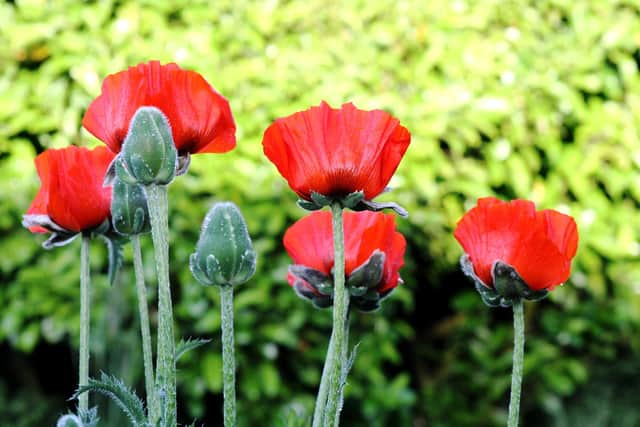

Oriental poppies love the sun and although they will tolerate most conditions, they will not thrive in sodden soils - decent drainage is essential.
But poppies don’t have it all their own way. Bergamot, also known as bee balm, produces vivid red, spidery-shaped flowers. It’s ideal for a border where, in a moist but well-drained soil, it can spread rapidly. If it starts to get out of hand, lift clumps and divide them in spring.
Dahlias are one of the great joys of the late-summer garden and those with red blooms are a joy to behold and, as an added extra, their foliage can be equally striking.
Then there is Crocosmia ‘Lucifer’, a devilishly attractive flower. In a sunny spot it will go from strength to strength, first producing long, lance-like leaves, and then decorating them with these butterfly flowers of the most startling red. The plant likes a well-drained, humus-rich soil in a sheltered sunny spot.
And, of course, there are the peaonies.
Paeony
Early summer is a time of riches in the garden; Nature is hell-bent on filling every space with colour, form and fragrance. And she obviously has a soft spot for one flower in particular - the paeony.
Which is hardly surprising when you see one in its prime – big, beautiful, richly-coloured blooms which stand out from the crowd of run-of-the-mill herbaceous plants.
So looking ahead to autumn, perhaps it’s worth considering planting one or more members of what can only be described as a spectacular family of plants.
While any rich, well-drained soil is acceptable, paeonies need plenty of sun and some protection from wind and rain. A few days of a normal English summer will see their delicate blooms battered and blown apart.
But given the right conditions, paeonies will make the most of them – in June and July their magnificent flowers, in an amazing array of colours, put all else to shame.
Planting requires a bit of preparation. Dig a deep hole when the soil is warm and damp, and mix in bonemeal and well-rotted manure. Place you paeony – bare-rooted specimens are preferable to those sold in containers (you can see just what you’re getting) – so that the buds on the plant are just a couple of inches below the soil. Water well and apply a much or organic matter.
Once planted, leave well alone. Paeonies are long-lived aristocrats of the herbaceous border and once they are position and growing happily, they hate to be disturbed.
Mulch heavily again in spring, water well in dry periods, stake the stems if they look likely to topple over, deadhead to encourage more blooms and, come autumn, cut down the whole plant to soil level.
Salvias
Salvias in virtually all their forms are plants worthy of growing and capable of providing weeks, if not months, of colour. And they are easy to cultivate, so there is really no reason not to grow at least one or two varieties.
The annual salvias have always been popular – particularly S splendens, the scarlet sage, renowned for its vibrant red growth and much used to dominate architecturally-designed bedding schemes – but it is the herbaceous perennials which are now coming more into fashion.
Normally, the blooms of most appear in late June and continue through to late August, although some varieties begin to flower in May. Container-grown specimens can also be persuaded to bloom before those planted in beds and borders.
Well-drained soils suit them best, but what helps them thrive is sunshine – so pick the sunniest spot for the best blooms.
To prolong flowering, remove the flower spikes as soon they start to fade. Apply a generous 5-7cm (2-3in) mulch of well-rotted garden compost or manure around the base of the plant in spring, which is also a good time to lift and divide established clumps (although some gardeners prefer to do the deed in autumn).
To propagate, take shoot tips (three inches long), stripped of their lower leaves and push them into pots of sandy compost in August. Pot up the youngsters once they are well rooted and overwinter them in a cool greenhouse or frost-free room.
It pays to mulch or lift - like dahlias - half-hardy varieties known to be susceptible to frost damage.