
Gardening: The best flowers to be planted in a container for a spectacular show
Some plants can be overwhelmed in a flowering border but can come into their own when planted in a container. David Overend selects the best.
Some shrubs were never meant to fight their corner in traditional beds and borders, but they have become the stars of the container world where they can have their own space.
Then there is the added advantage that comes with being able to move containers (or most of them) to provide more sun or shelter throughout the year.
Take, for example, the tiny Japanese maple, Acer palmatum ‘Corralinum’, a midget gem grown for its young spring foliage – coral-pink. It’s happy in a container where it can grow slowly to eventually reach an impressive 30ins in height and much less in spread.

The evergreen Daphne tangutica is a domed shrub whose fragrant flowers are one of the joys of the late spring garden. It also produces bright red berries and should, eventually, become a seasoned veteran measuring probably two feet in height and the same in width.
And for something very red, what about Potentilla ‘Gibson’s Scarlet’? It grows quickly to form a clump of foliage sprouting tiny, vivid red flowers. It doesn’t reach much of a height, so it’s fine for a rockery, although it prefers poorer soil than many other summer bloomers.
It loves the sun and, like the majority of cinquefoils, is easy to propagate from cuttings. To get the best results, cut back the foliage in late autumn.
And plenty of hardy fuchsias are more than happy to grow in containers, as are some abutilons and hydrangeas.
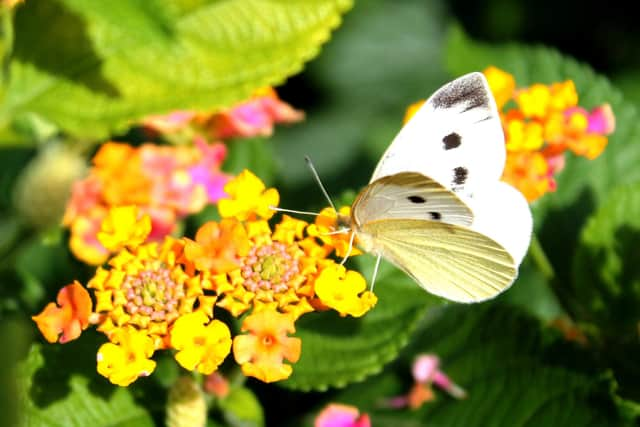
Then there is the stunning Lantana camara, which is a common sight in warm countries where it is usually grown as a floriferous hedge in the sun and a fertile but well-drained soil.
It comes is various colours – from orange through to pure white – and is usually left to do its own thing. In containers, it brings a touch of the Mediterranean to patios and is much-loved by butterflies.
Both pieris and skimmias make great pot plants and some camellias are equally happy in a container as they are in the open woodland garden.
So, think small(er) and have a spectacular show.
Hydrangea
Hydrangeas were a familiar flower in Victorian times but they lost their way in the 20th century.
Thankfully, things seem to have turned full circle, and hydrangeas are now selling in their hundreds of thousands, but this time more as container plants than permanent border fixtures.
Most people can recognise a hydrangea; well, the mopheads (Hortensias) at least. They are the most commonly seen, with their great, round flowerheads which normally start to appear in June or July.
They are very British – you can grow them in white, red or blue, but the colour depends on the acidity or alkalinity of the soil; acid gives red, alkaline gives blue.
Fewer people will recognise the lacecaps with their flat central flowers surrounded by a ring of larger blooms.
And as for the daddy of them all, H paniculata ‘Grandiflora’, well, it’s more like a shrub topped with flowery ice-cream cones – a stunning shrub for the late summer garden.
Hydrangeas like a fertile soil which is well-drained but moisture-retentive and although they aren’t averse to full sun, they do appreciate a bit of shade. Work in plenty of organic matter into the soil prior to planting, and after planting and in subsequent years, apply plenty of organic matter as a mulch.
The big blooms of the mopheads are ideal for flower-arranging, but it’s best to leave their dried carcases on the shrub until spring – cut them off in the autumn and they won’t be around to protect the shrub from potentially damaging frosts.
Azaleas
For vibrant colours, think azaleas. Brilliant whites, pinks, purples and reds – azaleas can bring them all to the garden.
From late autumn to late summer a huge range of different species and varieties are in flower, but for big bursts of blooms, the choice is greatest in spring.
Azaleas are a subset of the rhododendrons, regarded by many to be one of the most important plant families. They are a category of smaller-leaved, generally smaller and more ‘twiggy’ shrubs.
Acid soil is a must with nearly all of these shrubs, but if you lack this, containers and raised beds can work just as well in providing the necessary conditions. Ideal soils are moist, humus-rich and acidic, with good drainage.
All azaleas are surface-rooting, which means that when planted, soil should just cover the root ball. A bonus of this is that it’s quite straightforward to move them, should you need to.
Maintenance is limited and easy. Cut off dead flowers and stalks soon after flowering, as this will stimulate new growth. Otherwise, prune lightly to maintain the desired shape
As to the choice of species or variety, this depends on the look you wish to create, and what will work best in your garden, plus the space available, hence the rise in the popularity of dwarf azaleas.
My favourite has to be R luteum, a bushy deciduous shrub which, unfortunately, can’t really be described as dwarf. It can reach 4m in height, with leaves turning orange, purple and red in autumn.
But the flowers.... bright yellow, funnel-shaped blooms which make late spring an early summer a feast of colour and fragrance. Not for nothing is it known as the honeysuckle azalea.