
Gardening: The bold plants that are standing tall
Big isn’t necessarily beautiful, but if the cap fits… Thus it is with delphiniums, big and very beautiful. In July and August, the delphinium should be one of the marvels of the border; a giant of a flower capable of putting to shame all other flowers. That's why it’s best to grow it unopposed, in large, bold clumps or in splendid isolation against a wall or fence.
But the weather can be brutal, and the poor delphinium can take a battering. It may still look lovely, but it’s just a shadow of what it could be if the sun shone.
Despite all this, there are still gardeners who are prepared to soldier on with delphiniums. They know that whatever the weather, there will always be some blooms holding their heads high.
These are people who have learned to grow delphiniums successfully. They know delphiniums are greedy – these are plants which demand a rich soil and copious amounts of food, preferably liquid manure.
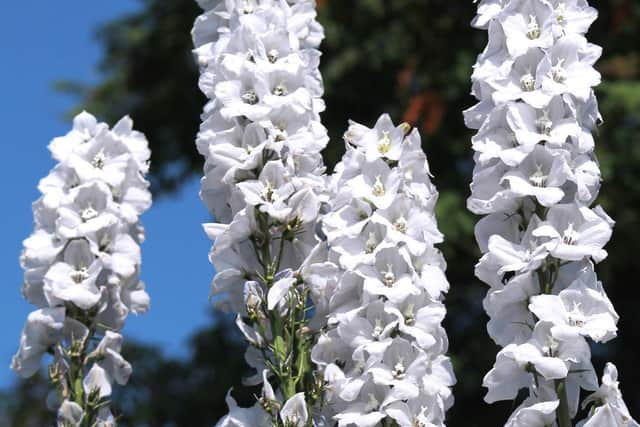

And in the unlikely event of a drought, they'll also require regular heavy watering. In addition, to keep them standing proud, they need staking and, if possible, a sunny, sheltered site.
Once the gardener has worked this out, he or she is well on the way to growing one of the loveliest and most stunning of all border flowers. They will feed regularly, dead-head to encourage a second, more restrained, flowering in September and finally cut them down to the ground and cover them with a thick mulch of old, well-rotted manure.
Foxglove
Thank goodness most plants know how to behave responsibly. Even though many seed freely and can become pests, others (in particular, the humble foxglove) flock together to form startlingly eye-catching groups.
We should look upon them as a free gift, and if they are in the wrong place, move them; they don’t mind being transferred to a more suitable site, just as long as they get the right growing conditions and are watered well to help them re-establish.
Just about everyone loves (or at least recognises) foxgloves which, last year, grew in abundance and which, this year, appear to be growing in even greater numbers.
A decrease in the use of herbicides in recent years has encouraged the return of many wild flowers, and Digitalis purpurea has taken its chance.
The foxglove is a wild and wonderful bloomer with an ability to find a home in the smallest space, and then to shoot upwards several feet to display its magnificent flower spike.
It loves shady spots, deciduous woodland areas and clearings in conifer forests, but it can grow in a crack in a wall, and its flowers – not always purple, despite the name – are now a common sight on many roadsides.
Bees love the foxglove’s pollen; in fact, bees are far and away the major pollinators of the plant whose shape provides the ideal landing-platform for the insect.
It has been calculated that just a single foxglove can produce more than one million seeds – which is another reason why the plant is so successful.
In spring, if a seedling or two appear in your garden but are, unfortunately, in the wrong spot, just lift them - with as much soil as possible around the root – and replant them in a semi-shady spot where the soil is rich in leafmould; heel them in, water well and wait for them to bloom in the summer.
A year later and they should be growing in greater numbers – close together, of course.
Hollyhock
Continuing the theme of tall and stately - If you really want to grow a hollyhock, there’s not a lot to stop you.
Well into August this impressive plant produces blooms in a variety of rich and delicate colours, from the deepest crimsons and maroons, to blush pinks, whites and pale yellows, all borne in a long succession on tall stems 1-3 metres high.
Most hollyhocks are technically biennials - producing leaves the first year and flowers the next. However, they often last longer than two years and so can be described as short-lived perennials.
Hollyhocks are old cottage garden favourites and seem especially at home in corners and narrow flower borders near walls where they are protected in the winter from the wet. They are very drought resistant.
As hollyhocks grow tall and are often exposed to the full force of the wind, it pays to provide strong stakes as support.
Hollyhocks love a deep, rich, loamy soil - but they will often thrive without it.
If you water hollyhocks during the summer months give them a thorough soaking, followed by a mulch of well-rotted manure.
There is a long succession of flowers, and as the lower blooms fade they should be picked. And when flowering is over for the season, the plants can be cut down to about 15-20.
If taken care of in this way, hollyhock plants will often last for several years but may people choose to treat them as biennials and propagate favourites by taking cuttings from the base of a plant during September and October. This is the best way to beat the dreaded ‘rust’, a fungal disease of the foliage, spread by airborne spores.