
Gardening: Three climbers that would be perfect for your garden - including one at the height of fashion
David Overend suggests three climbers that would be perfect for the garden and, once established, they do the hard work… with a bit of pruning.
Wisteria, a shrub instantly recognisable and a ‘love-it-anywhere’ plant.
The hanging bunches of pea-like flowers bring a feeling of affluence and style wherever you find them – as with all the best plants, they are always in fashion.
Climbers like wisteria are a possibility for every garden – they’re incredibly economical on space.
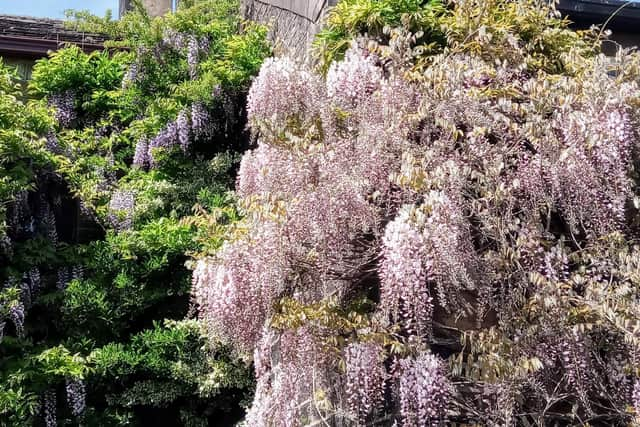

And when it comes to climbers, wisteria is an especially good choice because it’s tough and easy to look after, as well as putting on a breathtakingly beautiful display once it’s established.
It also provides attractive features beyond simply the blooms. The foliage of some wisteria, for example, turns a lovely yellow in autumn.
Wisteria x floribunda (Japanese wisteria) is one of the best choices for flowers now. It’s a vigorous, twining climber that produces racemes (long, hanging clusters) of violet blue flowers in spring and early summer.
The foliage is refined and attractive, too, with numerous leaflets producing an almost feathery appearance.
Wisteria sinensis (Chinese wisteria) is often the one you see growing around older houses and gardens.
Wisteria is generally hardy and quite fast growing. It’s happiest in fertile, moist, well-drained soil, but will tolerate poorer soils. Full sun or partial shade is equally suitable.
But be warned, to keep a wisteria flowering well requires regular pruning. Neglect it and it’s likely that, year on year, there will be fewer blooms, and the tangle of branches will bamboozle even those proficient in unravelling a Rubik’s Cube.
For the best results, wisteria should be pruned twice a year - once in late winter (February) to prepare the flowering spurs for the forthcoming season, and again in mid-summer (July to August).
Hydrangea
Most people can recognise a hydrangea; well, the mopheads at least. They are the most commonly seen, with their great, round flowerheads which usually start to appear in June and which continue well into September.
They are very British – you can grow them in white, red or blue, but the colour depends on the acidity or alkalinity of the soil; acid gives red, alkaline gives blue.
The big blooms are ideal for flower-arranging, but it’s best to leave their dried carcases on the shrub until spring – cut them off in the autumn and they won’t be around to protect the shrub from potentially damaging frosts.
Fewer people will recognise the lacecaps with their flat central flowers surrounded by a ring of larger blooms. They are a bit tougher and can be pruned after the flowers have faded.
And then we have the climbing hydrangea, H petiolaris, which has always had a place in the hearts of British gardeners. It’s easy to see why – first of all, it’s easy to grow, dependable and it doesn’t mind how you prune it because it will grow back in no time at all.
A great advantage when growing H petiolaris is that it needs virtually no attention. It’s self-clinging with aerial roots, the flowers are a creamy white and it’s deciduous.
It will tolerate semi-shade and suitable for a north-facing wall and it will grow just about anywhere as long as the soil isn’t waterlogged.
The drawback is that this is a very vigorous plant – leave it alone and it will soon grow higher than a house, so it does pay to trim it back in late summer. At any other time of the year you risk losing the following season’s flowers.
On the whole, all hydrangeas like a fertile soil which is well-drained but moisture-retentive. Work in plenty of organic matter into the soil prior to planting; after planting and in subsequent years apply plenty of organic matter.
Hop
It’s strange how certain words conjure up certain things. Like hops, long associated with brewing and beer but nowadays rarely seen in the garden.
Humulus lupus has stems which cling, tendrils which do seem to have a mind of their own, and an ability to attract detritus. Dirt, dust, dead insects, leaves and much, much more are accumulated within its leafy growth
A vibrant hop (particularly the golden form) is a sight to behold in late spring and early summer when it starts to throw out fresh, young growth. And then there are the hops themselves – like little wrinkled berries. And there’s the hoppy aroma.
All in all, a splendid plant, but not one to be planted lightly. It needs mastering, although it can be allowed to ramble to cover unsightly walls or, better still, constrained and supported to grow into living columns of vivid yellow foliage.
It’s ideal for growing up trellis or over an arch in a sheltered position. It will tolerate partial shade but a sunny place will produce the best leaf colour so long as the soil does not dry out.
Humulus lupus isn’t the first plant which springs to mind when a climber is being considered. The Virginia Creeper, Parthenocissus, was also once a very popular choice for covering walls and hiding eyesores.
It loves a fertile, free-draining soil where it can get a good grip with its roots. It doesn’t need any support to help it climb, but like the hop, it’s deciduous and will lose its leaves in autumn.
Don’t confuse Virginia Creeper with the ornamental vine, Vitis, which definitely does need support to climb.