
Gardening: Time to fill dining table for the birds
To call Clematis tangutica a climber is a bit like describing a Rolls Royce as just a car because although C tangutica is not one of the big-bloomed varieties packed with colour, it’s just as stunning.
Some plants are grown because they have that little something special; thus it is that tangutica has become a popular addition to many a garden.
It’s a late-flowering clematis that produces large numbers of bell-like, yellow flowers and the lots of lovely silky seed-heads which last well into winter.
It will scramble over the soil but it’s best grown up a trellis or through a shrub or tree. It prefers a well-drained soil and plenty of sun with its roots somewhere cool (pop a couple of roof slates over them).
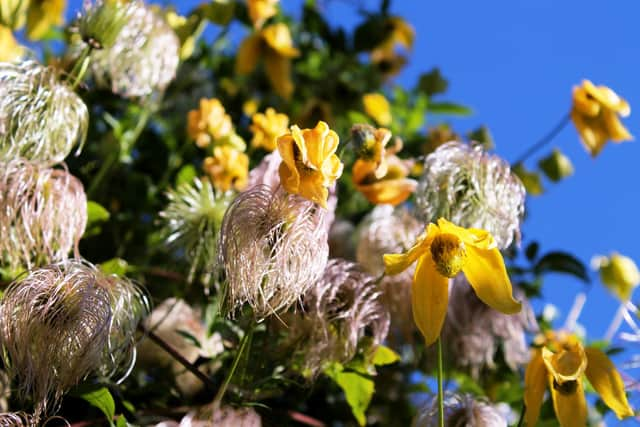

To see it at its best, prune it hard back in spring, leaving just seven or eight inches of growth above ground.
Another equally attractive late-flowering clematis is the variety rehderiana, rarely seen but instantly recognisable. From mid-summer until late autumn it produces clusters of small, primrose-yellow flowers that have a scent reminiscent of cowslips.
Just like C tangutica, it wants a rich, moist but well-drained soil where its roots can remain cool but where its blooms can thrive in the sun. It also needs supporting – it looks stunning when allowed to ramble over a pergola or weave its way through a tree’s branches.
Again, to encourage it to grow and flower, cut it back hard in spring and trim shoots to a pair or healthy buds.
Berries xxxxxxx
Berries are more than just seed containers – they are potential life-savers when winter approaches.
So that’s why gardeners should be more than happy that many colourful shrubs and trees are going to be come nothing more than food for the birds.
Rowans? Waxwings, redwings, fieldfares and even flocks of starlings go crazy for certain fruits.
Common hawthorn has lots of bountiful berries; blackbirds just can’t seem to get enough of cotoneasters; the fruit of the mountain ash tempt anything from starlings to crows, although the latter tend to be a bit ungainly in their attempts to reach the fruit.
Yew, while poisonous to many animals, doesn’t seem to worry birds, and even ivy (when it’s mature and sets fruit) and holly are known to provide a nutritional meal.
Plants don’t produce berries for fun – they produce them to propagate their species, and they rely heavily on birds to help. Birds eat the berries which contain seeds; the seeds pass through the birds and are dispensed around the countryside. So, the plants, the birds and the countryside all benefit. And, of course, so do we.
Which is why gardeners should grow at least a couple of fruiting shrubs or trees to provide a valuable food source for wildlife, shelter for birds and insects – and interest in the garden at what is normally the darkest and dullest time of the year.
And if there’s room, how about that mixed hedge? It won’t be a pruned and arrow-straight barrier, but it will be an inviting and calorific place for birds, small mammals and insects.
Consider blackthorn, that viburnum, honeysuckle, spindle, wild rose with its attendant hips, a small mountain ash and hawthorn and elder with one or two hollies thrown in.
If it’s a really impenetrable barrier that’s needed, add firethorn (Pyracantha) – the thorns are vicious while the berries are brilliantly coloured and a welcome addition to the birds’ winter menu.
Viburnum xxxxxx
Viburnum opulus, seen occasionally in gardens where it more often than not forms part of a mixed hedge, was a lot more common, grown for beautiful, globular white flowers and waxy, red berries which look a bit like red currants.
The plant’s leaves resemble those of a maple, but there the similarity ends. But that’s one of the reasons many people are puzzled by the plant – they can’t identify it.
And yet it’s a very accommodating shrub; it will tolerate most soil types that at one time it was a bit of a fall-back for sites where a lot of shrubs fail to flourish. A sort of fill-the-gap fall-back, a bit-part actor but never the star.
Yet give it a well-cultivated soil rich in humus, and it will put on a first-rate show before it finally sheds its leaves and becomes nothing more than a pile of brown twigs.
The acidic fruit is edible in small quantities, but it can be used to make jelly. It is, however, mildly toxic – so perhaps that’s why birds leave it alone unless there is absolutely nothing else on the dining table.
Viburnum opulus has a multitude of names, including Water Elder, European Cranberrybush, Cramp Bark (for its medicinal qualities), Snowball Tree and Guelder Rose. The latter appears to have originated because a popular cultivar originated in the Dutch province of Gelderland.
It can get a bit twiggy, and if left unpruned will spread to become a healthy 10 foot tall and equally as wide, and it can throw out more growth via lengthy underground roots, so it pays to keep it in shape by cutting it back after it’s flowered. Then, of course, you forfeit the berries for that year – although the birds probably won’t mind.