
How roadside Tactile Ground Surface Indicators help blind and partially-sighted people - Robin and Patricia Silver
Have you ever wondered what the name of the paving at junctions with flat topped raised domes or “blisters” is called? Well, it is rather grandly called “Tactile Ground Surface Indicators” or TGSIs for short.
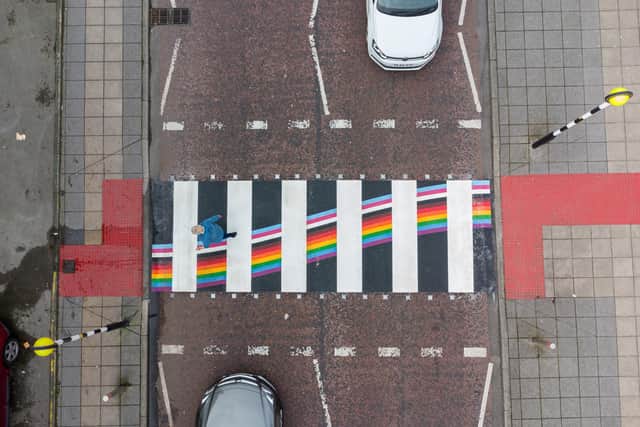
They were first invented in Japan in 1965 and called “Tenji” blocks, inspired by braille and began to be introduced there in 1967. They simply indicate to blind and partially sighted people that a safe footpath is ending or there is an imminent hazard ahead and are generally accompanied with a dropped kerb. They’ve also been proven to be immensely useful to people who walk about with their eyes firmly focused on their mobile phones, oblivious to all that is going on around them. Oddly, colour variations are used and those at a controlled crossing (traffic lights or zebra crossings) are red whilst those at a corner junction are yellow or buff coloured.
Variations can be commonly seen on railway platforms but the pattern is usually different featuring longer raised parallel strips. In Italy, a new version has been introduced with a radio ground frequency that is emitted and picked up by an electronic walking stick or baton.
Many countries have followed suit, often with rigid and complex rules, but not without controversy. Objections have been received from mobility scooter users, those with prams, buggies or other trolleys and, most commonly, the result of poor installation which can lead to more dangerous trip hazards. Whilst these features are of enormous help to the blind and partially sighted, it is surprising that, in contrast, there aren’t more rigorous regulations for something as simple as the common place banister or handrail which must be fitted to any staircase at home.

Back in 1951, when London’s Royal Festival Hall was built, this was addressed and a simple solution found. The banisters to all staircases were made of wood and fitted with a routed out groove in the middle of the top for the section of banister that was angled to match the stairs. When a hand was put on the banister, the groove could be easily felt and alerted everyone that there are stairs being encountered. As a landing or floor was approached, there is no groove at all so that people know that they are on a level floor. Really quite simple but effective.
Different material, texture and colour of floor covering also indicate that you are entering a staircase and where each step ends. This is of course of more help to the sighted. This has become an almost universal requirement in public buildings but not at all in our homes.
The Royal Society for the Prevention of Accidents (RoSPA) has reported that more accidents happen at home than anywhere else and accidents on the stairs at home are one of the most common places. Age UK has estimated that the cost to the NHS of accidents at home on stairs runs into billions so a straight forward aid like a groove in a banister could be beneficial to many, not only the blind or partially sighted. Simply taking more care and having a solid hand rail are absolute “musts.” An easy start!
Since 1951, there have been rafts of legislation and building regulations introduced to which handrails must conform. Examples are that stairs over one metre wide must have two handrails which must be easy to grasp and they must have a gap of at least 50mm between the handrail and the wall so that the knuckles don’t get squashed. However, it does appear that the simplicity of the design of the groove has not been commonly replicated over the past 75 years. Maybe now’s the time to “get into the groove!”