
Inside Sheffield’s landmark Park Hill as 20-year regeneration nears its final phase
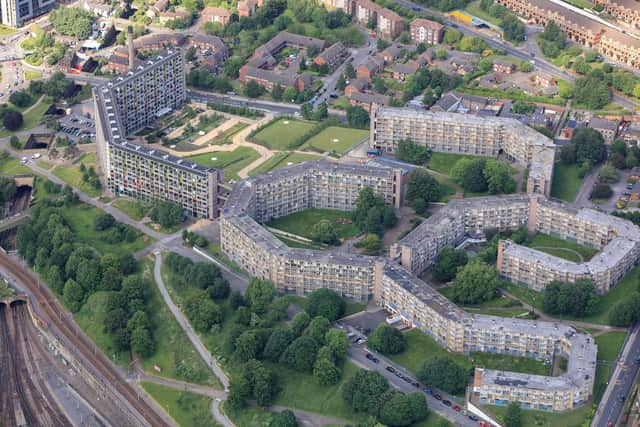
From the hillside above Sheffield, Park Hill’s vast concrete terraces tell the story of a neighbourhood that came close to disappearing.

Now, more than 20 years after its rescue, the final stages of its regeneration are under way.
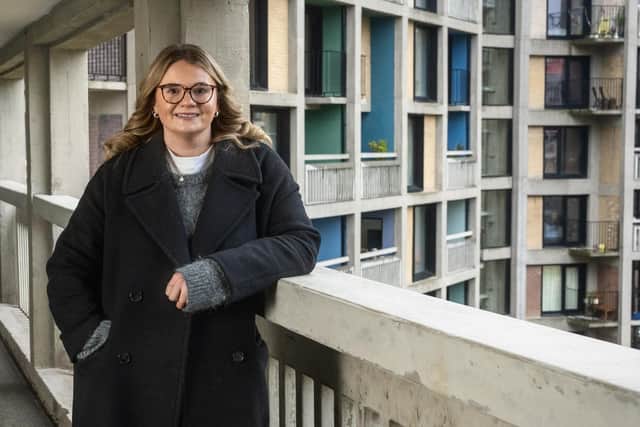
When I visit one bright autumn morning, the Brutalist building’s coloured panels catch the sunlight and the views stretch out across the city.
Residents are heading out of their flats along the walkways, offices are stirring into life and South Street Kitchen is serving its morning coffee crowd.

But walk a bit further and the scene changes. Behind hoardings, people in hard hats are stripping apartments back to their concrete frames, old walls are being demolished and new windows are being fitted.
This is Park Hill as it exists today: part finished neighbourhood, part building site.
Developer Urban Splash is currently overseeing phase four out of five, which involves creating 125 duplex apartments, including 30 affordable homes, with prices from £187,500. The first of the homes are due to be handed over in autumn 2027.
Originally constructed between 1957 and 1961 as part of Sheffield’s slum clearance programme, Park Hill Flats was designed by council architects Ivor Smith and Jack Lynn as a radical new form of housing.
Its famous “streets in the sky” were intended to recreate the communal streets of the back-to-back housing that had occupied the site, while the flats themselves were designed to make the most of sunlight and views.
At its peak, the building contained more than 1,000 homes, five pubs, shops and a nursery. But the loss of jobs in Sheffield’s coal and steel industries contributed to its decline, with occupancy falling and antisocial behaviour becoming a problem.
By the 1990s, demolition was being proposed. Instead, local opposition helped save the building and it was Grade II-listed by English Heritage in 1998.
In 2004, Manchester-based developer Urban Splash bought the complex from Sheffield City Council for £1 and its plans to transform Park Hill were approved in 2006.
The project has stretched over two decades, with the financial crisis delaying the first phase and the Covid pandemic affecting the second.
The joint venture between Urban Splash and Places for People has so far invested £100m in the regeneration, with phase four also part-funded by Homes England and the South Yorkshire Mayoral Combined Authority.
“It was always going to be a long-term project,” says Sian Stanhope, development manager at Urban Splash. “We’re super excited to be on with the fourth phase.”
Phase one saw the building of 260 homes and 30,000 sq ft of commercial space, while phase two added 195 homes and 20,000 sq ft of workspace, retail and leisure space. Both were designed to retain Park Hill’s distinctive character and were shortlisted for the Stirling Prize - phase one in 2013 and phase two in 2024.
Phase three brought 356 student beds to the scheme.
The construction team, which started on the current phase in January this year, is dealing with demolition, asbestos, concrete repairs, old services and the challenge of retaining the original fabric while bringing it up to modern standards.
Some of the original brickwork is being retained, while concrete balustrades that had deteriorated beyond repair are being replicated.
During the demolition, the team uncovered an old police station and cell. “When I opened that up, I found a desk and the toilet cubicle still had a toilet roll in there,” says GMI Construction’s senior facade manager Darran McDonald. “It looked like somebody had just walked out one day and locked the door.”
While the police station is due to become a hidden plant room, other traces of Park Hill’s past are more visible. The original connecting streets have been retained. When they were first built, they were wide enough for milk trucks to drive along and make their deliveries across the estate.
Darran remembers travelling past Park Hill on a bus in the early 1980s and seeing building repairs being carried out. “Now I get to work on it,” he says proudly.
That sense of continuity matters to those behind the regeneration. Urban Splash is keen to rebuild the community that once existed here.
There are now residents’ gardening groups, litter-picking activities, arts events and a summer party. The development has attracted families, downsizers, students and older residents. There is also a strong creative community alongside cafés, a pub, shops, offices and other businesses.
When Phase four launched for sale recently, 10 homes were reserved on the first day. One buyer was so determined to secure a particular apartment that she arrived at 11pm the night before and camped out.
The final piece, phase five, has planning permission for 105 homes, alongside commercial space, landscaping and parking.
Funding still needs to be assembled, but Sian says the ambition is to move straight on from phase four. “We’re keen to push on with that as soon as we’re able to,” she says.