
Inside the rise of shed culture - and why we all crave a space to escape
PERHAPS now more than ever we need a place to escape the turbulence of today’s world. My late grandmother used to say “there’s allas summat”, although after hitting 60 she stopped watching and reading the news and refused to have any kind of discussion on it.
Well that’s one way of getting away from it all. Another is to have an escape, and where better than a shed of one’s own? As a devoted sheddie myself I know what these buildings can bring, whether you have a basic wooden, borderline decrepit shack like mine, or a fancy bespoke structure.
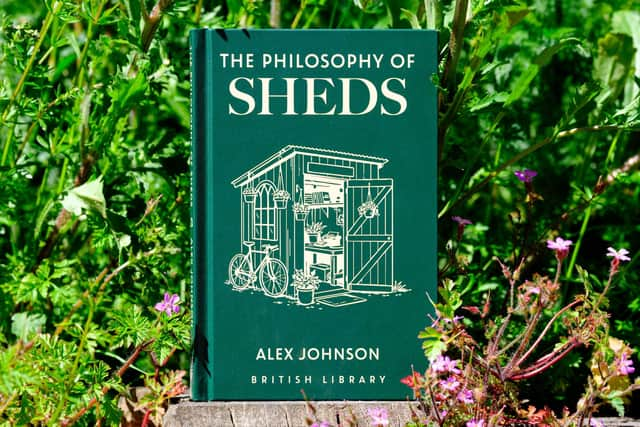
For shed devotees and the curious uninitiated there is a wonderful new book out, called The Philosophy of Sheds, which was commissioned and is published by the British Library as part of its Philosophy of … series.
It was written by former Yorkshire Evening Press journalist Alex Johnson. He is now a freelance writer and author who has been a devotee of shed working for decades. His wooden workspace, aka The Writing Hut, was built in his garden in 2003 and led to his first book on the subject in 2010. “Shedworking – the workplace revolution” led to him establishing the website shedworking.co.uk – a lifestyle guide for shed workers and other sheddies.
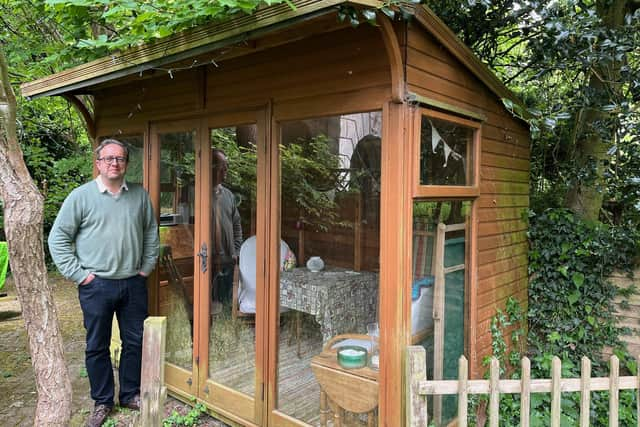

The website remains a great resource and reminds us that “sheds” now have many different guises, including chalets, pods and the now ubiquitous shepherds’ huts and and many can be squeezed into the smallest of spaces.
“They protect our garden tools, provide priceless workspaces and inspire philosophers. From the allotments of Birmingham to the mountainsides of Norwegian fjords, sheds are not just buildings, they are a way of life,” says Alex.
Playwright George Bernard Shaw is known to have written many of his major works in his own writing hut located at the bottom of his garden, inset.
Alex adds: “They come in all shapes and sizes and they are used for all sorts of things, including as a base for a small business. I’ve seen them used for pole dancing classes, chocolate making and crafting among many, many other things.”
The smallest shed he has ever seen was tall and very slim on a tiny balcony of a flat, where its svelte owner huddled in and tapped away on her keyboard. “I couldn’t quite believe it,” says Alex, who adds that wood sheds remain most popular because this natural material adds a layer of calm to a space.
A more recent phenomenon is indoor sheds, which live in your home. They range from small wooden pods to full-blown wooden office sheds.
If you are wondering what philosophy has to do with sheds I have checked that the two marry up and they absolutely do as philosophy is “the systematic study of fundamental questions regarding existence, among other things”.
The existence of sheds began way back when, says Alex who adds. “Humans around the world have been attracted to microarchitecture for hundreds of years. Pavilions in China date back to at least the Zhou dynasty (1046-256 BC), as do garden structures built by the ancient Egyptians to provide shade, and it’s tempting to speculate that ancient Greek philosophers such as Plato and Epicurus had some kind of shed-like structure in the gardens where they held court with their followers.

“Timber Japanese tea houses known as ‘chashitsu’ became popular rustic structures in which Zen monks relaxed in the Sengoku period from the late 15th to mid-16th centuries, around the same time that summerhouses began to be built in England.
“It’s around this time that early forms of the word ‘shed’ appear in England, although the word’s origin is not entirely clear. Take your pick from Old English and Middle English words such as ‘scheden’ and ‘sceadan’ meaning separation, ‘scydd’ signifying shelter, and ‘shadde’ indicating shade.
“Whatever its source, the concept of protection from the elements is clear. Variations of the alternative term ‘hut’ are found all over Europe in the same period, with the old Ukrainian equivalent ‘khata’ interestingly also indicating a connotation of private space as much as a simple physical structure.”
Alex has concluded that for many people the archetypal shed is American writer E. B. White’s small and simple timber shack in Maine, New England. “Its window offered a beautiful view out to sea, but inside it was furnished only with a modest chair, bench and self-built desk, an old barrel serving as a waste basket and an old croquet set box functioning as a cupboard. There was no decoration. Tight and plainly finished was how White termed it. It was here that he drafted his masterpiece Charlotte’s Web on his black Underwood typewriter.”
If you are tempted to buy a shed/garden building then you must do your homework before committing. This is an industry that has boomed in recent years and with it have come the inevitable grifters and chancers waiting to rip you off.
You can buy The Philosophy of Sheds from bookshops or from the British Library online shop shop.bl.uk.
For more shed inspiration, visit readersheds.co.uk, which gave birth to the Shed of the Year competition. Property Post will be highlighting some of its fabulous 2026 entries, so watch this space.