
Meet the man making stunning staircases for the last 30 years
It’s perhaps easy to take staircases for granted. After all, their role is a functional one – to get us from one floor to another. And yet a staircase can also be an architectural wonder and even a tourist attraction. Think of the Spanish Steps in Rome, the sweeping Tulip Stairs at the Queen’s House in Greenwich, or the famous red staircase in Porto’s Livaria Lello bookstore.
At its best, a staircase can be akin to a work of art and from its base just outside Helmsley, Bisca has established a reputation over the past 30 years as one of the world’s leading staircase designers and makers.
The business is the brainchild of Yorkshireman Richard McLane who set up the company in 1994 so he could, as he puts it, “design and make beautiful things.” Richard, a time-served blacksmith, started out as a one-man band doing design drawings on a sketchpad. Today, Bisca’s HQ includes a design studio, a traditional forge, as well as manufacturing and assembly areas. The company employs more than 20 people, including eight designers, and has worked on major projects all over the world from Sweden to Dubai.
Each staircase is individually designed and built entirely in the company’s own workshop and examples of their work can now be found in private houses, renovated barns and top-class hotels.
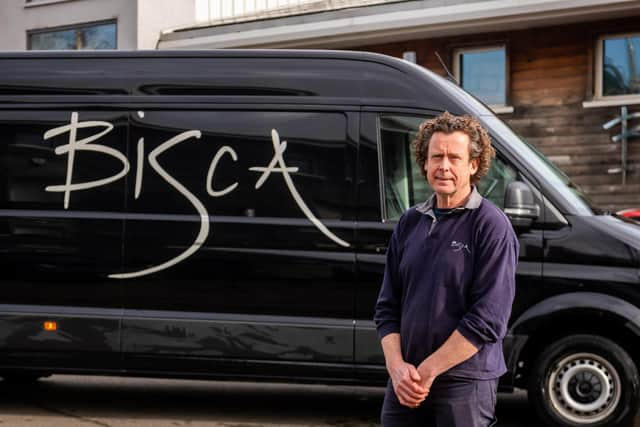

It’s a far cry from Bisca’s humble beginnings. Richard started the business in 1994 after graduating from Northumbria University with a first-class honours degree in design. He set up Bisca – an acronym of Brass, Iron, Steel, Copper and Aluminium (which were the materials he used in the early days) – with the aim of becoming a furniture designer and maker. “There was no real mass market at the time, it hadn’t really kicked in from abroad and people were looking for something a bit different and that’s the market I wanted to get into.”
He was initially based in Glasgow but moved back to North Yorkshire in 1998. For Richard, Helmsley was the obvious location. “I love North Yorkshire and it’s my local market town,” he says. “Also, North Yorkshire’s in the middle of the country and you’ve got the supply base and engineering skills of places like Leeds, Bradford, Shefield and Teesside.”
He designed and created his own furniture range, and it was while exhibiting his work at the 100% Design show in London where a property developer called Mike Spink asked if he could make him a staircase for his home. Richard agreed, despite not having made a staircase before. “John Sweeney, my tutor at college, always used to say ‘Richard, the worst mistake is to ever say ‘no’. Say yes to everything and worry about how you’re going to do it,’ and that’s the attitude I’ve approached business with.”
He sketched his ideas down on paper and started building the staircase in his workshop. The developer was impressed with his work and commissioned him to do more staircases for other town houses he owned dotted around London. Another big early break was being commissioned by Robin Hutson, who co-founded the Hotel du Vin chain, to work on a hotel in Bristol. “He drove all the way up here with his wife and he said ‘I’ve seen one of your balconies in House and Garden’ [magazine] and the next thing I knew I was doing the staircase, main entrance gates and 20 balconies in the old sugar refinery in Bristol. He started rolling out more hotels and I was working on all these, too.”
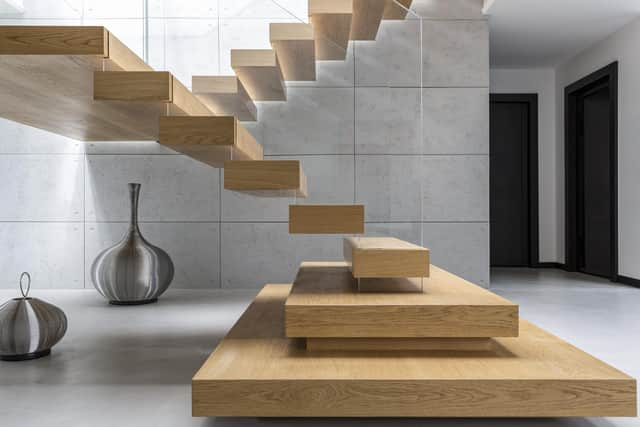
Around this time Richard invested in a swish website just as the Internet was taking off which gave him a platform to display his growing portfolio of staircases. The business has grown organically over the years and its base on the edge of the picturesque North York Moors is a hive of activity including in the forge, which is home to a 120-year-old power hammer originally used in the Merchant Navy that Richard picked up in a sale in Darlington 20 years ago. “You effectively build the staircase three times – once in 3D computer design, then again in the workshop and then on site,” he says.
Their work takes them all over the world. “You might be doing a little barn conversion up the valley here and the next minute you’re in Lagos in Nigeria,” says Richard. And sometimes, as with a client in the US seeking a staircase for his private ski resort, they get unusual requests. “He said, ‘I want you to design me a staircase that’s supercalifragilisticexpialidocious’ and that was the brief.”
Overseas jobs help raise the company’s profile, but most of their work is here in the UK with the majority of jobs for private homes rather than commercial businesses. They do between 40 and 50 jobs a year – everything from historic houses to contemporary homes – and for each job a designer will work with a member of the craft team throughout that particular project.
There have been no shortage of interesting commissions, like their work on the Marple Aqueduct, a world heritage site in Cheshire. “The Canals and Rivers Trust wanted to put a balustrade on one side of the aqueduct. And that was very exciting because we had to build it all here then load it onto a barge with a crane. So we were working off the water on the edge of this historic aqueduct.”
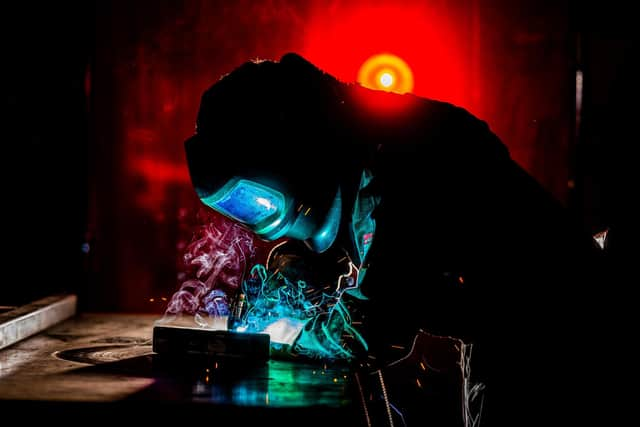
Bisca’s success is driven by Richard himself. He grew up on his parents’ pig farm in Ampleforth Valley (he still mucks in sometimes and is helping it move towards regenerative farming). “My dad is an aviator as well as a farmer and he’s got a studio workshop. He taught me how to weld when I was eight or nine years old. So making things was just something you did,” he says. “Working in agriculture you have the attitude that you ‘make do and mend’ and you’re constantly having to solve problems. I think I still have that attitude and the work ethic that comes with it.”
It's this determination and attention to detail that underpins Bisca’s longevity. “I think people want that provenance, they want something designed and made by real people.” This elite level of craftsmanship, rightly, comes with a hefty price tag. The average cost per flight of stairs is around £80,000, so they are definitely for those with deep pockets.
But there’s a reason why people are willing to pay such sums for a staircase. “They are ultimately the most important piece of furniture in your house if they’re done well,” he says. “When I start a project I say, ‘how do you want this staircase to make you feel?’ The staircase itself has to be awesome and the experience has to match that.”
What makes Bisca’s success even more impressive is that Richard didn’t serve an apprenticeship under a master designer but instead has developed and honed his own techniques and put together a highly skilled team. “You’re constantly learning and influenced by other people and that’s why I’ve developed these skills. Every day’s a school day and you come out with another lesson and another perspective.” Richard, who also runs the largest wood pellet producing business in the country, is understandably proud of what he has achieved through Bisca. “Thirty years on I still love it. It’s the diverse nature of it all, and I’d like to think I’ve created a business that makes people who work here feel happy and fulfilled.”
For more information visit www.bisca.co.uk