
'My idea of heaven': Inside the stunning Yorkshire garden of renowned horticulturalist George Smith
Internationally renowned flower arranger and horticulturalist George Smith MBE shows Sally Clifford how his beautiful garden grows and the work that goes into creating and maintaining it. Pictures by James Hardisty.
Tucked away from the busyness of the beautiful historic city of York lies a thoughtfully curated floral oasis. Seasons and styles are showcased in this compartmentalised garden which has appeared in prestigious gardening magazines and on screen, in programmes such as the BBC’s Gardener’s World.
This much celebrated quintessential garden is a horticultural masterpiece elegantly sculpted from around three acres surrounding this former 18th century farmstead.
The Manor House, in the village of Heslington, isn’t simply a showcase, it is a place internationally renowned flower arranger and horticulturalist, George Smith MBE, is proud to call home. It was the vision of the previous occupants, Lord and Lady Deramore, to create a garden incorporating the Old Granary and barns adjacent to the house.
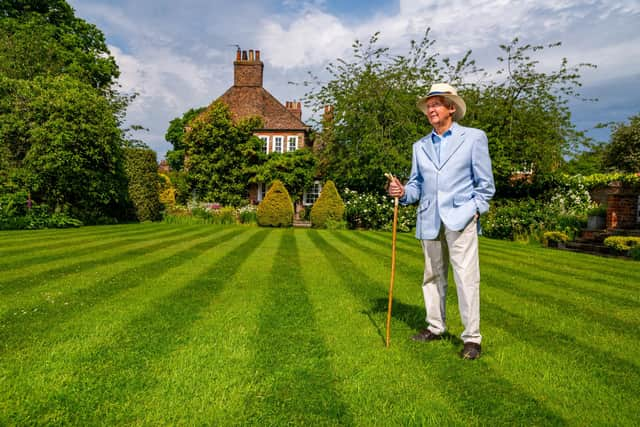

George explains it was a photoshoot for the first of three books he has penned about flower arranging which originally brought him here. “I said to Lady Deramore, who lived here, that it was my idea of heaven and after she left we came to live here in 1968,” says George. “The garden was a framework and I built on that. I was helped by many gardeners and talented people who have inspired me, and sharing the garden is one of the loveliest things you can do.”
Since making The Manor House their home, George and Brian Withill, along with their friend David Gilkeson, have extended the individual gardens enhancing the overall character. Occupying a stone trough in the cobbled courtyard, the first sight of George’s expansive Hostas collection comes into view. The impressive Siboldiana was a mutation which sported and was registered ‘George Smith’ in 1983 by the British Hosta & Hemerocallis Society, of which George is president.
“It was made by divine intervention. It grew in nature. There are 7,000 Hosta varieties because it is not a stable plant it is incredibly variegated and mutated, native to China and Japan,” explains George.
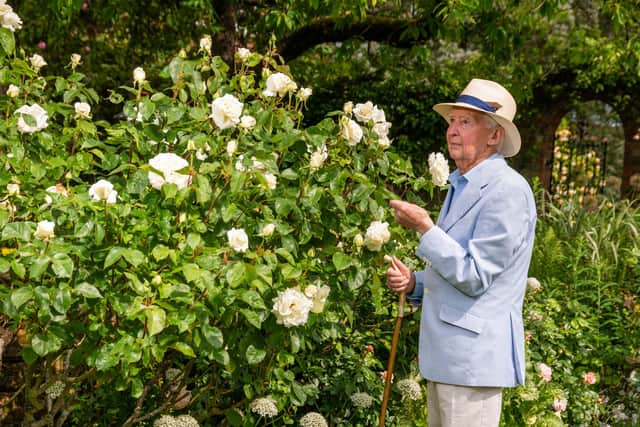
Along the terrace, a magnificent Magnolia grandiflora, native to the States, decorates the side of the house along with cascading Wisteria. Stepping down on to an immaculately striped lawn, the demilune water feature - a carved mask of Proteus spouting water - comes into view surrounded by a neatly trained wreath. Borders of white roses, shrubs and hardy perennials lead on to The Old Orchard where Aliums, Foxgloves and a striking purple Potato Vine add floral splendour to surrounding mellow brick walls.
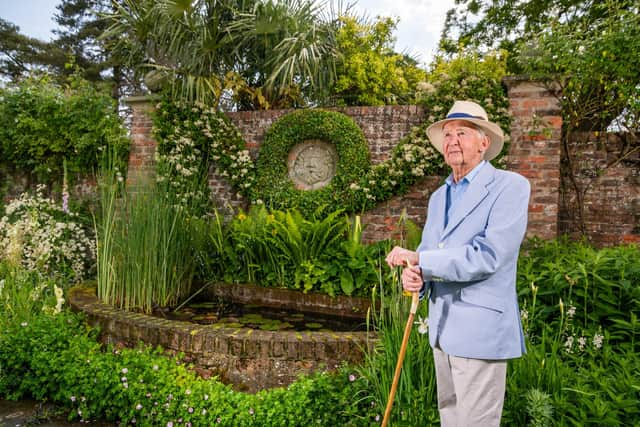
Draping over one of two ornamental ponds in the gardens is a contorted Willow from Belgium, not even grown at RHS Wisley, Surrey.
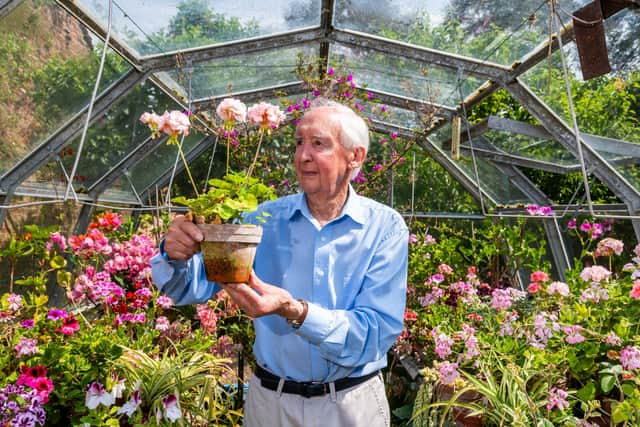
A Mediterranean Garden was currently being stocked with tender plants from two nearby greenhouses brimming with blooms. “One thing I have found is the love of flowers is universal,” says George. “Countless visitors, not only from the UK but also Europe, America, Japan and South Africa, have visited over 50 years.”
For three years they opened their garden to the public as part of the National Garden Scheme offering visitors access to participating private gardens in England, Wales, Northern Ireland and the Channel Islands and raising funds for nursing and health charities. Private garden tours and specialist horticultural groups have also been hosted here. More recently, a garden party was held to raise funds for St Lawrence Parish Church, York.
Underneath The Old Granary, the cart shed provides the perfect entertainment space. The studio above - its beams adorned with Brian’s decorative corn dollies – is home to George’s props collection for the floral demonstrations and lectures he has conducted at home following his foray into the world of flower arranging.
“I came from an automobile engineering family. Smith’s Garage was founded by my grandfather. We were appointed the first Ford agents by Henry Ford in the North of England in 1910.” Born in Halifax, George attended Ackworth School, Pontefract. “I didn’t go into the family business because my brother and cousins had already fulfilled that. My mother and father let me do what I wanted to do, which was horticulture, and that is how I came into the world of flowers,” reflects George. “I think a love of flowers is something you are born with. I was picking flowers as a toddler. My great aunt Harriet used to take me on little walks and we would pick dandelions, daisies and bluebells which she would put into a carrier bag and I would say ‘let them look out!’”
George credits his maternal uncle for his creativity. “He was an artist and a keen gardener. I think my gardening side comes from him. In a way, it is like a form of painting. There are parallels in the grouping of colours and the form of shrubs and foliage. It is making a picture with living plant material.”
After achieving his Certificate of Distinction from the Royal Horticultural Society of Great Britain at the Lancashire County Institute of Agriculture, Hutton College, George was called up for National Service. Based on his college results, he was posted to the Higher Education Centre for military re-settlement as Serjeant Instructor for Horticulture. When there were no students to teach, George recalls collecting rainwater for the Commanding Officer’s wife to wash her hair.
Reflecting, it seems he was blessed with a series of career changing encounters. His floral skills were recognised by the General’s wife when George gathered Rhododendron Ponticum, stripped off all the leaves and arranged a mass of orchid-like lilac blossom for her visit to Hipswell Lodge. This led to a group of officers’ wives requesting an evening class and George learned on the job inspired by Constance Spry’s ‘How to do the Flowers’ and ‘East Meets West’ by Japanese Californian, Gregory Conway.
Such was his flower arranging forte he decided not to pursue a degree at the University of Nottingham, instead working in a florist’s shop in his home town, and continuing his floral studies in Holland.
Eventually, demand for his lectures and demonstrations prompted him to go freelance. “Men arranging flowers in the fifties required courage, but credit must be given to Brian’s immaculately typed letters and secretarial skills,” says George.
Under the jurisdiction of the National Association of Flower Arrangement Societies (NAFAS), of which he is a Special Associate of Honour, George gained international recognition and, for 50 years, has been one of the world’s foremost lecture demonstrators and judges of floral design. The 92-year-old has travelled all over the world demonstrating, judging and lecturing in 28 countries, and led to him meeting the late film star, Grace Kelly, H.S.H The Princess of Monaco. He also assisted the Duchess of Beaufort in arranging flowers at Badminton House for the Royal family’s visit during the horse trials. George has been the artistic director of flower festivals in Yorkshire’s stately homes, Cathedrals and York Minster, creating the flowers for Royal visits. In 2004 he was awarded the MBE from the late Queen Elizabeth II in the New Year’s Honours List for Services to Flower Arrangement.
“Perhaps, it is not a career I would have chosen, but it is one I would not have missed. What I would say is don’t let opportunities pass you by.”