
Plants do like to be beside the seaside
Life can be tough at the seaside. Wind and the salt-saturated air aren’t the best conditions for a plant but it’s surprising just how many have been able to adapt to inhospitable growing conditions.
Look at the likes of cotoneasters, elaeagnus, escallonia, euonymus and many hebes – and gorse, or prickly broom, which hails from Africa,has found a happy home on Britain’s coasts while Genista lydia (broom) is another well suited to planting where the soil meets the sea. It thrives in hot dry areas, flourishes on poorer soils such as sandy or chalky soils, and laughs off any amount of salt.
It also loves full sun and although it doesn’t care overmuch for cold winds, a clifftop site is just about the perfect spot. The flowers are like small pieces of the sun, and they have a delicious fragrance to be carried on the breeze. Perfect for Penzance, Portugal or parts of the Yorkshire coast where summer is but a fleeting visitor.
What else?
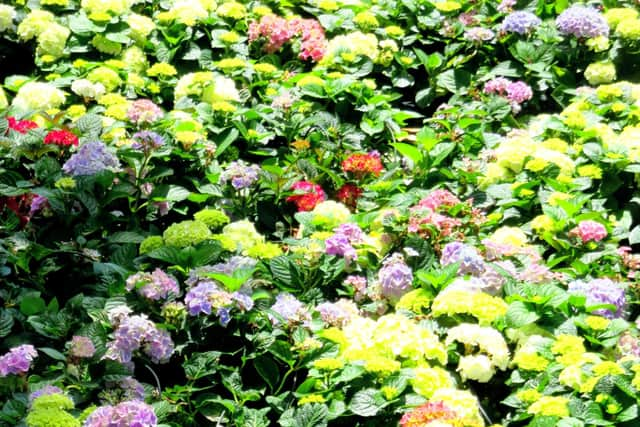

Many salvias are quite content to live at the seaside, as do lots of lavenders, culinary sages (Salvia officianalis), some shasta daisies, artemisias like ‘Powis Castle’, lamb’s ears (Stachys byzantina), the silvery cotton lavender (Santolina) and old favourites like hydrangeas, which seem capable of growing just about anywhere – whatever the conditions and no matter how little maintenance they receive.
And for anyone with a bit more room, and a love of trees, Alnus glutinosa (common elder) is a big deciduous tree (70ft or more in height), which has no fear of salt.
And Crataegus x persimilis ‘Prunifolia’ is a deciduous tree whose leaves turn orange-red in autumn. It also has white flowers in spring. In perfect conditions, it could reach 25ft in height.
Or something even larger...Pinus nigra (the European black pine) whose domed evergreen canopy can break the 100ft barrier. Big but beautiful – and a great addition to a wind-break.
Salvias
Salvias, in virtually all their forms, are plants worthy of growing and capable of providing weeks, if not months, of colour. And they are easy to cultivate, so there is really no reason not to grow at least one or two varieties. Plus, they don’t seem to mind living at the seaside.
The annual salvias have always been popular – particularly S splendens, the scarlet sage, renowned for its vibrant red growth and much used to dominate architecturally-designed bedding schemes – but it is the herbaceous perennials that are now coming more into fashion.
It’s not difficult to see why; their blue or violet flowers may not be as vivid as the likes of the aforementioned annuals, but they are long-lasting, easy to grow and beloved of insects as a source of nectar. Grow them and the garden should be alive with butterflies and bees.
Normally, the blooms of most appear in late June and continue through to late August, although some varieties begin to flower in May. Container-grown specimens can also be persuaded to bloom before those planted in beds and borders.
Well-drained soils suit them best, but what helps them thrive is sunshine – so pick the sunniest spot for the best blooms.
To prolong flowering, remove the flower spikes as soon they start to fade. Apply a generous 5-7cm (2-3in) mulch of well-rotted garden compost or manure around the base of the plant in spring, which is also a good time to lift and divide established clumps (although some gardeners prefer to do the deed in autumn).
Although some salvias are considered too soft to survive a British winter, many are surprisingly tough. However, it pays to mulch or lift - like dahlias - half-hardy varieties known to be susceptible to frost damage.
Hydrangea
Hydrangeas are now selling in their hundreds of thousands, but this time more as container plants than permanent border fixtures.
Most people can recognise a hydrangea; well, the mopheads (Hortensias) at least. They are the most commonly seen, with their great, round flowerheads which usually start to appear in July and which continue well into September.
They are very British – you can grow them in white, red or blue, but the colour depends on the acidity or alkalinity of the soil; acid gives red, alkaline gives blue. You can even grow them at the seaside.
Fewer people will recognise the lacecaps with their flat central flowers surrounded by a ring of larger blooms.
And as for the daddy of them all, H paniculata ‘Grandiflora’, well, it’s more like a shrub topped with flowery ice-cream cones – a stunning shrub for the late summer garden.
Hydrangeas like a fertile soil which is well-drained but moisture-retentive and although they aren’t adverse to full sun, they do appreciate a bit of shade. Work in plenty of organic matter into the soil prior to planting, and after planting and in subsequent years, apply plenty of organic matter as a mulch.
The big blooms of the mopheads are ideal for flower-arranging, but it’s best to leave their dried carcases on the shrub until spring – cut them off in the autumn and they won’t be around to protect the shrub from potentially damaging frosts.
And that’s why hydrangeas fell out of favour – if you hack off the flower-heads as soon as the blooms have died, the plants are nothing more than skeletons of dried twigs.