
The best flowers to grow in your garden which you can also eat
One thing is for certain this summer, more and more people are getting a taste for flowers, seeking something just a little bit special. David Overend reports.
Is it going to be another long, hot summer? Who knows? But centuries ago, we made the most of what we could get and in summer we could usually get a feast of flowers to complement our meagre fare.
While the rich tackled meats and fish and fine wines, the poor picked wild flowers and brewed beer.
So we aren’t the first to want to use flowers for food – and centuries of tasting, testing and experimenting have produced a pretty comprehensive list of edible ones.

So give thanks to those brave individuals who took risks to discover whether or not a plant was going to help satisfy their hunger or give them, at best, stomach ache, or, at worst, an early grave.
Nasturtiums are an obvious choice – they are a wonderfully colourful addition for salads and provide a real peppery flavour. You can also use carnations (not to everyone’s taste), the spicy flowers of chrysanthemums, marigolds, violas and pansies and borage.
Others to consider are the easily-grown English marigold, Calendula, cowslip (again, good in salads), even lavender.
And bergamot (Monarda fistulosa) produces flowers (and the young leaves) with an intense taste of mint. This is the plant that gives Earl Grey tea its distinctive flavour.
While clover (Trifolium spp) flowerheads are edible, and have a sweet, mild liquorice flavour.
But whatever you choose, grow them yourself because only then can you be certain they are chemical-free. Plus, there’s the extra satisfaction of knowing that they’re all your own work.
Sow the seeds in spring and harvest the flowers early in the morning when they should be at their tastiest. Don’t wash them unless you have to – you’ll remove some of the intensity of the flavour.
Finally, a word of warning: Some flowers may look appetising, but they could be deadly. Ones to avoid include poppy, lupin, cyclamen, anemone, iris, periwinkle, delphinium and celandine.
There are many more – some obvious, some not – which are best kept off the menu.
Centaurea
The annual Centaurea was once a wheatfield pest, but now its perennial cousin is in fashion.
It likes any well-drained soil and plenty of sun, although it will also grow in semi-shade. In fact, it can grow just about anywhere, which is why escapees can be seen on roadside verges all over the country.
Beware that it spreads quickly, so it’s best to lift and divide established clumps every two or three years in autumn or spring. Alternatively, pull up any unwanted strays.
Before it gets to that stage, enjoy it for those fascinating flowers, blooms that are much favoured by the cut-flower brigade. And here it proves its worth yet again – dead-head regularly and you’ll prolong the flowering period and encourage a second flush in early autumn.
In late autumn, when the plants are virtually exhausted, cut the stems down to ground level.
There are numerous varieties available for the garden and they don’t all come in blue but if it’s annual cornflowers you’re after, then, once again, there are plenty from which to choose, all of which like a well-drained soil and plenty of sun.
From June till September, varieties such as C cyanus ‘Blue Boy’, a large-flowered cornflower in classic bright blue, will do your garden proud. ‘Blue Boy’ is a tall-growing cornflower, with stems up to 36ins in height.
Sow cornflower seeds outdoors from March to April. Choose a position in full sun on well drained soil. When the seedlings are large enough to handle, thin them out to 6ins apart.
Alternatively, grow cornflowers indoors from August to September for early summer flowering next year. Sow the seed on the surface of compost at a temperature of 18-23C (65-73F) and cover with a very fine sprinkling of compost or vermiculite. Don’t exclude light because it helps with germination.
When the seedlings are large enough to handle, transplant and grow them on in cooler conditions until large enough to move outdoors.
Coreopsis
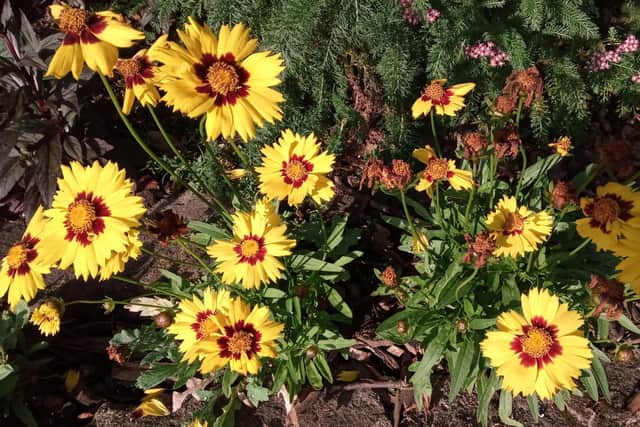
Coreopsis, those sun-loving, low-maintenance perennials with daisy-like flowers that bring a burst of colour to the summer garden, are drought-tolerant, long-blooming and happy to grow in poor, sandy or rocky soil.
Bees love them and gardeners love them because they are such delightful plants, even though some varieties are relatively short-lived and are more likely to be grown as annuals rather than perennials.
This is normally the case with C grandiflora ‘Badengold’, whose orange-centred yellow flowers are held aloft on 30-inch stems. In late summer, it pays to cut back this coreopsis if flowering has slowed or stopped. This will encourage more blooms, often well into autumn.
Once they have finished flowering they are cut back by one-third to one-half of their height but, like lavender, never into old wood.
Established clumps can be lifted and divided in early spring or autumn. If the soil is dry and compact, water it well the day before digging up and splitting the plant.
There are estimated to be as many as 80 Coreopsis species naturalized in the Americas. The common name of tickseed derives from the Greek ‘koris’, meaning bed-bug, and ‘opsis’, meaning appearance, referring to the resemblance of the seed.