
Watch Sheffield researchers build family home in 10 days using “factory-in-a-box” to tackle housing shortage
A prototype home built in just 10 days showed how a portable “factory-in-a-box” could speed up housebuilding in Yorkshire and cut delays caused by bad weather. Lizzie Murphy reports.

Ten days of building in wind and rain produced a completed family home not as a construction stunt, but as a demonstration of how new technology could help tackle the UK’s housing shortage.
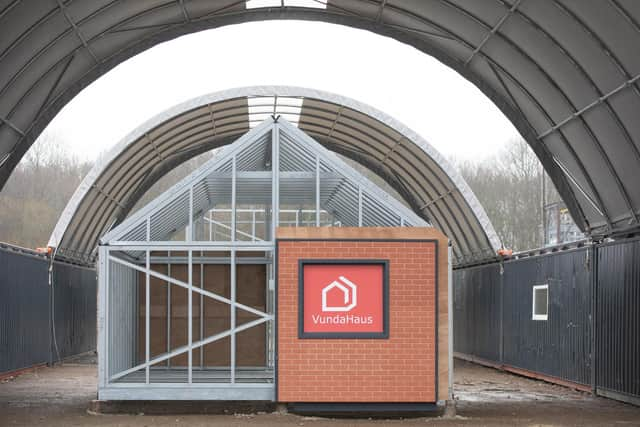
Researchers from the University of Sheffield built the house using a portable “factory-in-a-box” system that allows homes to be manufactured directly on site, even in poor weather conditions.
The project, funded by the South Yorkshire Mayoral Combined Authority, aims to show how homes could be delivered faster and more reliably as the Government works towards its target of building 1.5m homes by the end of the current parliament.

In most UK and global housing developments, construction is carried out entirely on-site. While this offers flexibility and can be adapted to local needs, it often results in unpredictable schedules, inconsistent quality and inefficient use of labour and materials.
Bad weather also frequently causes expensive delays to traditional builds.
One response to these issues has been the growth of modular housing, where sections of homes are manufactured in factories and transported to building sites for assembly. Off-site construction can improve efficiency and quality control, but it also brings logistical challenges.
Large prefabricated components often have to be transported long distances, requiring careful planning and specialist transport.
The system demonstrated in Sheffield attempts to combine the benefits of factory production with the flexibility of on-site building.
Developed in partnership with Seismic Group, the “factory-in-a-box” approach involves delivering a kit of parts to the site and assembling a temporary manufacturing facility under a protective canopy. Instead of transporting large completed modules from distant factories, the house components are produced on site.
The canopy acts as a mobile workshop that shields the build from rain and cold weather. Once a home is finished, the structure can be dismantled and moved to the next plot, allowing the same controlled manufacturing environment to be recreated across a development.
Supporters say the approach allows construction to continue in conditions that would normally halt work, while also enabling more precise fabrication techniques similar to those used in permanent modular factories.
Ben Hughes, professor of energy engineering at the university’s Energy Innovation Centre, says the project was designed to demonstrate how modern manufacturing methods could transform housebuilding.
“Our factory-in-a-box demonstrator is designed to deliver high-quality, sustainable homes in all weathers in a matter of weeks - that can be deployed at pace and scale,” he says.
“This demonstration shows that by coupling advanced manufacturing methods with on-site production systems it is possible to build the affordable, quality homes the country desperately needs, while improving efficiency and reducing costly delays.
“The Energy Innovation Centre’s location and proximity to the world-leading expertise and facilities at the University’s Advanced Manufacturing Research Centre (AMRC) puts us in a unique position to help the government meet its ambitious housing targets, using South Yorkshire expertise as a manufacturing and training hub supporting a national roll-out.”
Backers of the project say the initiative highlights the role that regional innovation could play in tackling the housing shortage.
Paul Johnson, strategic lead of the investment zone at the South Yorkshire Mayoral Combined Authority, says: “This project shows how we can develop safe, high-quality, affordable homes that allow people to stay near and go far.
“By supporting the university’s factory-in-a-box system, we’re demonstrating how world-leading research, innovative business and public investment can come together to build the homes our communities need.”
Industry partners also argue that new building methods will be essential if the country is to increase the pace of housebuilding.
Richard Crosby, director of Seismic Group, says: “Industrialised Construction is the only viable route forward to meet the government's ambitious targets and end the national housing crisis.
"Dealing with new and emerging skills requirements demands a joined up approach which the Sheffield Innovation District (Runway Park) has successfully demonstrated for many years.”
Researchers now plan to work with local authorities, housing associations and industry partners to explore how the system could be used more widely. A key aim is to develop a regional supply chain.