
Why more of us are turning to self-storage as our homes run out of space
Our homes are being asked to do more than ever, and the space we once used to store our belongings is increasingly being taken over by other things.

Spare bedrooms are becoming offices, garages are gyms or workshops, lofts are being converted into living space and homes are being filled with the equipment, clothes and possessions that come with modern family life.
Homes are also more expensive, meaning many people are buying less square footage for their money and are having to make the most of the space they have.
For most new build homes and conversions in England, minimum space standards apply, including minimum storage requirements, but these can only go so far.
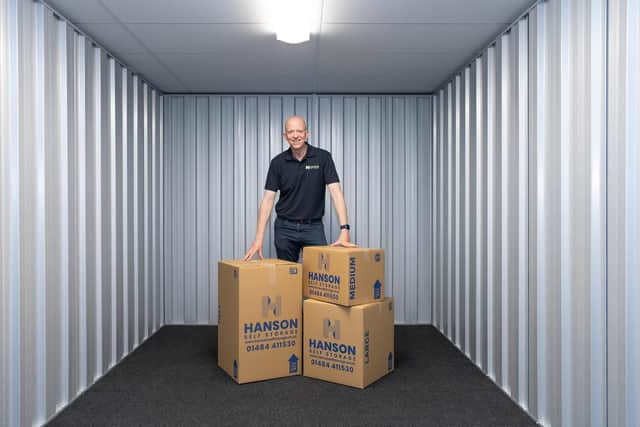

For some households, the answer to the resulting lack of storage is increasingly to move some of their belongings out of the house and into a self storage container.
According to the latest UK Self Storage Annual Report 2026, the UK self storage industry has a combined turnover of £1.3bn.
The housing market remains one of the biggest drivers of demand, with around 27 per cent of domestic customers citing a house move as their main reason for using storage.
But the report also points to a changing customer base, with domestic users now accounting for 75.9 per cent of the market, up from 73 per cent a year earlier.
Paul Pheasey, managing director of Hanson Logistics, which opened its first purpose-built Hanson Self Storage facility in Huddersfield in July, says his early experience reflects that demand.
The facility, which has 24-hour access, includes 495 units ranging from 10 to 600 sq ft, with house movers currently making up the majority of customers. “People are using their houses for a lot more things and we generally have a lot more possessions than we used to,” he says.
Hanson's customers include people moving house and renovators as well as those who require extra space for seasonal storage and other belongings.
Ben Pipkin, design lead at Cunniff Design in Leeds and chair of the RIBA Yorkshire Regional Council, says the pressure on space is something he is seeing both professionally and among his own contacts. “I asked the question of a few contacts in my network, and I was surprised how many of them have a storage unit or have access to one,” he says.
Their reasons ranged from home renovations and loft conversions to simply having too much stuff.
“One person said, ‘I have two 20ft containers for storage. It’s partly as I'm doing up my house, but also I have far too much stuff’,” he says.
Ben adds that rising housing costs are putting more pressure on the space they already have. “Houses are very expensive now, especially with mortgage costs, naturally you're going to want to make use of every square inch of space that you have,” he says.
Paul believes there is scope for storage to become much more of an everyday solution in the future. “More people are using storage units as an extension of their house,” he says. “They put all their summer clothes in during the winter and then flip it around in the summer, or they put the Christmas decorations in.”
There is also an emerging issue in city-centre accommodation, particularly among students.
Ben says his practice has had enquiries about potential self-storage sites in Leeds, with operators looking at whether city-centre locations could serve students who only have accommodation for part of the year. Instead of transporting belongings home at the end of a university year, students could use nearby storage for the summer.
The opportunity could extend beyond students, with a growing need for smaller, more accessible storage among young professionals in city centres.
In London, operators are increasingly targeting the city-centre market rather than relying on large out-of-town warehouses. “There are some operators who work on a slightly smaller scale, and the marketing of them seems to be a bit more lifestyle oriented,” Ben says.
People have more possessions, more specialist hobbies and, since the pandemic, are more likely to work from home. “Suddenly those sort of leftover spaces that you could pack stuff away into are sort of under pressure,” he says.
Paul agrees that self-storage could eventually become a much more familiar part of everyday life in Britain. He believes the UK could gradually move in the same direction as the US where the industry is more established.
That may still be some way off. But as homes become places to work, exercise, entertain, raise families and store an ever-growing collection of possessions, the question is whether the traditional idea of having everything you own under one roof is becoming less practical.