
Why the demise of SME house builders is a crisis for the industry - David Cross
In the 26 years I have been an architect I have watched the slow and almost total demise of the SME developer and house builder in slow motion.
Layer by layer we have regulated the sector beyond reasonable viability, to the point where building homes in large parts of Britain is becoming a state-sponsored affair.
The entrepreneur and maverick developer who was abundant in my early career as an architect is almost gone. The small builders who would pick up awkward little sites and deliver cool urban schemes, conversions or a handful of one-off houses are disappearing too.
In 1988 SMEs delivered around 39 per cent of new homes but by 2020 that had fallen to around 10 per cent.

A planning application now comes with contamination reports, transport assessments, travel plans, refuse strategies, sustainability statements, design and access statements, acoustic reports, archaeology reports, drainage strategies, ecology reports, biodiversity assessments, landscape designs, arboricultural reports, flood-risk assessments and sometimes construction details that would historically have been produced much later.
Then you get planning consent and start again because conditions need discharging, reports are revisited, consultants are reappointed, details are developed and legal agreements are completed.
On a fairly ordinary 50-home urban scheme it can now cost us a quarter of a million pounds to get from identifying the site to being genuinely spade-ready - and that is before you build anything.
The Home Builders Federation recently calculated that regulation, taxation, levies and construction inflation have added around £76,000 to the cost of delivering an average new home since 2020 and for high-rise homes the potential increase is closer to £98,000.
To be clear, that isn't £76,000 of architects' fees - it includes £37,000 of material and labour inflation and also includes building regulations, biodiversity net gain, the Future Homes Standard, taxes, levies and other policy costs.
It isn't difficult to see how we got here as nothing individually sounds unreasonable and that's the problem because almost nothing on the list is unreasonable on its own.
My concern as an architect is what happens when compliance is reduced to the cheapest standard solution. We could end up building darker homes that require more artificial lighting to solve an overheating problem, then add more photovoltaics to offset the additional electricity.
Zoopla’s analysis found that development was unviable across 48 per cent of the country, with another 16 per cent only marginally viable. It found that average sales values could support new development across 64 per cent of southern England, compared with just 13 per cent of the Midlands and 10 per cent of northern regions.
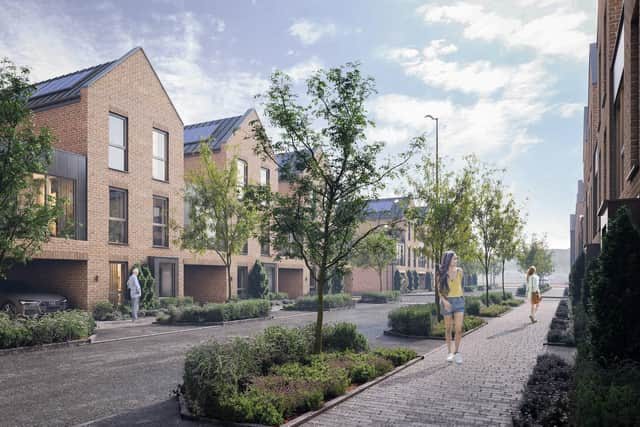
My own experience tells me much the same thing because for us to deliver a new-build scheme in the Sky-House style, we broadly need £300 per sq ft. In simple terms, a 1,000 sq ft home needs to sell for around £300,000 and in large parts of South Yorkshire, where we operate, that is difficult.
You can make the house smaller, you can strip out quality, you can reduce the windows, you can build on cheaper land but at some point we need to ask ourselves what sort of homes and neighbourhoods we are actually trying to create.
David Cross is founder and director of house builder Sky-House Co, based in Sheffield.