
Algarve: 'I visited the 'other' side of the Algarve - it was hugely rewarding'
Lindsay Sutton enjoyed time in the Algarve away from the usual madding crowds and discovered another quieter side to the region along with its abundant natural offerings.
Sometimes, in life’s hectic whirl, we can’t see the wood for the trees. And sometimes, not even the trees for the wood.
So it’s good for the soul to take time to look at nature close up. Never mind the big picture. It’s the small picture that can be the most revealing.
It’s hugely rewarding to connect with nature - and a three-day, four-night walking holiday, combined with a connection to art and culture in southern Portugal, is a real treat.

That’s what I did in the area which is billed as ‘the other Algarve.’ Not for me a sole emphasis on the sun, sea and sand-style holiday on the southern edge of Portugal, right there on the Atlantic Coast.
Nor the golf-focussed Algarve vacation so cherished by British followers of the small, white ball.
Nothing wrong with that kind of holiday, but there’s another option that I discovered and found hugely rewarding.
A paced, nature-focussed walk along the coastal path, with a well-informed local guide, is first up on the eco-friendly break that I joined up with.
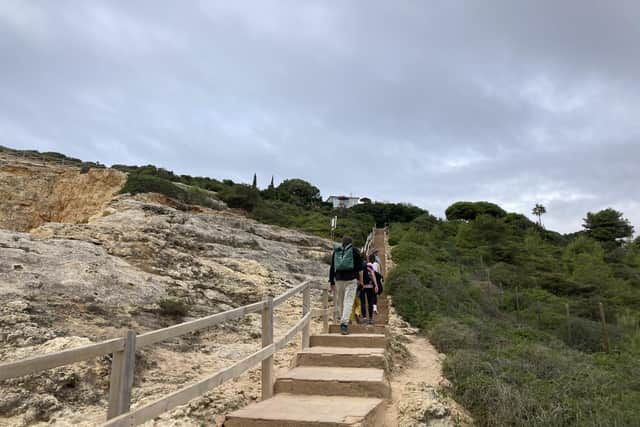
Then, an inland trek on the classic Sao Joao Walking and Art Festival route, popping off to do tile painting and T-shirt pattern-making en route.
Finally, a tour and walk in the mountainous north of the Algarve, taking in the characterful and beautiful villages. Perfect, especially for a spring or autumn break.
All far from the madding, and sometimes maddening, crowds of the Algarve resorts. Peaceful, pleasurable and perfect for those wishing to connect with nature. And if you choose the right hotels, a bit of rest and relaxation. Not to mention the wonderful Algarve cuisine.
Our group of eight Brits, joined by Portuguese walkers on parts of the route, was just what the doctor ordered. Away from ‘Stressville’, bolstered by like-minded people, and in touch with yourself and your surrounds.
So, what was on offer from the ecotourism experience put on by the well-organised operation called Algarvian Roots, and fully endorsed by Algarve Tourism?
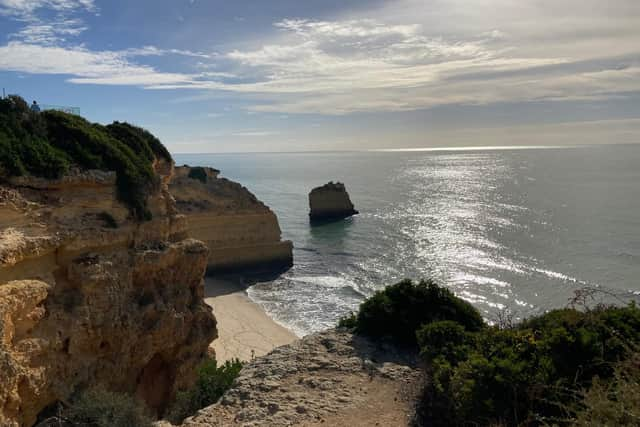
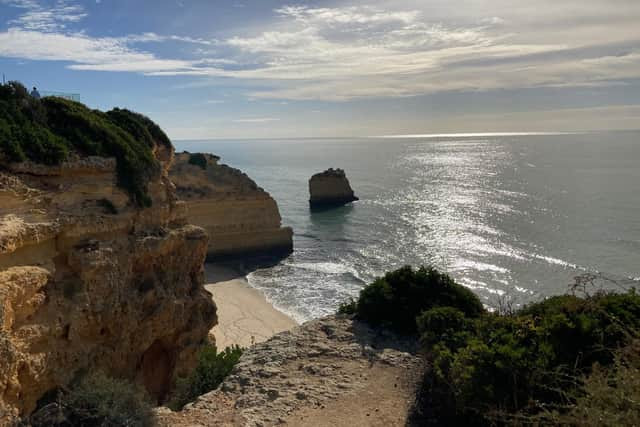
The five kilometre Praia da Marinha Walk along the Seven Hanging Valleys Trail gave us breathtaking coastal views of limestone cliffs, huge sink holes and caves, with steep valleys allowing access to the sea.
It’s a haven for migratory birdlife and our guide Miguel pointed out the three types of swift - Alpine, Common and Pallid. Not a Taylor in sight.
We looked closely at an orchid shaped like a feminine bee, thus attracting the male to pollinate it as it tried to mate. Some things never change.
We learned that under Portuguese dictator Salazar, access to Carvalho Beach was the prerogative of one of his naval commanders.
After the ‘Carnation Revolution’ of 1974 when democracy returned, all beaches were made public. And that’s how it is today.
On our inland walk, we took in the town of Silves, the one-time Moorish capital of the Algarve, complete with its seemably-impregnable castle.
It fell when the Christians dressed as Muslims to fool the Moors and retake the city. The old tricks are often the best.
After our walk, the arty side kicked in as we were invited to try our hand at traditional Portuguese tile design.
One paint brush, three pots of blue, but with different amounts of water in each. With a bit of coaching, my tile was just about passable.
Leaving the charming old town, with its cobblestone streets and whitewashed buildings, we hit the Sao Jaoa trail up into the forest area above the town.
Our guide, Joana, informed us: “Nature is not a zoo. I don’t know what we will see today.”
Sadly, no sign of the reintroduced lynx. But on the plant front, we looked up close at the small, white Star of Bethlehem flower that was not there when Joana walked the same route the day before.
There was also interest in the strawberry tree, whose small red fruit is made into a kind of Schnapps.
Looming over us on the crest of a hill were the giant sails of a wind farm. No carbon footprint, but as our guide observed: "Noisy, and a threat to visual beauty.”
As were the forest fires that recently ravaged huge area in the surrounding hills. With climate change and the introduction of combustible eucalyptus trees, the danger was obvious.
Only quick action by the local fire brigade saved the day - this time.
Back on the arts scene, we all spray painted T-shirts, with mixed success.
Then, back to nature, just after dusk, as we observed the monitoring of the Algarve’s moth population. A large sheet and bright lights did the trick.
Apparently 75 new species have now been registered. And what a revelation as we looked at the attracted moths through powerful magnifying cameras.
Next day we were transported into the mountainous terrain of Monchique, a characterful and unspoiled town between the 2,700 ft-high peaks of Foia and Picota.
Our guide, Francisco, who started up Algravian Roots, took us to the Charrette Restaurant for a classic Sunday lunch, along with local Portuguese families. Perfect.
Our final walk took us past cork oak forests, where denuded trees were marked with the number of years until the next harvest.
We ended with a chestnut roasting festival, where townsfolk raked the bonfire embers for the autumn harvest. Delicious.
The walks are manageable if you have reasonable fitness, and one indulgence at the end of an active day is to stay at a good hotel. We stayed at two first-class places.
First, the Westin Salgados Beach Resort (www.marriott.com), just a short stride from the coast, and set in its own palm tree-studded gardens, next to a lagoon nature reserve, with board-walk access.
Next was the Monchique Resort and Spa (monchiqueresort.com), located up high and with commanding views south to the Atlantic Ocean. Both are classy but not exorbitant.