
Golden moment for metal detectorist who stumbled upon £100,000 windfall
Golden moment…when a treasure hunter realised he’d found more than chocolate buttons. John Vincent reports on a £100,000 windfall.
Many things require patience. Waiting for a bite from a monster fish, for instance. Spending days hoping for a glimpse of a lesser-spotted woodpecker – or building a scale model of HMS Victory out of spent matchsticks.
It’s much the same with metal detecting… years, perhaps decades, trudging up and down fields, hoping and nearly always failing, to uncover something valuable, instead of bottle tops, toys, even urns with ashes.
Tony Asquith, who is in his 70s, had patience in spades and after 45 years of finding nothing of any real significance he was finally rewarded in August 2022 when he discovered a hoard of 35 ancient gold coins near Lenham in Kent.
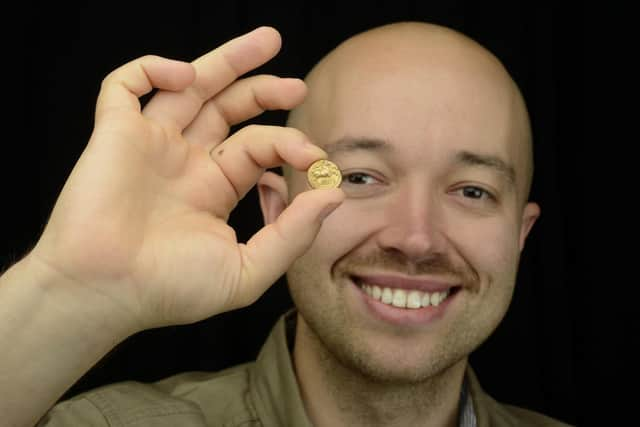

Now the stunning find has sold for a hammer price of £103,500 at Noonans in London, five times more than predicted.
The coins, called staters, with the name deriving from Greek coinage dating back to the 8th century BC, were struck by Celtic tribes in Britain, with the one for sale produced in about 55 BC, the year Julius Caesar first invaded England, succeeding with his second attempt the following year.
The coins were concealed in and around a lump of flint formed tens of millions of years ago and Mr Asquith at first thought he had uncovered a pile of chocolate coins. Putting on his glasses, he recognised them as rare Celtic staters. The discovery was made 35 miles from Pegwell Bay, now acknowledged as the landing site for both Roman invasions.
Highest price, £9,300 with buyer’s premium, was paid for a Gallo-Belgic stater, featuring the head of Greek god Apollo on one side and a stylised horse and charioteer’s arm and thunderbolt on the other. Its pre-sale estimate was just £500-£700. Another Gallo-Belgic coin (produced in northern France or Belgium), again with horse and charioteer’s arm, realised £6,080 (est.£600-£800), while the hollowed flint nodule used as a container for the Lenham Hoard, professionally reconstructed, went for £5,950 (est. £80-£100).

Mr Asquith, who will split the proceeds with the landowner, was left speechless after the sale but coin and artefact specialist Nigel Mills said: “Tony at first just found some wire and a shotgun cartridge. Then he got a signal which revealed a brownish coin, which he was surprised to recognise as a Celtic stater.
"On looking down he saw what looked like a pile of chocolate buttons laid out. Putting on his glasses, Tony realised they were all Celtic staters!”
Another hoard of ancient coins also surfaced at Noonans. More than 680 gold and silver coins, found at Helmington Hall, Suffolk, near a Roman road by treasure hunter George Ridgway, 34, in 2019, fetched £165,000.
It represents one of the largest hoards of Iron Age and Roman coins found in Britain, dating from 206BC to the time of the Emperor Claudius (10BC-54AD). Mr Ridgway said: “I knew I’d made an important discovery and called my dad to guard it overnight while we waited for an archaeological team to arrive and excavate the site. It took three months to recover the hoard.”
Museums claimed a further 63 coins, including a Roman gold aureus from the reign of Claudius, for their collections. The location and date suggests the coins may have been buried by a citizen soldier from the XX Legion, stationed at nearby Colchester.
In 47 AD, the East Anglian Iceni tribe rebelled after the Roman governor Ostorius ordered them to disarm, resulting in a fierce battle, which the Romans won. It is possible, the Helmington Hoard was concealed by a victim at this conflict.
Also at Noonans, a Congressional Gold Medal presented to Lieutenant Robert Henley on the orders of James Madison (1751-1836), fourth president of the United States, following the Battle of Lake Champlain (or Plattsburgh) in 1814, realised more than £223,000 (est.£40,000-£50,000).
A further rarity, one of America’s earliest coins, an “oak tree” shilling, from Boston, Massachusetts, dating from 1652, fetched £54,560 after being in the possession of the same British family for 300 years.
New England coinage was decreed by the British colonial government, originally with a willow tree design, and all coins bear the date 1652, representing the year the coinage was authorised, not the year they were struck.
But colonists had no right to coin money and the 1652 date was a deception to give the coins the appearance of being produced when there was no king following the execution of Charles I in 1649. In this way, colonists could deny any illegality after the restoration of the monarchy with Charles II in 1660.