
Morndyke Parrot Sanctuary: 'I was looking for washing machine parts online and ended up buying 40 parrots'
Sally Clifford chats to the family providing a sanctuary for a colourful menagerie of birds, which includes some critically-endangered parrots, and wants to educate the public about their needs.

There’s a parrot playing peekaboo around my head. Sonic moves on to play with the toggles on the hood before deciding my pen nib working across the pages of my notebook is a more interesting option.
This playful parrot is clearly curious and, along with his fellow feathered friends, is naturally inquisitive about the visitor coming into their jungle-inspired environment.
“Hello” squawks Jade, the Yellow Naped Amazon parrot – a critically endangered species in the wild – using the common greeting in human conversation.
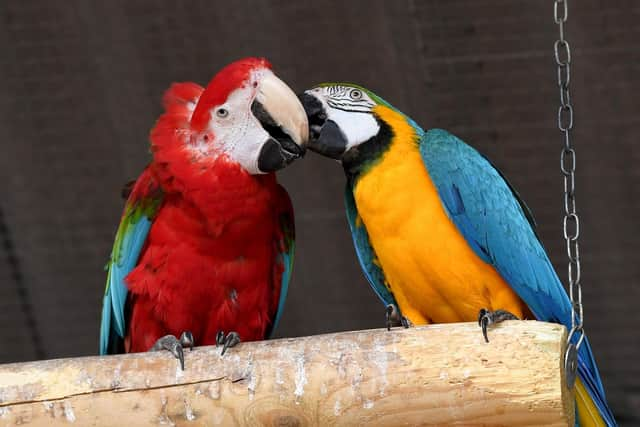
Seeing Sonic and Jade and their fellow feathered friends living companionably in this thoughtfully curated Amazon-inspired aviary with its hand-made waterfall and storm damaged trees re-purposed from the surrounding farmland and freshly planted parrot-friendly herbs, should educate every one of the need for these exotic birds to be free to fly and be with their own flock.
As fascinating as these intelligent creatures are, their purpose isn’t to be kept as pets in cages restricting their wingspans, yet scrolling through hundreds of parrots for sale online there is, evidently, a market for them as Tricia Phillips and her daughter Anna Kingston discovered.
“We were looking for a washing machine part and Anna said let’s have a look at parrots. Moved by the photos of the beautiful birds before them Tricia acted instinctively. “I bought 40.”
Tricia says while dogs and cats are domesticated and have been used to living with humans for thousands of years, parrots are exotic animals and have only spent around 30 to 40 years with humans en masse. “That is not domesticated,” says Tricia.
Yet, according to Tricia, birds per se are the third most common pet in the world. In the UK, around one and a half million are apparently caged and living in isolation.
To the former primary school teacher, who has scientifically researched the background and care of these beautiful birds, these are statistics she is keen to change through education.
Morndyke, the purpose-built parrot sanctuary she set up five years ago on the farm, which has been in her husband Alan’s family for more than a century, in the North Yorkshire market town, Thirsk, is believed to be one of only three parrot sanctuaries in the UK.
“It is almost like there was a niche in the market,” says Tricia.
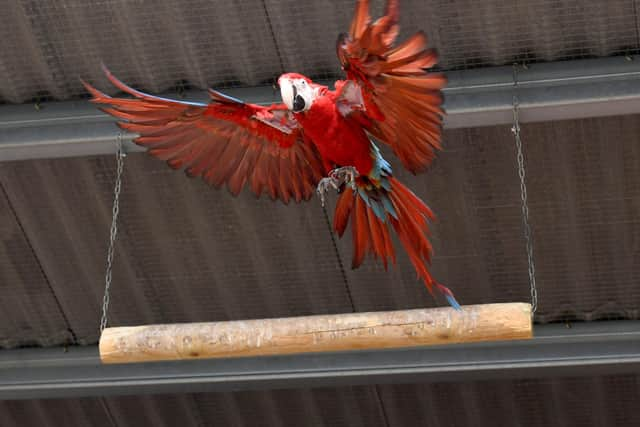
She explains Morndyke Parrot Sanctuary is founded on the four ‘Fs’. Freedom for the birds to choose what they want to do in an enriched environment; Flock Life – living with large and dynamic friendship groups; Flight – space to fly, and be, and do as they please: Food – of the highest standards to ensure the parrots live healthy lives.
“We are giving them back their wings; we are giving them back their life. Most of them have never set foot out of a cage before they came in. The legal requirement for a bird in a cage is two wing spans,” says Tricia.
The sanctuary caters for the parrots’ every whim and provides plenty of space for the birds to take flight and live in a replicated environment, not in isolation or cooped up in small cages, but with their companions as they would be in the wild.
Sanctuaries such as Morndyke are different from rescue centres as the birds in Tricia’s care, who find their way here through various circumstances, are here for life. Many were purchased as pets.
Tricia explains parrots, especially African Greys, became popular in the Seventies, Eighties and Nineties and have seen a resurgence through social media – but owners find they often bite off more than they can chew when it comes to the care of a pet that can, if responsibly looked after, live up to the age of 80, in the case of some species.
“If you saw a flamingo in a flock and you liked it would you take it home? Why is a parrot any different to any other wild animal?” asks Tricia.
“They are very hard to look after. I am not against having parrots with people if they are kept in an aviary, in a flock with the ability to fly and have the best food – the four ‘fs’ to make sure all their needs are met.”
For Tricia and her three senior volunteers, caring for the flock is a time consuming commitment. “I am in there 10 hours a day. I hear them, I hear what they have been through.”
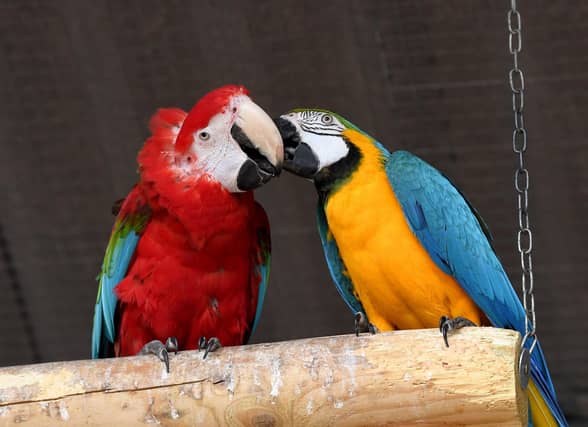
Jack, a stunning Blue and Gold Macaw, was kept in a glass cabinet. One parrot had been kept in a shed with rabbits while another came from a crack cocaine den and suffered with withdrawal symptoms from the illicit substances it had inhaled.
These are just some of the back stories of the many intelligent birds in Tricia’s care.
“African Grey parrots have the same intelligence as an eight-year-old child,” she says.
For Tricia, the introduction to parrots came through her daughter’s fascination with pigeons. “My daughter found a dying pigeon. She was 12 years old and she took it into her bedroom and loved it. After it died she wanted to rescue pigeons.”
Anna, who is currently in her third year of her Wildlife, Conservation and Ecology degree at Bangor University, is working in the middle of the Amazon jungle as part of her studies.
“I weaned her on David Attenborough,” says Tricia, whose own interest in nature came from walks with her birdspotting father.
Their initial incumbents were 10 special-needs ex-racing pigeons, some of whom they still have and are happily cooing around the retirement pen within the aviary built by Alan, a farmer and fencing contractor. There is also a special area for birds requiring end of life care.
The parrot passion began when Anna expressed an interest in working in a pet shop. A Kakariki Tricia spotted in the shop led to their feathered family’s expansion.
Companionship is important to the birds in this natural environment where many of the same species are perched in pairs or groups. “Odin and Harriet bonded as soon as they came in,” says Tricia, pointing to the Alexandrine Parakeets perched side by side.
A display board outside the aviary helps to identify some of the sanctuary’s species such as the critically endangered Blue Throated Macaw, Scarlet Macaw, whose population is declining and Sun Conures, another endangered species.
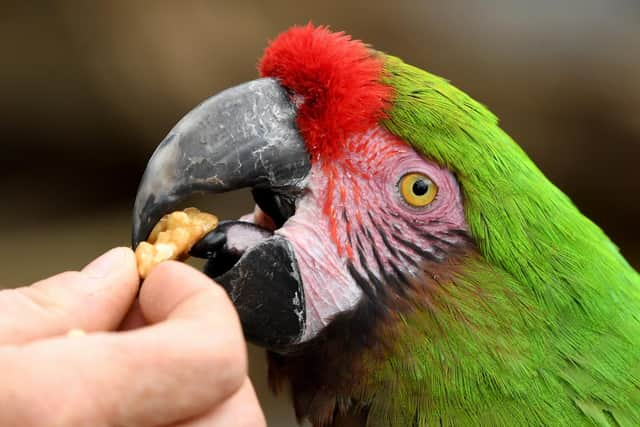
Inside a nearby barn, chest freezers full of pre-prepared meals containing up to 70 natural ingredients, including sweetcorn, human grade veggies, fruit, nuts and seeds - specifically suited to the birds’ diets - line one wall.
Close by an area has been dedicated to a small gift shop. This venture, along with the opportunity of to partake in Parrot Experiences, helps to raise funds for the sanctuary to continue its educational work and contributes to its extensive running costs.
Charitable Status, granted in 2023, will help to secure its future. Tricia’s children Anna and Thomas are among the trustees. Local vet and author, Julian Norton, is the charity’s Patron.
Work placements for vet students, and expanding partnerships with organisations within the local community is imperative for the sanctuary to raise awareness about its work and to educate people about parrots.
One of those partnerships is with The World of James Herriot Museum which recently sponsored Zeke the parrot.
Based in Thirsk, the museum celebrates the life and work of ‘Alf Wight’ – the globally renowned vet known as James Herriot whose books, based on his working life, spawned the ‘All Creatures Great and Small’ TV series.
Tricia talks of applying for a zoo licence, among future plans, enabling more people to benefit educationally from being with the parrots.
“It’s all about educating people. If we want to make changes it has to be through education,” says Tricia.
“It is my life and I will do this until the day I die.”
morndykeparrotsanctuary.org.uk