
Vivienne Westwood: The subversive and rebellious fashionista who defined an unforgettable era in British style
John Vincent looks at the life of confrontational fashion designer Vivienne Westwood who defined an unforgettable era in British style.
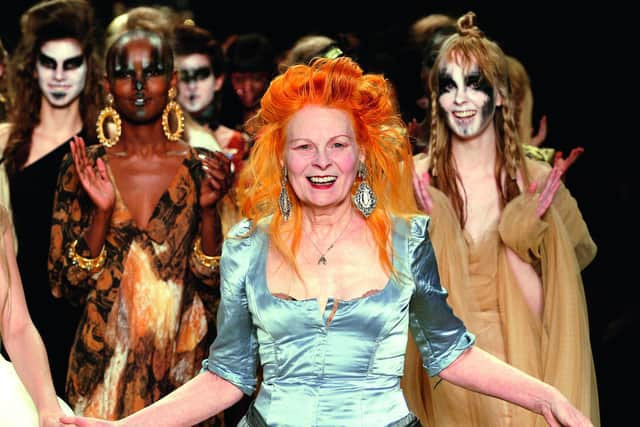
She was the Queen of Punk and New Wave – the subversive and rebellious fashionista whose very British brand of genius spanned more than 40 years.
Dame Vivienne Isabel Westwood turned fetishes into fashion, reinvented the bustle and corset, created the bondage aesthetic and became one of the most radical and influential figures in the history of the industry.
She first made her mark in the British rag trade after ditching husband Derek Westwood and moving in with designer Malcolm McLaren, future manager of the Sex Pistols.

Together they became the architects, through clothing and music, of the 1970s punk scene, principally from their boutique at 430 King's Road, Chelsea, named variously Let It Rock, Too Fast to Live Too Young to Die, Sex and Seditionaries and, finally, Worlds End.
The shop defined the era, with the rebellious, anti-establishment Westwood handcrafting the rips in clothes and creating a market for the bondage gear of punk rock at the exact moment the music exploded in popularity on the streets of London.
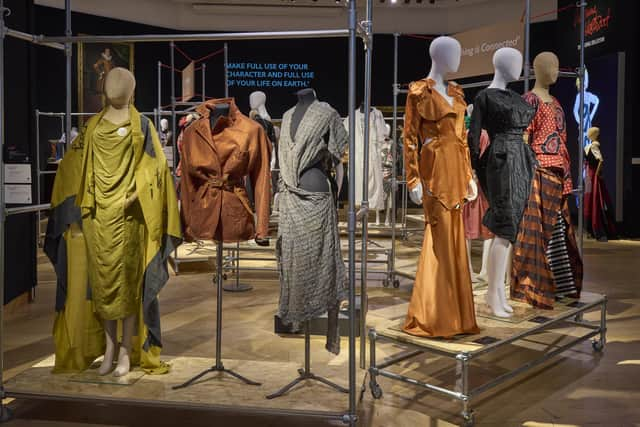
Now, following the death of the pioneering designer and activist in 2022 at the age of 81, an exuberance of pieces from her personal wardrobe has surfaced at Christie's in London to raise a total of £755,000 for the charitable causes she championed.
They included the Vivienne Westwood Foundation, Amnesty International, Medécins Sans Frontières and Greenpeace.
One lot, “The Big Picture, Vivienne’s Playing Cards”, consisting of limited-edition cards, produced in an edition of 10 portfolios, realised £37,800.
Here's some of the prices achieved for 95 lots of the rebel designer’s clothes, boosted, of course, by their provenance: a corset gown of taupe silk taffeta worn to a gala at the Victoria and Albert Museum in 1998, £32,760; her hand-stitched ice blue satin scoop-necked, ballet-inspired “Cinderella dress”, £25,200; cotton dress with printed “propaganda” modesty panel and apron with blue and white striped blouse £16,380; a 1930s-inspired Harris Tweed three-piece suit, £15,120; and a 2012 full-length nude “illusion” gown embellished with gold sequins, £8,820.
The sale also included jewellery and accessories, highlighted by a three-row, faux-pearl choker mounted with gilt-metal paste-set oversized “orb” pendant from the “Anglomania” collection, 1993-94, which sold for £10,080 . All these prices, and many more, were way, way over their pre-sale estimates.
Also under the hammer from her private wardrobe went a red, blue a white tam o’shanter beret from the “Erotic Zones” collection of 2001 (£1,000); an odd-looking pencil skirt printed with book shelves, also 2001 (£1,600); a pair of “clomper” platform ankle boots (£1,260); an "S&M” cuff bracelet (£1,385).
The yellow-haired, red-lipped designer and activist, ranked by Sky Arts as the fourth most influential artist in Britain in 50 years, once said: “I was messianic about punk, seeing if one could put a spoke in the system in some way.”
Her garments reflected the economic, social, and political contexts of the 70s, coinciding with a disillusioned youth, who gobbled up the new music and her unique creations.
Often they served to promote political causes, including the Campaign for Nuclear Disarmament, and she repeatedly took to the streets (and the runway) to speak out against everything from industrial farming to restrictive gender norms, in a career wholly defined by rebellion.
She made fashion statements out of fetishes, sporting the memorable tagline “Rubberwear for the office”. From totteringly high heels and sexy corsets, to New Romantic chic, her collections and shows subverted the heroin chic trend by creating outfits for the bodies and curves of “real women”.
She dubbed 1981-85 “New Romantic”, creating the look of the band Adam and the Ants, and 1988-91 as “the Pagan Years”, transforming punks and ragamuffins to Tatler girls wearing twinsets and skirt clothes that mocked the upper class.
She also inspiration from the ballet Petrushka to design the mini-crini, combining Victorian crinoline with the modern mini-skirt, and designed many of the colourful outfits of Duran Duran.
In the 90s and 2000s, her expertly cut, romantic dresses became go-to wedding gowns and celebrity red-carpet garb.
In 2011, Princess Eugenie wore three Westwood designs, for her pre-wedding dinner, the wedding ceremony and the after-wedding party of the current Prince and Princess of Wales and Dua Lipa wore custom Westwood on the red carpet at the 2021 Brit Awards.
But Westwood warned against "the drug of consumerism", saying in 2007: "I don't feel comfortable defending my clothes. But if you've got the money to afford them, then buy something from me. Just don't buy too much."