
Antiques: Celebrity couple hailed in high society
Theirs was the love that dare not speak its name. The phrase was not to enter the English lexicon for more than a century after their unconventional relationship was in full bloom. But while the lifelong love affair between Lady Eleanor Butler and the Honourable Sarah Ponsonby scandalised some, including their families, their "Boston marriage" (*) captured the imagination of Georgian society.
They became national celebrities and their home in North Wales became a haven for famous visitors travelling between Dublin and London, including poets Robert Southey, Lord Byron, William Wordsworth and Anna Seward, novelist Walter Scott, Waterloo hero the Duke of Wellington and potter Josiah Wedgwood. Halifax-born landowner, diarist and entrepreneur Anne Lister, known as Gentleman Jack, subject of the eponymous TV drama starring Suranne Jones, visited the couple and was possibly inspired by their relationship to informally marry her own lover, Ann Walker.
Wordsworth even wrote a sonnet about them, entitled To the Lady EB and the Hon Miss P, and Seward wrote the poem Llangollen Vale in their honour. Such was their fame that Queen Charlotte persuaded her husband, George III, to grant them a pension.
Although Sapphic love affairs were not criminalised, such relationships often remained hidden, or at least ambiguous, making it difficult to distinguish between deep platonic love and amorous relations. In an age when public declarations were near impossible, Eleanor and Sarah - the Ladies of Llangollen (the Welsh village they made their home) - hit on a novel way of expressing their love.

The Irish ladies, whose disapproving families lived only 15 miles apart, commissioned a suite of silverware engraved with their intertwined initials, B and P. And now, the best part of 200 years after the couple's deaths, the 23-piece "harlequin" set (all the same pattern but made up of various makers and years) surfaced at Cheffins of Cambridge to realise £3,250, against an estimate of £800-£1,200.
The early 19th century cutlery was owned by the family of Richard Jebb, friends of "The Ladies", since it was bought at the 1832 sale of the Welsh house and estate where the couple were tenants before moving to nearby Llangollen.
Eleanor (1739-1829, daughter of Walter Butler, 16th Earl of Ormonde, of Kilkenny Castle, met Sarah (1755-1831), an Irish MPs daughter, in 1768, when the latter was just 13. Rather than face the possibility of being forced into unwanted marriages, they left County Kilkenny together in 1778. Their families tried in vain to force them to give up their plans. Instead, they moved to Wales and then sent for Sarah's servant, Mary Caryll, who lived with and worked for them for the rest of her life.
During their 50 years together, the couple extended and redesigned the house, which they bought in 1780 and named Plas Newydd (New Mansion), adding oak panelling, pointed arches, stained glass windows and an extensive library. They spent their time entertaining friends, improving the estate and studying literature and languages. Despite their renown, the pair were said to have led "a rather unexciting life".
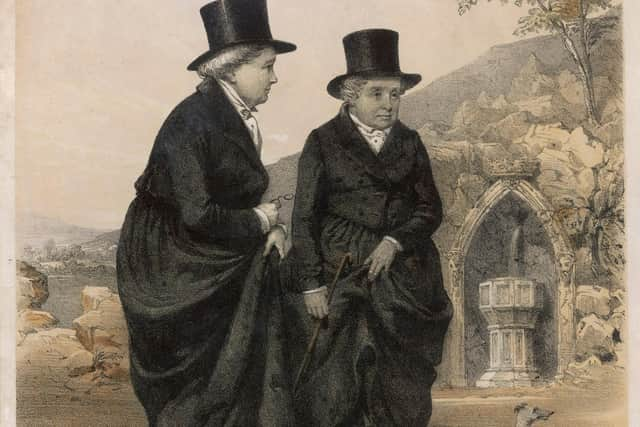
Contemporary press reports described the pair thus: "Miss Butler is tall and masculine. She always wore a riding habit. Hangs up her hat with the air of a footman in the hall and appears in all respects a young man, if we except the petticoat which she still retains. Miss Ponsonby, on the contrary, is polite and effeminate, fair and beautiful."
According to another report: "They live in neatness, elegance and style. Miss Ponsonby does the duties and honours of the house, while Miss Butler superintends the garden and the rest of the grounds." Towards the end of their lives, they both dressed in black riding habits and wore men's top hats, to the bemusement of some visitors, while others thought the attire merely practical for outdoor living.
Eleanor died on June 2, 1829, aged 90, and Sarah died on December 9, 1831, aged 76. They were buried together in the same plot with a shared grave marker at St Collen's Church, Llangollen, together with their servant, Mary, who pre-deceased them.
*The expression "Boston marriage" is a late 19th century term, first used in New England, for a long-term, committed domestic partnership between two financially independent, educated women. Such relationships, popularised by Henry James's novel The Bostonians, could be platonic, romantic, or lesbian, offering women an independent life outside traditional heterosexual marriage.
The love that dare not speak its name is a phrase, generally interpreted as a euphemism for homosexuality, from the last line of the 1892 poem Two Loves by Oscar Wilde's lover Lord Alfred "Bosie" Douglas, published in 1894, and mentioned at Wilde's gross indecency trial in 1895.