
Antiques: Iconic pictures that are frozen in time
Photography: easy, right? Just whip out your smartphone, snap - and everybody's a photographer. New technology makes it simple to capture high-quality images with minimal effort, with billions of uploads and downloads of soon-discarded pictures (creating a substantial carbon footprint, incidentally).
But let's step back in time, not to the struggles of pioneers Louis Daguerre (1787-1851) and William Henry Fox Talbot (1800-1877) in the 1830s and 40s, but to the Heroic Age of Antarctic Exploration, from about 1899 to the end of the First World War.
Imagine, if you will, the difficulties facing Herbert Ponting , photographer and cinematographer on Captain Scott's successful but ultimately ill-fated 1910-13 Terra Nova expedition to the South Pole, an exceptional artist and technician whose work constitutes one of the most compelling and enduring visual records in the history of polar exploration.
He faced extraordinary challenges in harsh conditions...lugging large, heavy equipment on a sledge over the ice in extreme weather, the limitations of early photographic processes, setting up gear in treacherous environments, the risk of frostbite and technical difficulties such as light, exposure times ,moisture and condensation in the camera. The frigid temperatures in Antarctica made handling equipment difficult - merely touching metal with bare skin could cause instant frostbite. Then there was the danger of falling through thin ice while pulling his gear-laden sledge.
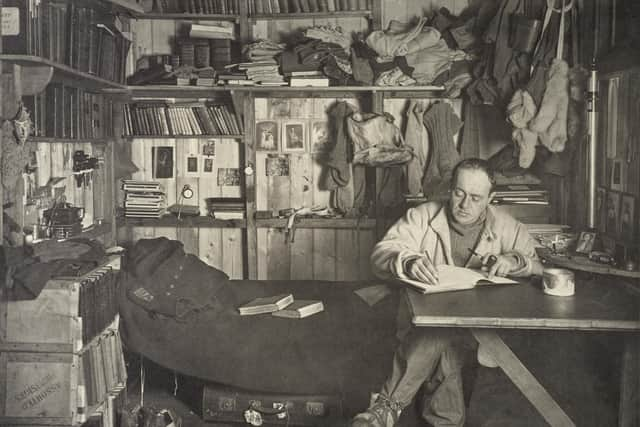

So, then, we can appreciate the skills and endeavour that went into producing the iconic photograph above, developed on site, like hundreds of others, in variable temperatures in his darkroom in the expedition hut at Cape Evans. A large green-tinted limited edition carbon print of the famous photo, The Terra Nova at the Ice Foot, Cape Evans, fetched £3,330 at a Travel and Explorations Sale at Bonhams in London.
Capt. Robert Falcon Scott had discovered the Cape during his Discovery expedition of 1901-4 and built the hut there on his return in 1910. As history records, Scott reached the South Pole with Edward Wilson, Lawrence Oates, Edgar Evans and Henry Bowers on January 17, 1912 only to find that the Norwegian Roald Amundsen (1872-1928) had beaten them to it. Delayed by illness and blizzards, they perished, one by one, on the return journey.
Two silver gelatin prints by Ponting showing Scott writing in his crowded cabin shortly before setting out on his final journey sold for £4,610 and another print, The `Castle' Berg, Scott's Last expedition, made £5,630. This beautiful, 100ft high iceberg, dramatically photographed in darkness by using magnesium flash-powder, was frozen into the ice about a mile from the hut, its shape resembling a fine old medieval castle.
A relic from the Endurance expedition of 1914-17 led by Sir Ernest Shackleton (1874-1922), in the form of a 1916 New Year menu card, went for £8,320. The front depicts a penguin holding a Union Jack and fare, listed on the back, includes starters of "lax on toast" (gravlax) and Scotch broth, followed by Roast Aptenodytes Fosteri (Emperor penguin), ox tongue and ham, with an eccentric pudding called Jellies Macedoine. Celebrations, I learn, went on until 4am.
The menu was painted by Aubrey Howard Ninnis (1883-1956), nephew of Dr Belgrave Ninnis, who served as a surgeon on the British Arctic Expedition 1875-76, led by George Strong Nares, and cousin of Belgrave Sutton Ninnis, who lost his life during the Australasian Antarctic Expedition 1911-14, led by Douglas Mawson. Ninnis joined the 1914-17 expedition as motor engineer and was one of 18 men stranded in the Antarctic ice aboard the supply ship Aurora for the best part of a year from 1915-16.
A private log book kept by Ninnis, with a fascinating account of life aboard Aurora during the "Long Drift", fetched £46,100, while a silver pendant made for the Terra Nova expedition and depicting the ship held in ice, passed down through the family of the expedition's surgeon, Edward L Atkinson (1881-1929), who led the search party which found the bodies of Scott, Wilson and Bowers, fetched £7,040.
A final word on the enigmatic, complex and tenacious Ponting (1870-1935), first photographer to work in Antarctica and whose photos and film are uniquely of scientific, historical, social and aesthetic interest. He produced more than 1,000 still photographs, an acclaimed cine film, 90 Degrees South: With Scott to the Antarctic, and a successful book, The Great White South. His biographer, HJP Arnold, says: "[He] never became an explorer or a team man. He remained primarily a single-minded and superb photographer...a loner to the end." Despite his accomplishments, he died relatively unknown and unrewarded.