
Antiques: Into the shifting sandy lands of time
They call them the sandy lands… and on such a spot in the Vale of Pickering a remarkable discovery was made in the 1970s. It began when quarry worker Jim Carter from West Heslerton found some early Anglo-Saxon burials while moving ploughsoil ready for the extraction of sand and gravel.
Investigations revealed the cemetery contained the remains - along with dress fittings, weapons, pottery and wooden vessels - of some 250 people buried between the end of the 4th century and the middle of the 7th.
Further excavations of Cook's Quarry revealed something even more surprising: evidence, through tiny flint blades used to make tools, of human activity about 5000 BC during the Late Mesolithic period. The Anglo-Saxon cemetery discovery had kickstarted a nine-year dig, involving 1,000 volunteers and covering 50 acres, which rewrote the history of ancient Yorkshire and proved the existence of human habitation in the area spanning upwards of 6,000 years.
The broad band of sand and gravel which separates the edge of the wetlands and the foot of the Yorkshire Wolds, often referred to as the sandy lands, is now considered to be of poor agricultural value. But the light sandy soils covering the sand and gravel deposits provided an ideal setting for prehistoric and later settlement. At Cook's Quarry, a layer of blown sand restricted visible cropmarks and hid this important evidence of long-forgotten habitation.
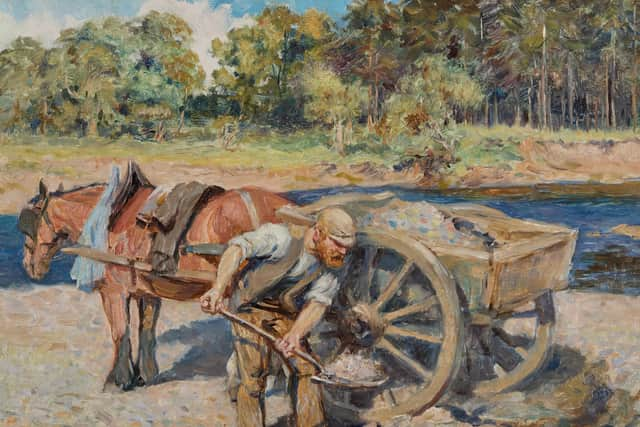

Rich deposits of gravel were moulded in Yorkshire about 13,000 years ago by the melting of glaciers that formed Lake Humber. Surviving small, circular pits show gravel has been extracted on a small scale in Yorkshire for many centuries but more significant extraction began with the demand for ballast at Spurn Point in the 1600s. In the 19th century, gravel was collected primarily by piecework labourers who dug and loaded it onto carts.
All this, then, sets the scene for the emergence at Elstob Auctioneers of Ripon of an oil by Staithes Group painter Ralph Hedley (1848-1930) depicting an elderly, bearded labourer in a cap shovelling gravel into a cart beside a river while a blinkered horse waits patiently. The 1902 painting, entitled Collecting Gravel, fetched £1,710, and was the highlight of the £28,000 retirement sale of predominantly 19th and early 20th-century British paintings of North East art dealer John Nicholson.
Born in Gilling West, near Richmond, Hedley exhibited at the Society of British Artists and the Royal Academy from 1879 and his works can be seen in Sunderland and Newcastle galleries. He won acclaim for his beautifully observed and well executed paintings depicting the working lives of ordinary people in his native North East and his best-remembered painting is News Boy, showing a small boy sitting on stone steps, apparently asleep, clutching a pile of newspapers under his arm.
Some 40 of the 116 lots at the Nicholson sale depicted views of Yorkshire, Northumberland and County Durham, along with the Lake District and Scottish Highlands.
Watercolours of local interest included The Farm Sale, Scaling (north west of Whitby), a busy scene by Staithes Group painter John Atkinson (1863-1924), which realised £1,035; another Atkinson watercolour, Horse Trading outside the Wheat Sheaf (£670); an 1870 watercolour, Bamburgh Castle, by Sheffield-born Thomas Bush Hardy (1842-1897), which also made £670; Shipping off Scarborough by County Durham painter Frank Henry mason (1876-1975), which realised £670; and St Paul's from the Thames, a watercolour by William Richardson of York (1842-1887), a top-selling £2,440.
Back to that Heslerton dig. Those "microlithic" flint blades dating back to about 5000 BC were used, I learn, to make complex composite tools. Rather than making a spearhead from a single large flint blade, multiple small blades were set into bone, antler or wooden handles using tree resin as glue. Their discovery alongside an ancient stream channel emerging from the foot of the Wolds may indicate that this area was also used for hunting and probably also as a route linking the centre of the Vale to the lower slopes of the Wolds. Excavations at Heslerton revealed Neolithic landscape monuments and a large number of "avenues" comprising posts and pits containing burnt hazelnut shells, animal bone and pottery possibly associated with domestic activity. The pits themselves may have originally been dug as storage for hazelnuts, a valuable food source.
On the light sandy soil grew the first cereal crops of wild wheat planted individually using simple digging sticks in much the same way as a modern gardener uses a dibber. The earth of ancient Yorkshire was easy to work but would become less fertile.