
Antiques: Moorcroft pottery is still in demand
One day shortly before the Great War the bright young head of design at a Staffordshire ceramics company decided he could better himself by setting up on his own and marched his workforce across town to establish his own factory.
His name was William Moorcroft...prodigiously talented creator of the bold and distinctive, brightly coloured pottery adored by generations of middle-class, often middle-aged, collectors in Britain and in former colonies such as Canada, Australia and South Africa.
It all began when 24 year old William, who inherited his skills from his artist-potter father, Thomas, joined James Macintyre & Co. in Cobridge, Stoke-on-Trent, in 1897 and was employed to design new collectable pieces within his own studio.
Ambitious William made sure his entire output bore his signature or initials and soon his name became better known than that of Macintyre. His first innovative range, called Florian Ware, won him the Gold Medal at the 1904 Louisiana Purchase Exposition in St. Louis, Missouri, and, although Macintyre's showed remarkable patience, a split was inevitable.
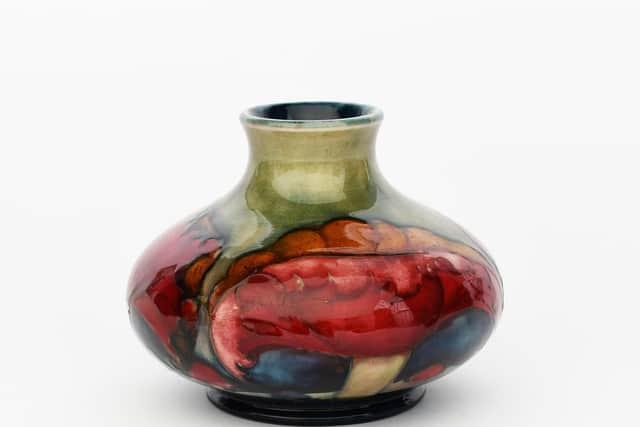

But it was not until 1913 that William took his dramatic leave - walking his design and production team across nearby Cobridge Park to Sandbach Road, where he had a new factory set up and ready. The business, backed by Liberty, the famous London store which controlled Moorcroft until 1962, blossomed and in 1928 came the prestigious accolade of being appointed Potter to Her Majesty, Queen Mary, a keen collector.
Moorcroft survived the Second World War but William died in 1945, aged 73, to be succeeded by his elder son, Walter, whose artistic talents were matched by an astute business brain. The pre-war level of prosperity, however, could not be regained and in 1984 the family sold most of its shares. In 1993, the company came under the control of Maureen and Hugh Edwards and in that year Rachel Bishop joined Moorcroft as only its fourth designer in almost a century.
In 2014, I covered the sale at Bonhams in London of Ken Manley's fabulous collection of Moorcroft, which featured mainly vases and plates but also mugs, goblets, jars, bowls, lamps as well as the odd Toby jug, cigarette box and lighter. The 212-lot auction raised £300,000 and included a pair of "Cornflower" vases of swollen form, circa 1912 (£7,500), a Claremont plate depicting cluster of toadstools, circa 1918 (£1,250), daisy-pattern vase from 1905 (£6,000), large ginger jar and cover, "Spanish Cornflower", 1914 (£6,500), Florian vase, "Tulip and Forget-me-not", circa 1905 (£3,375), Hesperian Ware lustre vase, circa 1905 (£4,450), rare "Pomegranate" advertising plate promoting Moorcroft Pottery, circa 1916 - £6,500, Waratah (large Australian shrub) flambé vase, circa 1925 (£5,625) and Eventide biscuit barrel and lid, circa 1920 (£2,000).
Specialists at the time told me they believed Moorcroft was a "safe" collectable with prices, especially for good early pieces, likely to increase in value. And they have been proved right, with a collection which surfaced at Woolley & Wallis of Salisbury, Wiltshire, surpassing expectations.
Top sellers were a unique James Macintyre "Flambé Carp" ovoid vase by Moorcroft, decorated with fish swimming in waterweed, which fetched £31,500 (estimate:£6,000-£10,000), a similar "Carp" vase of a different colour, which realised £25,200 (est.£6,000-£10,000), a Moorcroft Flambé Claremont vase of compressed form decorated with a large mushroom £6,050 (est.£1,000-£2,000) and a "Honeysuckle" vase in pink and green £3,150 (est.£200-£300).
Not all Moorcroft pieces required such deep pockets. A King Edward (VII) and Queen Alexandra mug made £150, a Flamminian Ware tray £190, Flamminian Ware biscuit box and cover £480 and a multitude of vases fetched prices ranging from £190-£2,395.
A few words on the man himself. William Moorcroft's father, Thomas, was a ceramic artist of note, chief designer at EJD Bodley's, which was one of the leading potteries in Burslem. Years later, Moorcroft paid tribute to the formative influence of both his parents but his childhood idyll was short-lived. His mother died at 32 in 1881, leaving Moorcroft Snr. to care for William and three brothers. Thomas married his housekeeper in 1884 but died just nine months later, aged 36. Moorcroft was not quite 13.
The Moorcroft factory closed earlier this year but has been rescued by the founder's grandson, Will Moorcroft.
*Ken Manley, owner of the collection sold at Bonhams in 2014, named a racehorse Moorcroft Boy after his favourite pottery. The horse survived a horrific injury at Aintree in 1995,suffering a broken neck, but recovered to win the Scottish Grand National the following year. He lived to the ripe old age of 28.