
Antiques: Now proving to be a mane attraction
It's one of the most popular sayings in the English language: "A dog is Man's best friend." But who said it first? It is believed to have been Frederick the Great of Prussia shortly before his death in 1786, although he put it less succinctly, opining: "The only, absolute and best friend a man has, in this selfish world, the only one that will not betray or deny him, is his dog."
Dogs' ability to offer companionship, emotional support and love has developed over thousands of years and is deeply reassuring. But what of horses? Ever since they first allowed us on their backs about 6,000 years ago, horses have proved themselves truly Man's most loyal servants in both war and peace - playing key roles in battle as well as transportation, farming, ranch work, logging, pulling ploughs and carts, recreation, law enforcement, showjumping, dressage, racing and equine therapy.
There's more to horses than strength, speed and pulling power; they also offer a deep and complicated companionship and their sensitivity to human emotions make them invaluable in psychological treatments. A recent report claiming horses convey meaning through 17 unique face gestures lends credence to the belief that horses are capable of extraordinary levels of perceptive insight.
Equine art has proved popular through the centuries (think George Stubbs, Sir Edwin Landseer, Sir Alfred Munnings and John Frederick Herring , who settled in Doncaster when he was 18). But many of the earlier paintings were of thoroughbreds, commissioned by wealthy owners such as the 2nd Marquess of Rockingham (1730-1782), who paid Stubbs 40 guineas for a painting of racehorse Whistlejacket, and politician Peniston Lamb, 1st Viscount Melbourne (1745-1828).
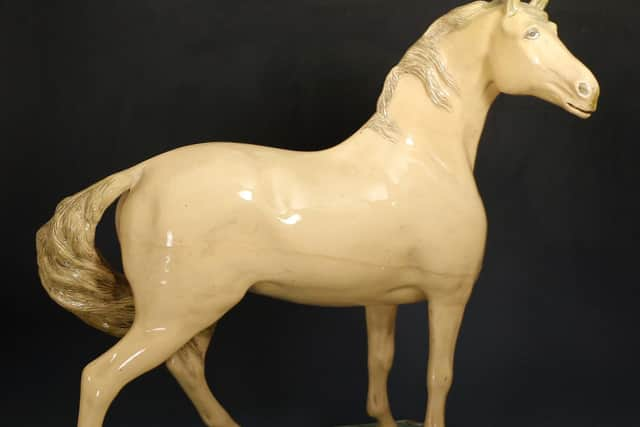

Equine ceramics, however, were not particularly popular, perhaps, according to antique English pottery specialist John Howard, because horses were regarded as more workaday. "That's how people got around - a bit like the cars today - and so most people thought them not interesting enough to merit serious attention."
Mr Howard, who operates out of Woodstock, Oxfordshire, has always loved ceramic horses, however mundane in appearance, and I recorded in this column in 2013 him offering a sturdy- looking ceramic horse, a delicately restored Leeds Pottery masterpiece, damaged by the great-uncle of the Hunslet family that had cherished it since early Victorian times when he staggered home and knocked off the horse's ears with a wave of his stout walking stick. Despite the damage, the 17in tall cold-painted equestrian figure from about 1810 was such an imposing rarity he offered it at £17,500.
Always on the lookout for ceramic horses, for both business and pleasure, Mr Howard now has several examples for sale from the little-remembered St Anthony's Pottery of Newcastle-on-Tyne, which specialised in producing horses in a semi-naive, folk art style in the short window from 1800-1815. They are now so rare that surviving specimens in good condition are extremely valuable.
St Anthony's pieces on offer include a 6in pearlware glazed grey-dappled horse, circa 1810 (£2,850), a 7in sponge-decorated black and white horse, circa 1815 (also £2,850), a 6.5in horse from 1810 sponge-decorated in ochre (£2,950) and a pair of pearlware saddled horses in shades of maroon and brown (£5,850). Such dobbin-type St Anthony's pieces were normally bought by the middle and low-middle classes in the early 19th century and could be picked up for about 1s 6d (7.5p).
A pearlware figure of a horse and top-hatted rider attributed to Mexborough Pottery, dated 1810-1820, has also been sold by Mr Howard recently for considerably more. Even further upmarket is a 16in Leeds Pottery pearlware figure of a buff-coloured standing horse of considerably superior modelling, circa 1820, sold for a sum in the region of £20,000. Such extremely rare figures on distinctive bases represent the earliest examples produced by Leeds Pottery and were used as a display pieces for saddlers, vets and tack and feed suppliers. Swansea Pottery also produced equestrian ceramics and a pearlware figure of two prancing horses, circa 1820, is offered by John Howard at £1,850.
St Anthony's Pottery was founded in 1780 but little has been documented about the 15-year manufacture of ceramic horses. Leeds Pottery was started in Hunslet in about 1756 by members of two families, both called Green. They were joined by Lancashire businessman William Hartley and the firm became famous as Hartley Greens & Co. In the late 19th century the name reverted to Leeds Pottery and remained as such until 1957.
*Most valuable ceramic horse sold at auction is thought to be a Chinese Tang Dynasty (618-907) Sancai-glazed pottery specimen, sold for £3,740,000 at Sotheby's in 1989.