
Antiques: Reality behind a happy family scene
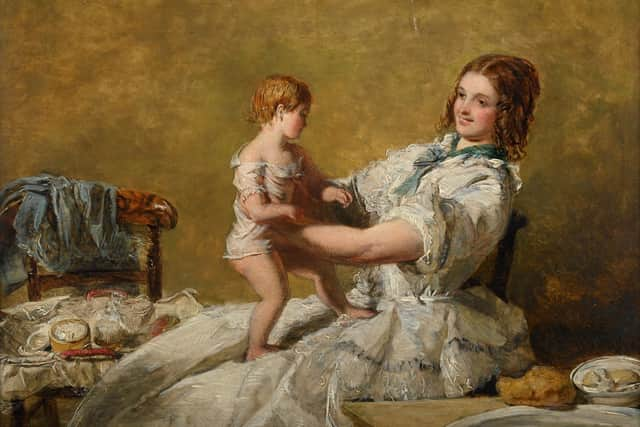
A joyous moment is captured by a Yorkshire artist as a young woman proudly holds her first-born daughter after bathing her in this intimate and affectionate study of Victorian middle-class domestic life. Capturing the 19th century taste for Romanticism is William Powell Frith (1819-1909) and the oil depicts his own first-born child, Isabelle, doting on his first grand-daughter.
To all the world, then, a dutiful and faithful husband and family man. But appearances can be deceptive. While fathering 12 - yes, 12! - children with his wife, confusingly also Isabelle (nee Baker), he was maintaining, just a mile down the road, a mistress, Mary Alford, formerly his ward, whom he controversially married in 1881 after his wife's death the previous year. Together they had seven children, making Frith a father of 19.
It's all in marked contrast to the upright family scenes depicted in the wistful reflection on his first-time fatherhood, Bedtime (1852), and Many Happy Returns of the Day (1856). The painting above, entitled Bath Time and which has fetched £3,530 at Dreweatts of Newbury, Berkshire, was undertaken by Frith in 1867, when his daughter, who married merchant and banker Charles August Oppenheim 1864, was 21 and his grand-daughter Mary Frances Isabelle was two.
If taking Mary Alford (1834-1895) - legally a child under his protection - as mistress and second wife was frowned on, his aversion to modern art proved as controversial as those of Sir Alfred Munnings more than 60 years later when he gave a tipsy, ill-tempered speech dismissing modern art as "damned nonsense".

Frith, bohemian in his private life, was a traditionalist painter critical of more experimental movements such as the Pre-Raphaelites and the Aesthetics, favouring detailed, narrative-driven scenes. His resistance to changing tastes led to him, initially at least, being overshadowed by the rise of more avant-garde movements.
Frith, born in Aldfield, near Ripon, four months before the future Queen Victoria, was encouraged to take up art by his father, Thomas, a Harrogate innkeeper. He moved to London in 1835, studying art at the academy founded by Henry Sass (1788-1844). He was elected to the Royal Academy in 1853, winning contemporary praise as the "greatest British painter of the social scene since Hogarth".
A man with great social contacts, his best-remembered paintings include An English Merrymaking a Hundred Years Ago (1847), The Crossing Sweeper (1858), Charles Dickens in His Study (1959), and The Marriage of the Prince of Wales (1865, depicting the 1863 wedding of Albert Edward, Prince of Wales, later Edward VII, and Princess Alexandra of Denmark). In 2011, an early version of Frith's 1850s horse race picture Derby Day fetched £505, 000, a world record auction price for the artist, at Christie's, London. The completed version hangs in Tate Britain.
Now to another acclaimed Yorkshire artist: York-born Henry Scott Tuke (1858-1929), a presumed uranian (the name given at the time to a male homosexual in the late 19th century) famous for his intimate and sensual paintings of the male nude. His art fell from fashion in the years before his death but returned to the limelight more recently after he became an icon among the LGBTQ+ community and a new generation of openly gay artists.
No nudity on display in his 1900 oil Keeping Her Off, which has just fetched £32,760 at Christie's in London. We know who one of the boys is in this masterly canvas: standing, pushing the boat away from the shallows, is Georgie Fouracre, one of Tuke's favourite models. Born 1883 , he was the elder of two sons of the artist's housekeeper, Mrs Elizabeth Jane Fouracre (1857-1916).
His brother Richard, who also modelled for Tuke, was born in 1884 and therefore could not be the anxious-looking young lad depicted sitting down in the boat. Tuke was renting rooms at Pennance Cottage in Falmouth, Cornwall, at this time, with Mrs Fouracre keeping house. Georgie Fouracre appeared in 14 other paintings by Tuke over 15 years, notably Mid-day Rest (1897), Summer Evening, (1901), Ruby, Gold and Malachite (1901), Noonday Heat (1902/3) and To the Morning Sun (1904).
When Tuke died in 1929 he left £25 (a tidy sum in those days) to both Georgie and Richard in his will. Georgie died in 1947 after serving in the Great War and Richard, who remained in Falmouth, married and had 10 children, died in 1966.
*At Tennants, Leeds-born Helen Bradley's simple but illustrative House for Sale went for £12,975. Bradley (1900-1979) reinvented herself as an internationally acclaimed artist at the age of 65, principally to show her grandchildren just different the world was when she was a child.