
Antiques: 'The Admirable Crichton' - a scholar to cut a dash through history
Once up on a time there was a Scot named James Crighton, who travelled widely and died young.
The movie was based on JM Barrie's 1902 stage play of the same name, with the skilled and resourceful Jeeves-like butler Crighton saving the lives of the family of haughty Edwardian aristocrat Lord Loam.
A more learned account comes in the 1819 biography Life of James Crichton of Cluny, Commonly Called The Admirable Crighton, by advocate and historian Patrick Fraser Tytler (1791-1849), although the truth was muddied earlier by the enigmatic Sir Thomas Urquart (1611-1660), who wrote a semi-fictionalised account of Crighton in his 1651 work Ekskubalauron.
So, then, to the true story - or as true as one can get after 460 years - of James Crighton, the young chap wearing the traditional Elizabethan ruff and holding a sword in this portrait by a Follower of George Jamestone (1589-1644). The oil, bearing an indistinct date of 1581 and titled James "The Admirable" Crighton, fetched £15,120 at the sale at Dreweatts of Newbury, Berkshire, of the fabulous collection assembled by Melissa Ulfane, founder of the Pushkin Press publishing house,
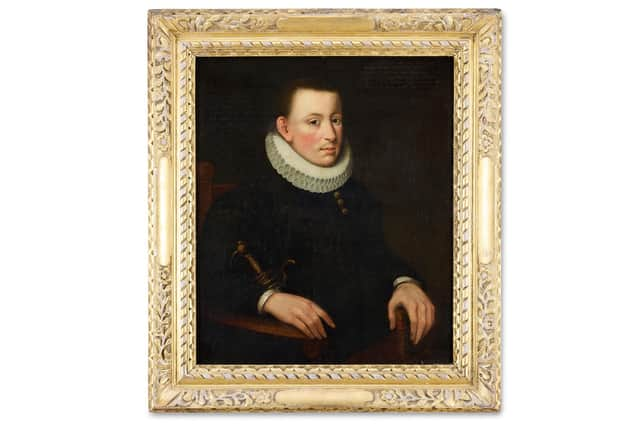

In short, Crichton (1560-1582) was said to possess a photographic memory and was noted for his extraordinary accomplishments in languages, the arts, sciences and sport before being murdered aged 21.
Born in Cluny, he claimed descent from Scottish royalty and completed his bachelor's and master's degrees at the University of St Andrews by the age of 14. The socially refined child prodigy, gifted with almost total recall, was taught by the intellectual George Buchanan (1506-1582) alongside the young James VI of Scotland, becoming fluent in 12 languages. He was also skilled in a wide range of sports and other accomplishments, including swordsmanship
Crichton continued his education in Paris, where he challenged French professors to ask him any question on any science or liberal arts subject in a range of languages from Arabic to obscure Syria. It is said that the scholars failed to stump him on a single question, no matter how abstruse.
In Italy in 1579, after two years as a soldier in the French army, he is said to have bested a professional gladiator in a brutal fencing match, although it's possible that time has added a certain sheen to his reputation.
He then entered the service of the Duke of Mantua and may have become tutor to the Duke's headstrong son Vincenzo Gonzaga (1562-1612), only son of Guglielmo Gonzaga, Duke of Mantua. In 1582, Vincenzo murdered The Admirable Crighton while crazed with jealousy from his father's admiration for his prodigy as well as the fact that Crichton had replaced Vincenzo as the lover of the prince's former mistress.
The circumstances are recorded thus: on the night of July 2, Crichton was attacked by masked ruffians. He beat off all but one with his sword, until the last man removed his mask. It was Vincenzo Gonzaga himself. On seeing Vincenzo, Crichton instantly dropped to one knee and presented his sword, hilt first to his master's son. Vincenzo took the blade and stabbed him through the heart, killing him instantly.
A neat story...perhaps a bit too neat. Much of Crichton's posthumous reputation comes from Sir Thomas Urquhart, a man given to hyperbole. That said, Samuel Johnson (1709-1784) wrote in an 1753 issue of the periodical The Adventurer: "Among the favourites of nature...none seems to have been [more] exalted above the common rate of humanity, than the man known about two centuries ago by the appellation of the Admirable Crichton."
Others took up the theme. A historical novel entitled Crichton was published by William Harrison Ainsworth (1805-1882) in 1837 and he cropped in the writings of Charles Dickens, William Makepeace Thackeray and Anthony Trollope. A memorial to Crichton can be found in the church of St. Bride's in Sanquhar, Dumfries, and in the church of San Simone in Mantua, Lombardy. There's also a James Crichton Society at the University of St Andrews.
*At the same sale, an equestrian oil by Robert Byng (1666-1720), depicting Lord Craven's grey hunter Carpenter, held by a well-dressed young black page, fetched £30,240, and at Tennants, pitman painter Norman Stansfield Cornish's A Man Seated at a Table with Pints of Beer made £5,210.