
Antiques: The history of owls in art and culture
When I was five I was given an autograph album and asked my mother to christen it with the first entry. This is what she wrote:
The wise old owl sat in an oak,
The more he heard, the less he spoke,
The less he spoke, the more he heard.

Why can't we be more like that that wise bird?
That short poem, Mother's version differing only slightly from the original published in Punch in 1875, neatly encapsulates the Western view of the nocturnal bird of prey: one of wisdom, knowledge and insight, combined with judge-like solemnity and a hint of mystery.
The owl's nighttime nature and exceptional ability to see in the dark have also contributed to its association with the perplexing and the shadowy. There has always been, both literally and figuratively, something of the night about the owl - a description once bestowed on former Conservative leader Michael Howard by MP Ann Widecombe.
This image of reason and fairness attributed to the owl dates back to Ancient Greece, where owls abounded, and the mythology surrounding Athena, goddess of wisdom and of the city of Athens, which was named in her honour. Athena (equivalent of the Roman goddess Minerva), noted for intelligence, cunning, and strategic thinking, is depicted accompanied by an owl, which became her symbol.
But many cultures do not share this perception of the swivel-headed, beady-eyed bird. To the Chinese, its call was traditionally considered an omen of death, evil or misfortune. The Hindus, Romans, Native Americans, Aztecs and the Maya all shared similar fears. Many societies considered owls delivered messages from beyond the grave or supernatural warnings to people who had broken tribal taboos.
Respect them or fear them, owls have long been favoured subjects for painters, sculptors, writers, wood carvers, ceramicists, glassmakers, jewellers, stonemasons, taxidermists, silversmiths and goldsmiths. A cave painting in France more than 30,000 years old shows the unmistakable outline of an owl; Renaissance painter Albrecht Durer's 1508 watercolour The Little Owl is world famous; that Renaissance master of the macabre, Hieronymus Bosch, was probably the most owlish artist in history; a limited edition version of Pablo Picasso's 1969 ceramic owl vase, Chouette, fetched $95,000 in 2017; and Romanian-American sculptor Constantin Antonovici is celebrated for his bronze Sleeping Owl.
Craftsmen from Robert "Mouseman" Thompson to Tiffany, Lalique to Clarice Cliff have featured owls in their work, turning out everything from bookends to brooches, teapots to tiles, egg cups to earrings.
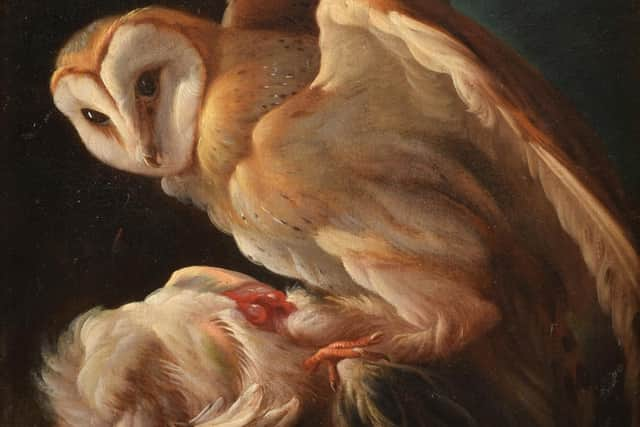
To illustrate the nighttime raptor's enduring popularity with collectors, here are some recent sales at Tennants: two Farnham Pottery earthenware owl jugs in green glaze and a blue Bourne Denby stoneware jug, circa 1925, which fetched £805; an 18th or 19th century European School oil Study of barn owl with prey (£8,060); a Liberty & Co. English pewter jug, circa 1902, cast in the form of an owl with glass cabochon eyes (£560); a Victorian silver owl mustard pot by James and Nathaniel Creswick, Sheffield, 1854, with glass eyes (£2,480); a pencil and watercolour, Barn Owl (1952), by bird artist Charles Frederick Tunnicliffe (£2,355); a Mouseman Thompson oak owl holding a mouse on its talon on a rock (£9,300); a lapis lazuli, green tourmaline and diamond brooch modelled as a stylised owl (£1,860); and a Tiffany enamel brooch with a winking owl on a branch (£2,730).
A little more on owls, of which five species are found in Britain: the barn, tawny, long-eared, short-eared and (since 1800) the little owl. For thousands of years, it was believed that witches had cast a magical spell enabling owls' extraordinary nighttime vision. Christopher Columbus harboured contempt for owls, describing them in his journal as "funeral birds of the night". Shakespeare was no big fan either ("the vile owl", Troilus and Cressida) and Roman scientist and author Pliny the Elder called the bird "the monster of the night" which was "greatly abhorred" and "a direful omen".
Florence Nightingale had a pet owl which she rescued while on holiday in Athens and called Athena. She carried it in her pocket and even had it stuffed after it died. Picasso had one, too, which he found injured and saved. He called it Ubu and the bird served as a muse for numerous paintings, drawings and ceramics. Hollywood actress Salma Hayek rescued a scops owl, which she rescued and called Kering.
And that "too-wit, too-woo" hoot of the tawny owl? It isn't the call of a single bird but made by a male and female calling to each other. The female makes the "too-wit" sound and the male answers with "too-woo".