
Antiques: The men who made great escapes
Colditz....a name both thrilling and forbidding to schoolboys in the post-war years. Still savouring the taste of victory, and fuelled by first-hand accounts, youthful wonderment, books, comics and the popular 1955 war film The Colditz Story, starring John Mills and Eric Portman, the medieval castle in Saxony became a byword for British ingenuity, perseverance and pluck.
The Germans foolishly believed the castle's position on a rocky outcrop high above a river made it escape-proof, even to the most high-risk prisoners-of-war who had made repeated attempts to escape from other camps. The boast served as a challenge to Allied PoWs and between 30 and 36 men, including 10 British and Commonwealth officers, succeeded in fleeting the fortress.
Perhaps best known escapee from Offlag IV-C, as the camp was officially known, was Military Cross-winner Captain Pat Reid (1910-1990), who crossed the border into neutral Switzerland in late 1942. The Colditz Story, directed by Guy Hamilton, was based on Reid's 1952 memoir about his escape attempts and his "home run" from Colditz. First Brit to make a successful escape from Colditz, in May, 1942, was Airey Neave (1916-1979), who became shadow Northern Ireland secretary and was assassinated in a car bomb attack at the House of Commons by the Irish National Liberation Army.
Now to a third escapee, Royal Navy Commander William Lawson Stephens, known as Billie, who was awarded the Distinguished Service Cross for his part in the daring and successful Saint-Nazaire raid, codenamed Operation Chariot, against the dry-dock on the River Loire in March, 1942. Stephens was in charge of a column of motor launches but his own vessel was set ablaze under point-blank fire and he raised his hip-flask atop the burning wreck for a final quick slug of whisky before abandoning ship with his men.
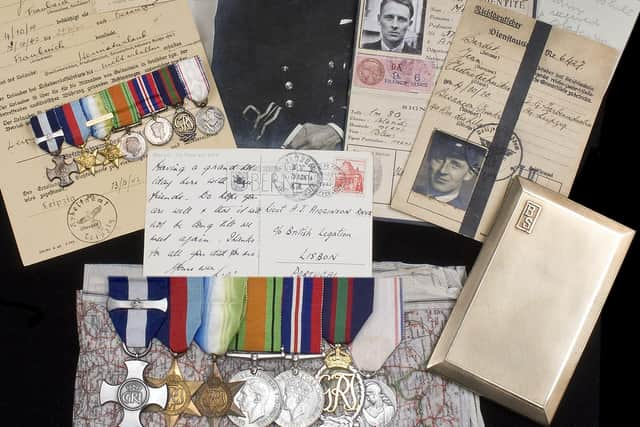

After his capture he made several escape attempts before being taken under armed guard to Colditz but jumped from the train and spent first eight days in solitary confinement. On the night of 14-15 October 1942, however, he escaped again, together with Pat Reid and two others, achieving the record for the shortest time spent in Colditz.
Escape attempts were made almost daily by PoWs and included dressing as Hitler Youth, hiding under the bread delivery van, dressing as a woman, hiding in a mattress and tunnelling - once through a hole under the dentist's chair.
The foursome made their dash for freedom under cover of the PoW orchestra conducted by the legendary flying ace Group Captain Douglas Bader (1910-1982). They squeezed naked through a narrow vent "like toothpaste through a tube", Stephens recalled later. The daring escape by "The Four", as they became known, led the Germans to distribute a wanted poster, complete with photographs and descriptions.
Stephens and Major Ronnie Littledale separated from the other two and walked to the town of Rochlitz in civilian clothes carried in attaché cases and travelled by train with forged documents and on foot, fooling sentries and dodging patrols, before reaching Switzerland. Reid and Canadian pilot Flight Lieutenant Howard "Hank" Wardle also made it to Switzerland, contributing to a record home run tally for Colditz. Stephens was once more imprisoned on crossing the Pyrenees into Spain but talked and bribed his way free by offering his wristwatch to a guard and was smuggled out in the boot of an American car to Gibraltar, from where he flew to the UK in July, 1944.
Stephens' Saint-Nazaire DSC with second award bar, his campaign medals and French Third Republic Medal of Gratitude, fetched £59,520 at Noonans in London when offered with unique forged identity pass from Colditz, escapers' map, portrait photograph and other documents and correspondence. After the war he returned to Switzerland to marry Chouchou de Meyer, whom he met during the war, then settled back in his homeland of Northern Ireland, where he became High Sheriff of County Down.
He made a return trip to Colditz in 1978. "I particularly wanted to show it to my wife, "he recalled. "But she didn't like it any more than I did. There was a feeling of decay everywhere. It was very sad." Billie Stephens, a private, modest man, died at his home in France in August, 1997, aged 85.
*Also at Noonans, the British War Medal of a Pontefract-born First World War soldier-turned-air ace fetched £1,180. Captain Edmund Tempest, who joined the Royal Flying Corps from the King's Own Yorkshire Light Infantry, downed nine German aircraft and was rewarded with the Military Cross and DFC. He died in a flying accident in Baghdad in December, 1921, aged 27, while testing a new plane.