
Antiques: The myths and magic of a charmstone
Doctor John Dee was a man of many skills, to say the least. Mathematician, astronomer, astrologer, teacher, geographer, polyglot, calendar reformist, philosopher, librarian...there was seemingly no end to his extraordinary range of talents, which, intriguingly, also included magic, alchemy, necromancy, clairvoyance and divination using crystals and mirrors for curing disease.
The more arcane obsessions of the scholarly Dr Dee (1527-1609), astrologer to Queen Mary and necromancer to Elizabeth I, who also appointed him to choose the most propitious day for her coronation, landed him in hot water with the authorities. He was charged and found guilty in 1555 of "calculating" (maths being considered the equal of possession of magical powers). His "conjuring books" were destroyed but he was released from prison after a few months.
The doctor also used a rock crystal charmstone, believed to possess religious or magical powers for healing, protection or luck but also thought by some to house a terrifying demon. It was also quite possibly used for "spirit tapping", by which spirits would be asked to tap once for a "yes" or twice for a "no" to answer questions.
The original, historic charmstone is connected through later ownership to the Society of Antiquaries, which has launched a series of fundraising events to shape the future of its London headquarters at Burlington House into a heritage centre with increased access to vast collections.
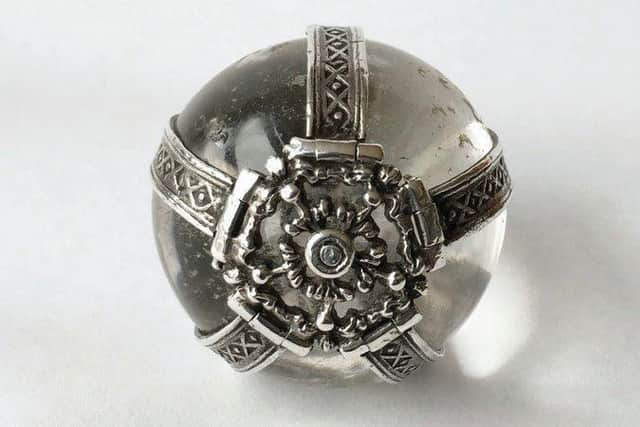

Now the mysterious silver-mounted stone is to appear, not by magic but through Antiques Roadshow specialist jeweller Geoffrey Munn, in a Halloween Night (October 31) Myth and Magic talk, also available online. Mr Munn, 72, was not available to elucidate at the time of writing but on Halloween he will reveal the secrets of the mysterious and magical 16th-century charmstone. He will also shine a light on how our ancestors lived in a world entirely ignorant of bacteria of viruses and were obsessed with witchcraft, the "evil eye" and the persistent dread of disease and mortality.
Such enchanted stones in precious metal mounts have been found in Anglo-Saxon graves and in those from the Merovingian dynasty of the royal family of the Germanic Franks from the 5th-8th century.
A pencil note in the Society's library suggests the stone - a "fluke discovery" - was used for "spirit tapping" and Dr Dee used it to effect cures and for "scrying", a divinatory practice that involves gazing into a reflective or illuminated medium, such as a crystal ball, mirror, or pool of water, to receive symbolic visions or messages.
Other events include a lecture by Tim Knox, Director of the Royal Collection, on Royal Patrons and Collectors in the 20th Century, on October 28, and lifting the lid on the secrets of one of the most curious and least known aspects of the Society of Antiquaries, an offshoot known as The Cocked Hat Club, founded in 1852 and once regarded, but not now, as notorious for its behaviour at election ballots.
Back to Dr Dee, whose father, Roland, was a "gentleman sewer" of textiles at the court of Henry VIII. Dee was a brilliant Cambridge student, studying Greek, Latin, philosophy, geometry, arithmetic and astronomy, working 18 hours day, sleeping for four and allowing two hours for meals. An all-round genius, he became obsessed with alchemy and magic and befriended occultist and scryer Edward Kelley (1555-1597). Their magical investigations included the professed ability to see spirits or angels in a "shew-stone", or mirror, and worked on the secret of transmuting base metals into gold.
Dee, who wrote on trigonometry, calendar reform, navigation and geography, claimed to be able to predict the future by looking for symbols or the ghosts of people in the charmstone, which he said was given to him in 1582 by the Archangel Uriel, who had instructed Dee on how to make the Philosopher's Stone, one of the goals of alchemy.
Dee and Kelley visited Poland and Bohemia in the 1580s, giving displays of magic at the courts of princes. Kelley achieved fame and wealth and was knighted. But poor old Dr Dee faced severe financial difficulties and returned to London in 1589 to discover that much of his library and most of his scientific instruments had been stolen. In 1605, Dee's wife and several of his children died of the plague. He returned to London where he died a few years later.
The crystal was entrusted to Dee's son, Arthur (1597-1651), who passed it on to Nicholas Culpeper (1616-1654) as a reward for curing his liver complaints. Culpeper was a physician and alchemist who used the crystal to try to cure illness, until 1651, when he believed a demonic ghost burst out from it.