
Antiques: The naked truth of Yorkshire artist William Etty
Children, avert your eyes! Not necessary, I'm sure, as the young have long been exposed to explicit nudity, most recently through the internet and social media, much of it without a semblance of artistic merit.
Of course, nudity in art has been with us for centuries, even millennia, with the first recorded example a limestone figurine of a woman discovered in Austria in 1908, dubbed The Venus of Willendorf, crafted 20,000-30,000 years ago.
The nude was prevalent in Ancient Egypt, Greece and Rome and later through the work of artists including Botticelli, notably The Birth of Venus (1484), Rubens (The Three Graces, 1636-39), Velazquez (The Rokeby Venus, 1647-51), Goya (The Nude Maja, 1797-1800), Alexandre Cabanel (Fallen Angel, 1847), Manet (Olympia, 1863), Cézanne (The Large Bathers, 1884-87), Luis Ricardo Falero (Seduction, 1893), John Collier (Lady Godiva, 1897) and John William Waterhouse (A Mermaid, 1900).
More recent examples include, famously, Lucian Freud's 2002 painting of a naked and pregnant supermodel Kate Moss, which sold for £3.5 million at Christie's in 2005.
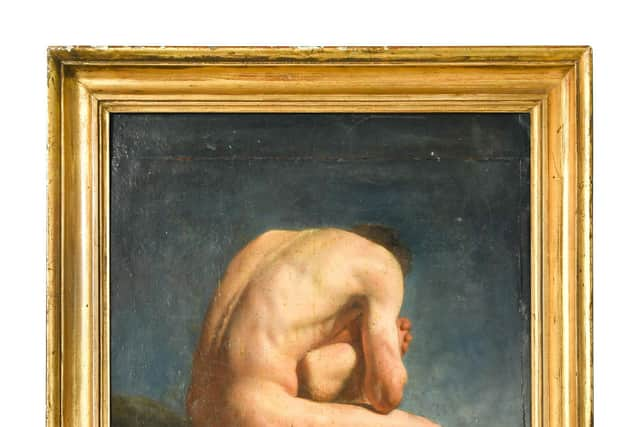

So, then, to a Yorkshire artist noted for his historical and classical paintings featuring nudes, male and female: York-born William Etty, mentioned here most recently when his portrait of a partially-robed actor-theatre manager William Charles Macready, in the role of Hamlet, fetched £17,640 at Dreweatts of Newbury, Berkshire.
The trio featured today by the previously somewhat underrated Etty (1787-1849) surfaced at Cheffins of Cambridge, with one, from Greek mythology, depicting Leander, leaning forward on rocks. Leander fell in love with Hero, virgin priestess of Aphrodite, swimming the Hellespont at night to visit her, guided by a light from her tower. One stormy night the light was extinguished and Leander was drowned. Hero, seeing his body, drowned herself. The painting, depicting Leander preparing for his nightly swim - perhaps the fateful one - fetched £5,750.
His Study of a Female Nude, her back to the artist, illuminated by moonlight and beside a floral still-life, perhaps in mourning, is related to another Etty canvas, The Mourner, similarly set at night and featuring a half-nude woman seen from behind, glancing down at a funerary urn. The oil consigned to Cheffins fetched £4,750. The third, another study of a female nude , this time bending forward, acquired at a Harrogate fair in 1962, went for £2,250.
Born at 20 Feasegate, York, the seventh child of Methodists Matthew and Esther Etty (née Calverley), William showed early artistic promise, drawing in chalk on the wooden floor of his father's shop, before leaving school at 12 to become an apprentice printer in Hull. He moved to London to join the Royal Academy Schools in 1807, studying under Thomas Lawrence (1769-1830), and made his name as the first significant British painter of nudes and still-lifes.
But early success proved elusive and while travelling abroad developing his talent he was severely depressed, writing to his brother from Florence: "I feel so lonely, it is impossible for me to be happy" and complaining of "the vermin in the bed, the dirt and the filth". Back in England, via Paris, he began achieving commercial success. His Cleopatra's Arrival in Cilicia (1821) featured numerous nudes, its success prompting further depictions of historical scenes with nudes. All but one his RA exhibits in the 1820s contained at least one nude.
The prolific Etty's major works involving nudity include Male Nude with Arms Up-Stretched (1828), Candaules, King of Lydia, Shews his Wife by Stealth to Gyges, One of his Ministers, as She Goes to Bed (1830), The Sirens and Ulysses (1837), Somnolency (1838) and Musidora: The Bather (1843). Although turning to portraiture, he continued to paint both male and female nudes, prompting condemnation from some elements of the press.
Extremely shy and considered physically unattractive, he rarely socialised and never married, living from 1824 with his niece Betsy, on whom he grew increasingly dependent. He retained a keen interest in his native York, establishing the city's first art school and helping preserve York city walls.
His pictures work continued to sell well and soared in value after his death. But he fell out of fashion and remained largely unrecognised until this century, when his reputation was boosted by inclusion in Tate Britain's Exposed: The Victorian Nude exhibition of 2001-02 and a retrospective at the York Art Gallery in 2011-12.
He died of heart disease on November 13, 1849 and is buried in St Olave's churchyard in York.
*Also at Cheffins, a farmyard scene by Doncaster-born John Frederick Herring Jr. fetched £4,500.