
Antiques: The treasures from house of scandal
For more than 300 years it was home to dukes, earls, viscounts and a prince - the glittering hub of high society, hosting exclusive parties and political gatherings.
But for many the very name, Cliveden, is associated with one of the great scandals of the 20th century: the notorious Profumo Affair of 1963, when it was the home of William Waldorf Astor II, 3rd Viscount Astor (1907-1966).
John Profumo, the Secretary of State for War in Harold Macmillan’s Conservative government, had begun an affair with model Christine Keeler, mistress of a suspected Russian spy, after spotting her naked in the swimming pool at a summer party hosted by Lord Astor in the magnificent gardens of Cliveden House.
Profumo, married to actress Valerie Hobson, denied any impropriety to the House of Commons. But he later admitted he had lied and the scandal - involving tales of call girls, orgies, drugs, two-way mirrors, black magic rituals and, ultimately, the overdose death of West End osteopath and artist Dr Stephen Ward - severely damaged the credibility of Macmillan's government. He resigned as prime minister in October 1963 and the fallout contributed to the Conservative defeat by Labour in the 1964 election.

Cliveden House in Buckinghamshire, built in 1666 by the 2nd Duke of Buckingham, was destroyed by fire in 1795 and after a second fire destroyed its replacement in 1849, the current mansion was built in 1851 for the 2nd Duke of Sutherland. It was sold in 1868 to Earl Grosvenor, later 1st Duke of Westminster, and in 1893 it was bought by America's richest man, politician, hotelier and philanthropist William Waldorf Astor, later 1st Viscount Astor, for $1.2 million.
He made grandiose changes to the interior of the vast house and remodelled the gardens but tragedy struck when his wife, Mary Dahlgren Paul, Lady Astor, known as Mamie, died at Christmas, 1894, aged 38.
In 1906, a devastated William gave the estate to his eldest son, Waldorf, later 2nd Viscount Astor Jr. (1879-1952), as a wedding gift on his marriage to fellow American-born Nancy Witcher Langhorne (along with a 55 carat pale yellow diamond). She became Britain's first MP in 1919.
And so began the golden age of Cliveden, which became a centre of European political and literary life as well as the setting for glittering parties for the rich and famous. The combination of the house, its owners, setting and leisure facilities - boating on the Thames, horse riding, tennis, swimming, croquet and fishing - made Cliveden a destination for film stars, politicians, world leaders, writers and artists. Charlie Chaplin, Winston Churchill, George Bernard Shaw, Mahatma Gandhi, Franklin D Roosevelt, Lloyd George, Amy Johnson, Rudyard Kipling, Henry Ford...all enjoyed the famous Astor hospitality, along with George VI, Queen Elizabeth and the young princesses, Elizabeth and Margaret.
No surprise, then, that fabulous treasures were accumulated at Cliveden. Now a portion of those treasures, in the form of silver and objects of vertu, have surfaced at Dreweatts of Newbury, Berkshire, after being passed down by the Astor family.
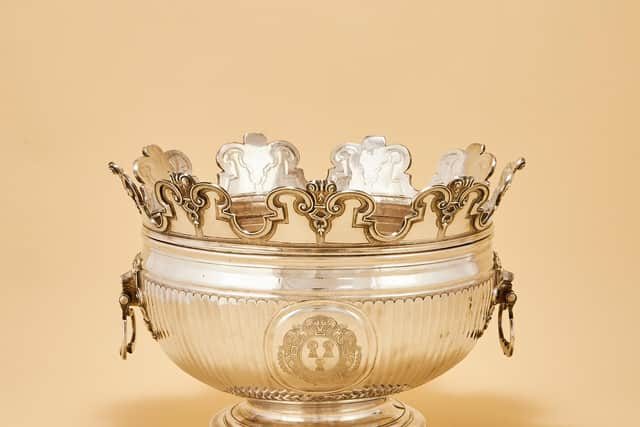
Most expensive piece was a gold and green hardstone horse racing trophy for the 1964 Doncaster Cup, won by Grey of Falloden, ridden by Joe Mercer and first owned by the 3rd Viscount Astor. The cup, bearing the Doncaster coat of arms, on a green onyx base, fetched £40,640. Other highlights included a George I silver monteith (large bowl for chilling wine glasses), dated 1715 (£30,480); French Art Deco nephrite, onyx and diamond paper knife by Henri Lafabre of Paris, 1920-25 (£25,400); George II silver baluster shaving jug by David Willaume II, 1742 (£20,320) and a gold, enamel and agate seal of Queen Anne featuring a lion standing on a stylised crown (£15,250).
Unusual lots included a silver gilt-mounted porcelain snuff box/bonbonnière modelled as a crouching white rat, Dresden, 19th century (£635); an 18 carat gold combination pocket knife by Cartier, 1933 (£8,890); and a nephrite and rose gold-coloured bell push, early 20th century (£890).
That 1963 scandal shattered the Astors' lives and the death shortly afterwards of Waldorf and Nancy's son William, known as Bill, the 3rd Viscount, hastened the family's decision to leave Cliveden. Waldorf Astor had given Cliveden to the National Trust in 1942. Today the actual house is a luxury hotel and spa.
*If you're wondering which of the Astors died on the Titanic, that was Colonel John Jacob Astor IV, wealthiest passenger on board. His pregnant wife, After the Titanic disaster, Madeleine Astor was rescued and returned to New York, where she gave birth to her son, John Jacob Astor VI - the "Titanic Baby" - in August 1912.,