
Antiques: Time to remember a Charge survivor
I often used to wonder about the meaning of that old aphorism "Old soldiers never die, they just fade away." I now realise that the phrase, plucked from an English folk song and quoted by General Douglas MacArthur in 1951 after he was removed from command by President Truman during the Korean War, means that while soldiers eventually leave the military, their contributions and legacy live on.
Some soldiers are remembered longer than others, of course, among them the survivors of the calamitous Charge of the Light Brigade at Balaclava during the Crimean War. One such is Yorkshireman Thomas Everard-Hutton, memorialised in at least four areas of the UK and whose story surfaces through the sale of his silver pocket watch and assiduous research by a couple intrigued by an inscription in a Welsh church.
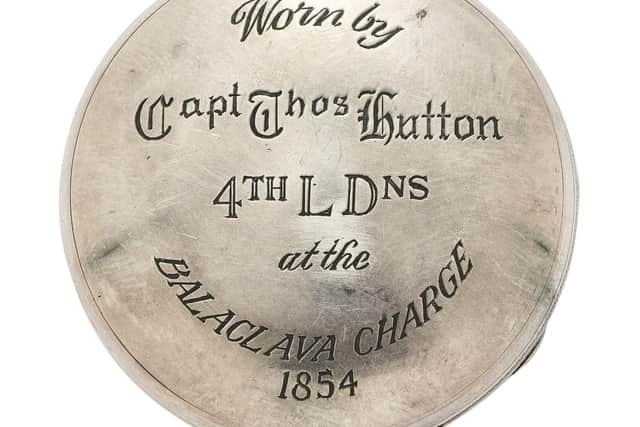
First, the watch. Bearing the signature of London maker Thomas Perry and dating from 1836, it is inscribed: "Worn by Capt Thos Hutton 4th LDns [Light Dragoons] at the Balaclava Charge 1854" and fetched £6,875, well over four times more than expected, at a Fine Antique Arms, Armour and Militaria sale at Olympic Auctions in London. His saddle and Hussar-pattern sword are already housed at the National Army Museum in London, which has a photograph of a handsome, moustachioed Hutton in uniform, dark hair curled around his ears.
Beverley-born Hutton (1821-1896), who first served with the 15th (Yorkshire, East Riding) Regiment and then, from 1847, with the Light Dragoons, was shot through the right thigh during the infamous charge at Balaclava on October 25, 1854. As he returned from the guns he was again wounded, this time through the left thigh. His horse was wounded in 11 places and had to be destroyed. Hutton survived treatment in Scutari Hospital in Turkey (he arrived a few days before Florence Nightingale) and was later treated in Malta before being returned to England in March, 1855. He received his Crimea War Medal from Queen Victoria two months later and retired from the Army as brevet-major by sale of his commission in 1857.

A couple from Caerwys, Flintshire, were intrigued when they learnt that St George's Church, Rhos-on-Sea, held an inscription commemorating the surviving Charger and wanted to know more. Piecing together Clive and Barbara Petty's sleuthing with my own research, it is clear that Hutton married Maria Georgina Everard, of Middleton Hall, near King's Lynn, Norfolk, in 1856.
She added her maiden name to his own, giving him the name Thomas Everard-Hutton, and they moved to North Wales, living in imposing Dolben Hall, Llanefydd, Denbighshire, with records showing that between 1860 and 1867 their four children were baptised locally. One of their daughters, Violet, stayed on in Wales and she and her husband, Enoch Evans, were living at The Vicarage at nearby St Asaph in 1891, according to that year's census. Violet (1867-1924) commemorated not only her father in St George's Church but also her sons, Noel Everard Evans (1899-1918), who died in France while serving with the Royal Artillery, and giving thanks for the safe return of 2nd Lieutenant Morgan Paget Evans, who served with British Expeditionary Force at Mons, Marne, Aisne and Ypres, also on the Western Front, and was awarded the Military Cross.
Capt. Everard-Hutton, his wife and the rest of the family then moved to Bath, where the old Charger died on June 10, 1896, aged 74. A memorial in Bath Abbey, dedicated by another daughter, Maud (1861-1935), refers to her father as “One of the Six Hundred" and quotes a line from Psalm 140: "Thou has covered my head in the day of battle."
In Norfolk, too, there is a memorial in St Mary's Church, Middleton, to both Major Everard-Hutton and his wife Maria, who died in 1913, aged 87. She was the daughter of Edward Everard, of Middleton Hall, the grounds of which contain the grave of the horse shot after the Charge. How or why the body was transported from the battlefields of the Crimea to Norfolk is not recorded.
At Noonans in London, a George Cross awarded to Lancashire-born Charles Smith (1908-1987), a miner from the age of 12, for his gallantry in rescuing a trapped miner buried for three hours by a roof fall in the Warren House Seam at Askern Main Colliery, near Doncaster, in 1940 fetched £14,880. After serving with the Royal Artillery in the war, he returned to the coal industry, where his keen eyes in spotting a frayed cable on a mineshaft lift prevented a disaster at the Stargate Colliery in County Durham in 1953.