
Antiques: Work that scandalised and intrigued
Only last week I was writing about the Ladies of Llangollen, whose Sapphic love both scandalised and intrigued Georgian society. Today, by coincidence, I report on the artwork of Madeline Green, whose preferences are more ambiguous but whose paintings of females are free from the burden of a fixed identity.
Her subjects are, to use the modern jargon, gender fluid. Some would be dressed as farmhands or costermongers; others in rumpled clothing as working-class boys, smoking, or wearing trousers, men's shirts with rolled up sleeves, caps, short hair and mannish scarves.
Green's experiments with representations of gender and sexuality through clothing in the period after the First World War were not fully appreciated by the art establishment at the time. But now her oils and watercolours are attracting considerable attention, with one, The Step-dancer, fetching £26,250 at Bonhams in 2018.
Two major works by Miss Green (1884-1947) surfaced at Tennants, both of which raise questions about the identity of the ladies depicted. In our main picture, The couple, which realised £14,880, the one dressed in more manly clothes, with the bowler hat and check scarf, is identified by cataloguers as Madeline's sister, Gladys, with the her artist herself in more feminine attire. Same applies to the second oil, At the races, which has the additional feature of a child in the foreground. It fetched £5,950.
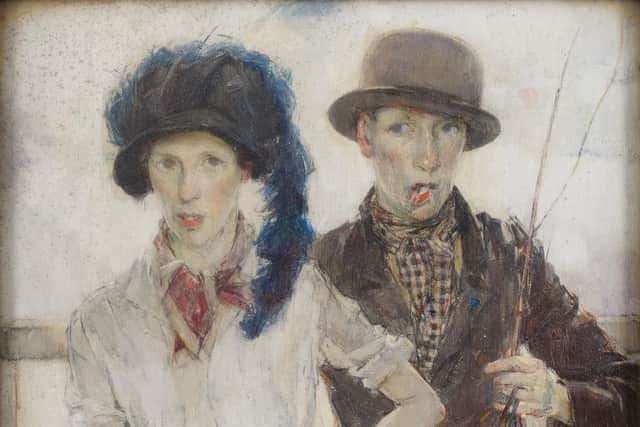

Other reviewers identify Green as depicting herself as the one dressed in manly clothing - and to add to the confusion, a painting which made £6,875 at Bonhams depicting a lady in masculine attire wearing the same telltale check scarf is entitled Miss Brown.
Madeline Emily Green, who exhibited widely at the Royal Academy and at least 18 other galleries, never married and her sister Gladys managed her home and financial affairs. This left Madeline free to focus on her art, painting herself, Gladys and other women, often relatives, dressed in different costumes. Her figures look directly out to the viewer, meeting their gaze but giving nothing of their selves away.
The figurative artist's enigmatic and progressive challenge to society's strict gender roles for men and women - and the assumption that heterosexuality is the natural human sexuality - was viewed as a threat to the stability of social order. Her manipulation of dress and disguise to experiment with different visual identities leave room for ambiguity about her own sexuality but have fostered fresh demand for her work among 21st century collectors.
Moving on...and a first mention in these pages for artist Joseph Edward Southall (1861-1944), who attended (Quaker) Ackworth School in Pontefract and later visited his alma mater on occasions to speak to pupils.
Eleanor Crosland, a scholar at Ackworth from 1893-98, owned a painting by Southall and at some stage gave it to the school. Now the painting, a dreamy 1931 watercolour entitled Fowey Harbour with white barque, has been consigned for sale by the school to fetch £37,200, three times more than expected, at Tennants. Apparently, the school had been proud to own a Southall but the work had to be stored in a safe in recent years because of its value and was of no benefit to the pupils. Proceeds will benefit students with special educational needs.
Southall, whose parents Joseph and Elizabeth (nee Baker) were both Quakers, was encouraged in his art by a visit to Oliver's Mount, overlooking Scarborough, was a vigorous campaigner against the Great War, which would have made him many enemies. In 1914 he joined the anti-war Independent Labour Party, serving as the party's President from 1914-1931.
But his reputation as an artist survived and he and his wife Anna travelled Europe and the English South Coast. He began exhibiting at the Royal Birmingham Society of Artists in 1881 and was president of the RBSA from 1939-1944. He also co-founded the Society of Painters in Tempera in 1901.
Finally to Alfred Wallis (1855-1942), the former fisherman and rag-and-bone man whose naive, or primitive, art is now more popular than ever. He only took up art in about 1925, aged 70, "for company" after the death of wife Susan in 1922. Everything he drew came from memory and he left an extraordinary artistic legacy, including two mixed media seascapes which surfaced at Tennants. One, Sailboats and Fish, sold for £27,280 and the other, Steamboats and lighthouse, made £18,600 - prices which have astonished the untrained and uneducated Cornishman whose initial paintings were created with household paints on scraps of cardboard, packing boxes and bits of wood.
Although he rapidly became the best known of British naive artists, painting "what used To Be out of my memory what we may never see again", he died in a workhouse.