
Birdwatching: Birds indicate that autumn has arrived
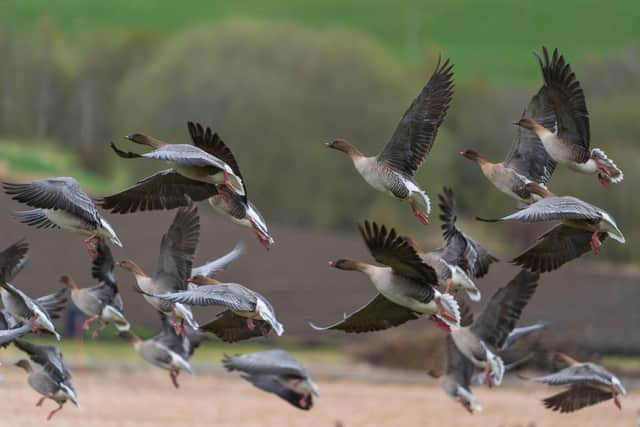
The sight and sound of a flock of pink-footed geese flying overhead is a major announcement that autumn has arrived.
Groups have been reported across the region all week making their way back to wintering grounds.
They fly in a ragged V formation,calling excitedly to each other- a shrill wink wink sound that can be heard from below. Other features include a short pink and black bill. and grey-brown plumage.
Pink-footed geese have major breeding populations in Greenland and Iceland with the latter nesting in the centre of the country.

When the breeding season is over they take to the open water for 25 days to moult ready for their flights south.
When the winds are in the right direction they take off into the North Atlantic and head for the Faroe Islands where they rest for a day before continuing south to the British Isles.
There are three major wintering sites in Scotland and two in England, in Lancashire and Norfolk which in some winters can hold a quarter of the entire global population. Smaller numbers are now a regular sight in fields around the Humber and roosting at Read's Island.
The last 70 years have seen an amazing growth in numbers of Pink-footed
geese with at least 400,000 present in the British Isles each winter.
This compared to a census carried out in 1951 which gave a population of just 30,000- by the end of the Millenium this had grown to 230,000.
This growth has been helped by several factors including a shift away from feeding on pastures and saltmarshes to arable land such as winter stubble and old potato fields.
A particular favourite are sugar beet fields where, after the crop has been harvested, the geese move in to feed on the waste leaves, stalks, root crowns and any weeds. The geese also like the large open fields on today's farms which provide them with all-round visibility.
The wader passage is still gathering pace and a major feature has been a big influx of Curlew sandpipers with three figure counts at some sites and 50 plus at others although none of these have been in Yorkshire so far.
There have been three vagrant North American waders, a juvenile Pectoral sandpiper at Hornsea Mere, Buff-breasted sandpiper at Blacktoft Sands and Lesser yellowlegs at Nosterfield LNR.
A juvenile Red-necked phalarope was at Easington lagoons.